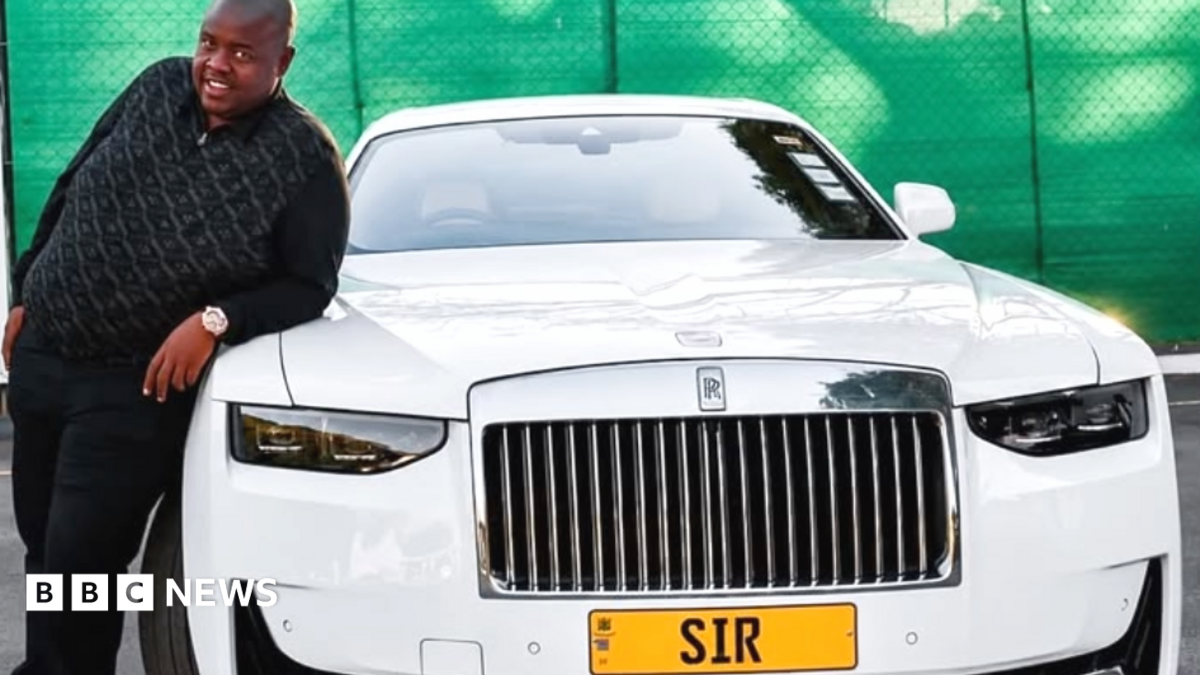
Wicknell Chivayo, the Zimbabwean tycoon, 45, died in a helicopter crash along with his wife Lucy Muteke last week. He called himself "Sir Wicknell", a nickname that epitomised his lifestyle. This was reported by Qazaqyia.kz citing BBC News.
He was relentlessly self-documenting, building much of his public persona on social media, where he posed with piles of cash and announced the cars and money he gave to people he considered deserving. Chivayo delighted in displaying his access to heads of state across Africa and showing off his possessions, conducting video tours of his fleet of expensive cars, mainly Rolls-Royces, with vanity plates, watches and a vast collection of designer shoes.
His admirers saw a fabulously wealthy man sharing his good fortune. His detractors recoiled at the ostentatious displays, questioned the origins of his money and his political connections, and saw his lifestyle as a stark illustration of inequality. According to the World Bank, nearly half the population lives below the international poverty line.
"He gave to those few on an island of wealth in a sea of poverty," Pedzisai Ruhanya, director of the Zimbabwe Democracy Institute think-tank, told the BBC, explaining how his donations were mainly to influential people. He dismissed Chivayo's generosity as grandstanding for the ruling Zanu-PF party.
Nonetheless, there has been an outpouring of grief, especially from recipients of his largesse, and tributes from politicians, religious leaders and business figures.
Among the mourners gathered at the Chivayos' opulent home in the capital, Harare, ahead of their burial on Thursday, was Cleopas Mukungunugwa, a young and prominent Zanu-PF social media influencer and recipient of two luxury cars from Sir Wicknell. He told local media that he was devastated by his patron's death, explaining how "Sir Wicknell" often dictated what he should write in his posts. "He was criticised by many on social media and our goal was to bolster his reputation as a philanthropist," he said.
Chivayo dropped out of high school aged 15 because his family could no longer afford the fees after his father died when he was 10. His first job was as a wages clerk for a bus company. From there, he moved into his first independent hustle - selling mobile phones and dealing in foreign currency, often on the black market at the height of the country's hyperinflation crisis.
In 2005, he was sentenced to five years in prison for money laundering involving 837,000 South African rand (then worth $137,500, £72,000). He served three years at Chikurubi Maximum Prison after two years were suspended.
Details of his career following his release are murky, but he went into the energy business, becoming what one state-run newspaper described as a "tenderpreneur" - making money by getting government contracts. He headed the firm Intratrek Zimbabwe, which partnered with Chinese electrical giant CHiNT Electric. This was at a time when legislation required all companies in the country to cede economic control to black Zimbabweans, under a policy known as indigenisation.
In 2014, Intratrek was selected to build a 100MW solar power station in the southern town of Gwanda. A contract worth more than $170m was signed the following year. It became one of the biggest controversies of Chivayo's business career.
Zimbabwe Power Company, the state-owned utility that awarded the contract, sought to terminate it when Intratrek failed to deliver, but the courts ultimately ruled that the agreement remained valid. A parliamentary inquiry later described Intratrek as a "briefcase company" being used as a front to attract investment.
Chivayo acknowledged that Intratrek lacked expertise in solar construction, describing it as the local partner while CHiNT provided the technical muscle. Intratrek received an advance of more than $5m for the Gwanda solar plant, but it remains unbuilt to this day. Just weeks before Chivayo's death, Intratrek received a government notice to proceed with the project and was given 24 months to complete it.
As the accusations flew, the businessman just smiled and sweet-talked his way through the maelstrom - even winning over President Emmerson Mnangagwa, who was initially unimpressed by him when he first came to power. In 2018, Mnangagwa cited Gwanda as a lesson in the dangers of doing business with "fly-by-night briefcase businessmen", adding ominously that "Chikurubi is not full". The state-run Herald newspaper reported that the warning was directed at Chivayo.
Yet within a few years, that relationship transformed into a bromance. In one of several photographs capturing the remarkable informality between them, Chivayo lounges, almost lying, on a sofa beside Mnangagwa, apparently entirely at ease in the president's company.
His access was not confined to Zanu-PF - he also posted photographs with opposition figures, including the late Morgan Tsvangirai and Nelson Chamisa. But he became a conspicuous presence around Mnangagwa, speaking glowingly of the president and making no secret of his support for Zanu-PF.