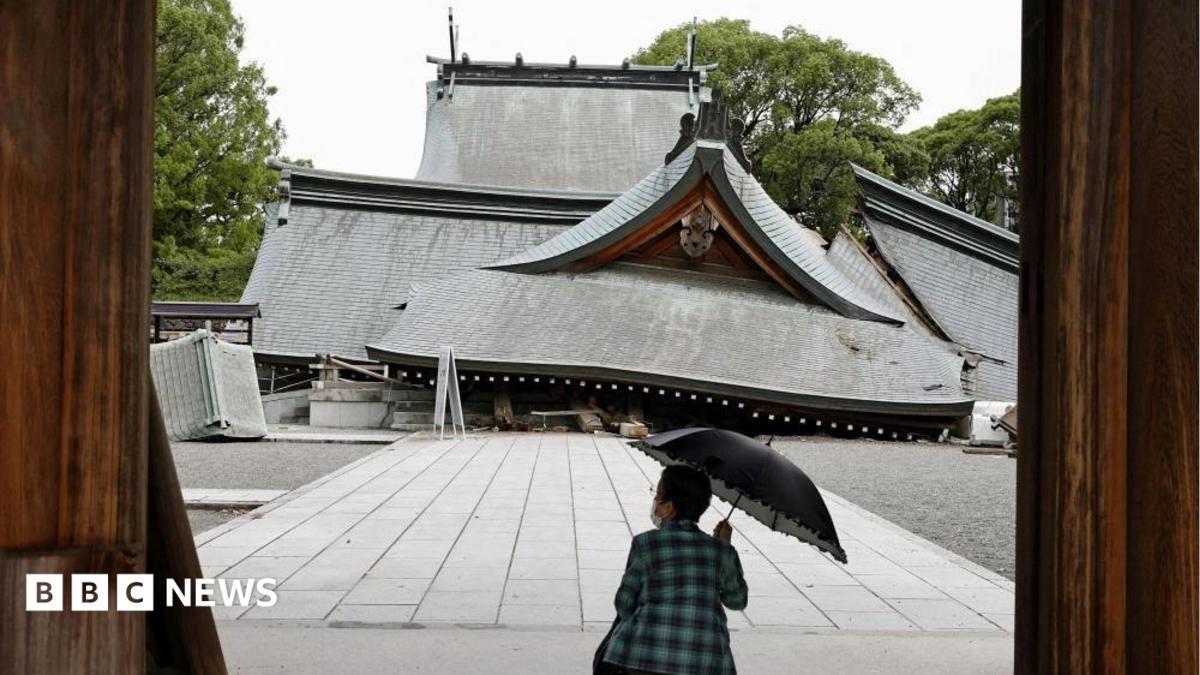
Japan's south-western Kyushu region has had more than 100 aftershocks since it was struck on Tuesday by a magnitude 6.8 earthquake which left at least 13 people dead. This was reported by Qazaqyia.kz citing BBC News.
Many others were said to be in "cardiopulmonary arrest" - a term often used in preliminary reports in Japan before a death is officially confirmed.
Amid searing heat, rescue crews are digging through the rubble at a paper factory and a shopping mall in Kumamoto prefecture, looking for trapped survivors. The mall suffered an explosion in the hour after the quake struck.
Japanese Prime Minister Sanae Takaichi warned it was "truly a race against time" to rescue those trapped. Thousands are in evacuation centres, and many are without power.
The Japan Meteorological Agency (JMA) is urging residents to be alert for more strong earthquakes. A JMA official said: "For the next week or so, especially the next two to three days, we would like people to watch out for potential earthquakes with a maximum seismic intensity of 7."
Rescuers are continuing to search the rubble of Aeon Mall in Kashima town, where a portion of the second floor collapsed. Aeon Mall president Akio Yoshida confirmed three people were killed in the mall explosion, while another three, all who worked in the mall, were still missing. Some 2,700 people were employed at the mall.
Yoshida said at a press conference on Wednesday: "We sincerely apologise for this incident."
Other areas affected include a factory in Yatsushiro City where two people were found to have no signs of life and nine others were unaccounted for. Takaichi said on Wednesday: "Although more than 20 hours have passed since the earthquake, there are those still in need of help."
More than 4,600 personnel were deployed to help with rescue efforts. Officials advised rescuers and quake survivors to take precautions against heatstroke as temperatures hit about 35C (95F).
Defence Minister Shinjirō Koizumi said in a post on X that about 300 air conditioning units would be flown to Kumamoto and distributed in the worst-hit areas.
The JMA measured the earthquake magnitude at 7.1 and the US Geological Survey later placed it at 6.8. The quake's shallow epicentre - with a depth of 10 km (six miles) - was about 20km south of Kumamoto city.
Footage aired by NHK showed cracked roads and bridges and several buildings on fire. Train services were suspended and electricity cut off for thousands of homes.
One resident, Hiroko Ogata, 75, told the BBC: "All of a sudden there was a big jolt, and I was surprised and scared... I have lived here for 75 years, but I have never experienced such a big quake. I thought I would die."
American tourist Chantel Mohar was also in Kumamoto with her family when the earthquake struck. She told the BBC: "While travelling in the tourist bus, everyone's phones went off with earthquake alerts. There was just a lot of rocking and confusion."