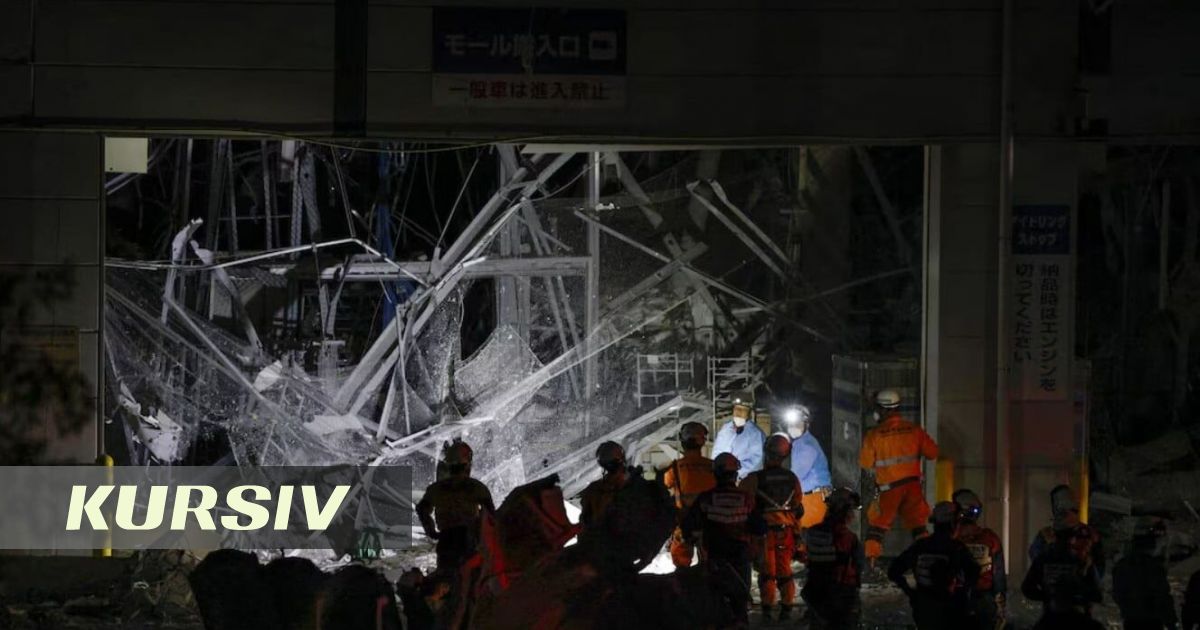
The death toll from a magnitude 7.1 earthquake in Japan's Kumamoto Prefecture has risen to at least 13. Rescue workers continue to search for people trapped under rubble. This was reported by Qazaqyia.kz citing Kursiv Media.
The tremors occurred on July 28. The epicenter was located about 20 km south of Kumamoto city on Kyushu Island. The earthquake damaged buildings, roads and bridges, leaving tens of thousands of homes without power.
"Even now, there are people waiting to be rescued, and it's a race against time. We are mobilizing all available resources on the ground to save as many people as possible," said Japanese Prime Minister Sanae Takaichi.
One of the hardest-hit sites was the Aeon Mall Kumamoto shopping center. About an hour after the earthquake, a powerful explosion occurred in the building, causing part of the structure to collapse.
Rescuers pulled eight people from the rubble. Two women in their 20s died. The cause of the explosion is under investigation; authorities are considering a gas leak.
According to Japanese media, between 20 and 30 shopping center employees were missing after the collapse. Firefighters, police and military personnel focused searches on parts of the building from which calls for help were received.
The shopping center housed about 200 stores and had only reopened in June after a major renovation. It had previously been damaged during the devastating 2016 earthquake.
Another seven people were missing after a chimney collapsed at a Nippon Paper Industries plant. Four people suffered serious injuries.
Dozens of injured were taken to hospitals. Some medical facilities were overwhelmed.
At a hospital in Uki city, power outages caused serious problems with equipment operation.
"The hospital has turned into a field hospital," a hospital representative said.
Another hospital stopped accepting new patients after treating 86 injured, three of whom had severe injuries.
Authorities recommended about 260,000 residents of the prefecture to go to evacuation centers.
More than 36,000 homes remained without power. The situation is complicated by heat: on July 29, temperatures in the region were expected to rise to about +34°C. Authorities fear an increase in heatstroke cases.
Residents were warned of possible new strong tremors within a week, as well as the risk of landslides.
The Japan Meteorological Agency said the earthquake occurred at a depth of about 10 km. No tsunami warning was issued.
Due to the earthquake, Honda and chip equipment maker Tokyo Electron temporarily halted operations at their plants in the region.
Major contract chipmaker TSMC evacuated employees from its Kumamoto plant but began gradually resuming work on the evening of July 28.
Large cracks appeared on several highways. Road damage caused traffic jams and hampered rescue services.
Japan lies on the Pacific "Ring of Fire" and regularly experiences strong earthquakes. The country accounts for about 20% of the world's recorded earthquakes of magnitude 6 or higher.
In 2016, a series of earthquakes in Kumamoto killed 275 people. Another 2,739 were injured, and thousands of buildings and historical structures were damaged.