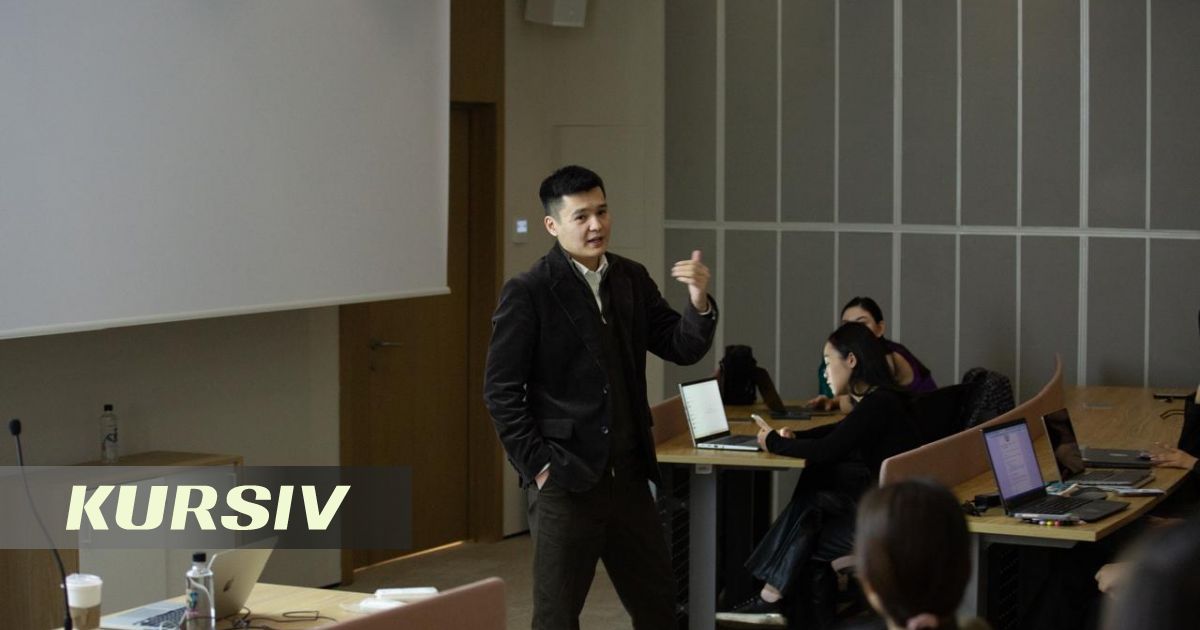
AI expert and head of the AI Research Lab educational center Zhanibek Serkulov explained what the new company AI Research Labs Ltd., which he created together with former vice-minister Dmitry Mun and BeInTech Kazakhstan Ltd., will do. This was reported by Qazaqyia.kz citing Kursiv Media.
In an interview with Kursiv, he explained how the company plans to teach students, teachers and business employees the practical application of AI, why the AIFC was chosen for registration and what the authorized capital of $100 means.
What exactly will the new company do?
— We are creating a company to solve a specific problem: to narrow the gap between studying artificial intelligence and its practical application. Universities still lack teachers who can teach students to use AI to solve real problems. I have experience in teaching, working with universities and opening a university, so I understand how important it is to build education in connection with industry needs.
Our goal is to train personnel for Kazakhstan's digital economy. The main areas of work are creating laboratories at universities, teaching students and improving the qualifications of teachers. We want graduates to be able to use ready-made AI tools, evaluate their results, understand limitations and apply them responsibly. The training will be based on practical tasks, scientific validity, ethics and safety.
For Kazakhstan, this is an opportunity to build its own competencies in the field of AI. Access to technology alone does not produce an economic effect; specialists capable of implementing it in companies, education and other industries are needed. Training such personnel can help businesses increase productivity, and universities bring educational programs closer to labor market demands. Teacher training is of particular importance: they will be able to pass on the acquired knowledge to subsequent streams of students, expanding the effect of the program.
We have already signed a memorandum with Astana IT University. With the Kazakhstan branch of Moscow State University in Astana, we are working on a course for the master's program. With QAIRU and Narxoz University, we are discussing possible areas of cooperation. We are also negotiating with universities in Pavlodar, East Kazakhstan and other regions.
The regional direction is fundamentally important for us. We plan off-site training for teachers and students so that practical AI training is available outside the largest cities.
At the same time, we are ready to work with private companies that need to train employees in the use of AI. This will help connect universities and industry: business will be able to identify real tasks, and universities will train specialists capable of solving them.
Why did you decide to create a separate legal entity in the AIFC?
— The decision to create a separate legal entity in the AIFC is connected with our business model and plans to export educational and expert services in the field of AI. For working with foreign clients and partners, a clear legal environment is important, in which it is convenient to formalize contracts and build long-term cooperation.
At the same time, our activity is not related to attracting investments or managing other people's funds. Participation in government tenders is also not the goal of creating the company. We plan to earn on specific services: training and development of educational programs.
For Kazakhstan, the export of such services means the opportunity to offer its own expertise to the international market and receive income through intellectual labor. Therefore, the choice of the AIFC for us is primarily an organizational basis for developing the international direction of business.
Which AI products or solutions do you plan to develop first? Are there clients, partners, projects?
— First of all, we are developing solutions for the practical mastery of AI in universities and companies. Today the main question is no longer access to technology, but whether people know how to apply it in their work and get a measurable result. This is what we are focused on. For universities, we have prepared an applied AI program in which practical work is included in the curriculum.
A memorandum has been signed with Astana IT University, and with the Kazakhstan branch of Moscow State University in Astana we are working on a course for the master's program. With QAIRU and Narxoz University we are discussing cooperation.
The next step is expanding work with regional universities and creating applied AI laboratories. They should become platforms where students and teachers can work on tasks, including those coming from business.
For companies, we use a different format: a team comes with its own work tasks and, with the support of our mentors, brings them to working solutions in several sessions. The value here is twofold: the company gets a concrete result, and employees acquire skills that they can use independently. This helps make the use of AI part of everyday work.
In the near future, we plan to launch the AI for leaders program for executives. Its task is to help them understand where AI can benefit business, which processes should be changed and how to evaluate the result of implementation.
How did you meet your partners and come to creating a joint company?
— Dmitry and I have known each other since our studies at Moscow State University: I studied at the Faculty of Mechanics and Mathematics, he at the Faculty of Computational Mathematics and Cybernetics. Later he taught at the Kazakhstan branch of Moscow State University, where he gave master's students a course on the application of AI and big data analysis in management. Therefore, we had a common basis for cooperation — mathematical training, teaching experience and interest in the practical application of technology.
My work was also closely connected with education. I taught mathematics at a physics and mathematics school and participated in opening the RFMSH in Astana. At Astana IT University, I held a leadership position and participated in creating educational laboratories together with Huawei, Cisco, Kaspersky Lab, 1C and other companies. Later I headed the Choco corporate university, where I was involved in retraining employees and AI initiatives.