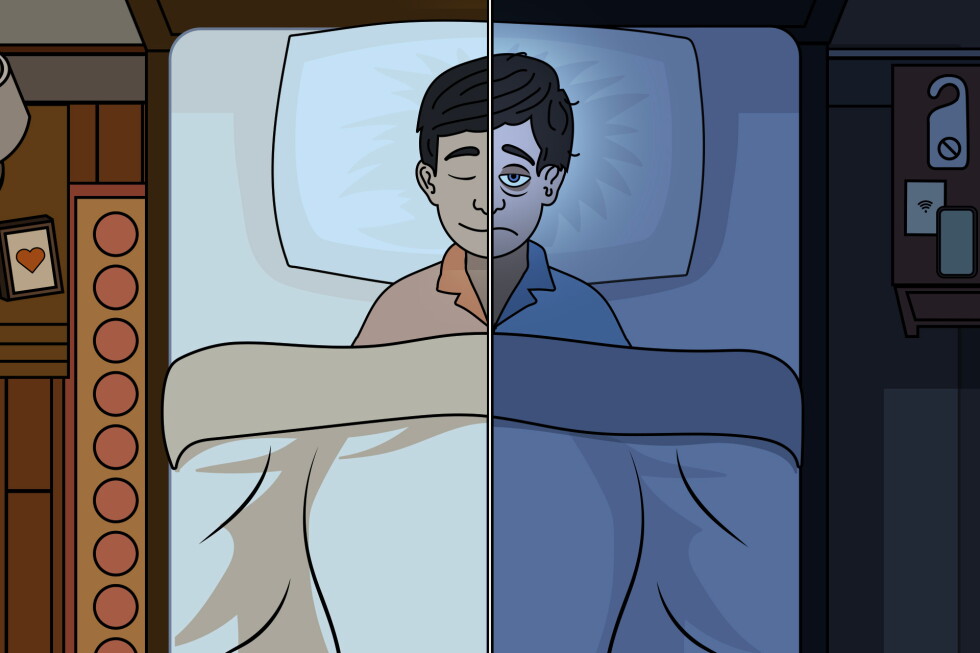
The first night in a new place is always the same for Robinson Leoni: He takes longer to fall asleep, wakes up more often during the night and gets less sleep overall. This was reported by Qazaqyia.kz citing Associated Press.
At home he averages seven hours. The first night away — with or without earplugs and regardless of the bed's quality — his smartwatch tells him he gets about five. This was reported by Qazaqyia.kz citing Associated Press.
"I feel normal, you know, no stress, nothing, but it's just I notice I wake up continuously," said Leoni, a sales director for a tech company who travels once or twice a month for work.
He is a victim of what sleep specialists call the first-night effect. The phenomenon has been confirmed by dozens of studies and is believed to have evolutionary roots, said Anna Wick, a senior sleep researcher at the University of Freiburg in Switzerland.
"It's assumed to be an adaptation response that the sleeping brain remains vigilant in this unfamiliar environment," Wick said.
Ahmad Mayeli, a psychiatry professor and sleep researcher at the University of Pittsburgh, said most people experience it, and even those who may not notice it probably do on a small level. On average, people sleep about 20 to 30 minutes less in a new environment.
His research found that the frontal lobe, an area associated with the deepest stage of sleep, was more active, indicating a sense of alertness. In other words, not only do people sleep less, but also less deeply.
"They are saying that, like in dolphins, part of the brain is awake when you are sleeping," Mayeli said. "It's not exactly like dolphins, but still, studies show part of the brain is sleeping less."
He noted that age makes a difference. The effect is more pronounced in children, adolescents and older adults, and it typically worsens with age. Those in their 20s are the least affected.
Mayeli suspects that the brain may be wired to be wary of new places because, historically, they were the most dangerous to rest.
"It doesn't matter if it's a Marriott hotel or it's the savannah," he said. "Your brain hasn't gotten the memo that this place is completely safe."
Wick said evidence suggests the effect fades after the first night.
Lisa Strauss, a psychologist specializing in cognitive behavioral treatment of sleep disorders, said several factors can impact sleep in a new place beyond evolutionary vigilance.
Travel itself can have a negative effect, even within the same time zone. Environmental factors may get in the way, like a flashing smoke alarm light in a hotel room. Relational tension, perhaps while visiting family members you're not close with, could also contribute.
Strauss noted that some people may sleep better the first night if they're tired after a long day of travel or if the location provides a sense of disconnection from daily stressors. And people who have trouble sleeping at home might fare better because they don't associate the new place with a history of difficulty sleeping.
While anyone can experience the first-night effect, Strauss said those who are more anxious at baseline are especially vulnerable. It becomes a self-fulfilling prophecy — the worry about whether they can sleep is what keeps them awake.
Leoni acknowledged there are times he goes into the first night thinking about how he'll sleep.
"Sometimes the thoughts come automatically," he said. "You talk with your colleague, and you say, 'I'm going back to the room, but I'm not going to sleep anyway.'"
Strauss recommends general sleep hygiene practices such as going to sleep in a cool, dark room at the same time every night, following a nighttime routine and turning off screens well before going to bed. Those are especially helpful if you start (or restart) doing them in the days or weeks before an important trip.
She suggested people try to make the environment their own by spending a little extra time in the room.