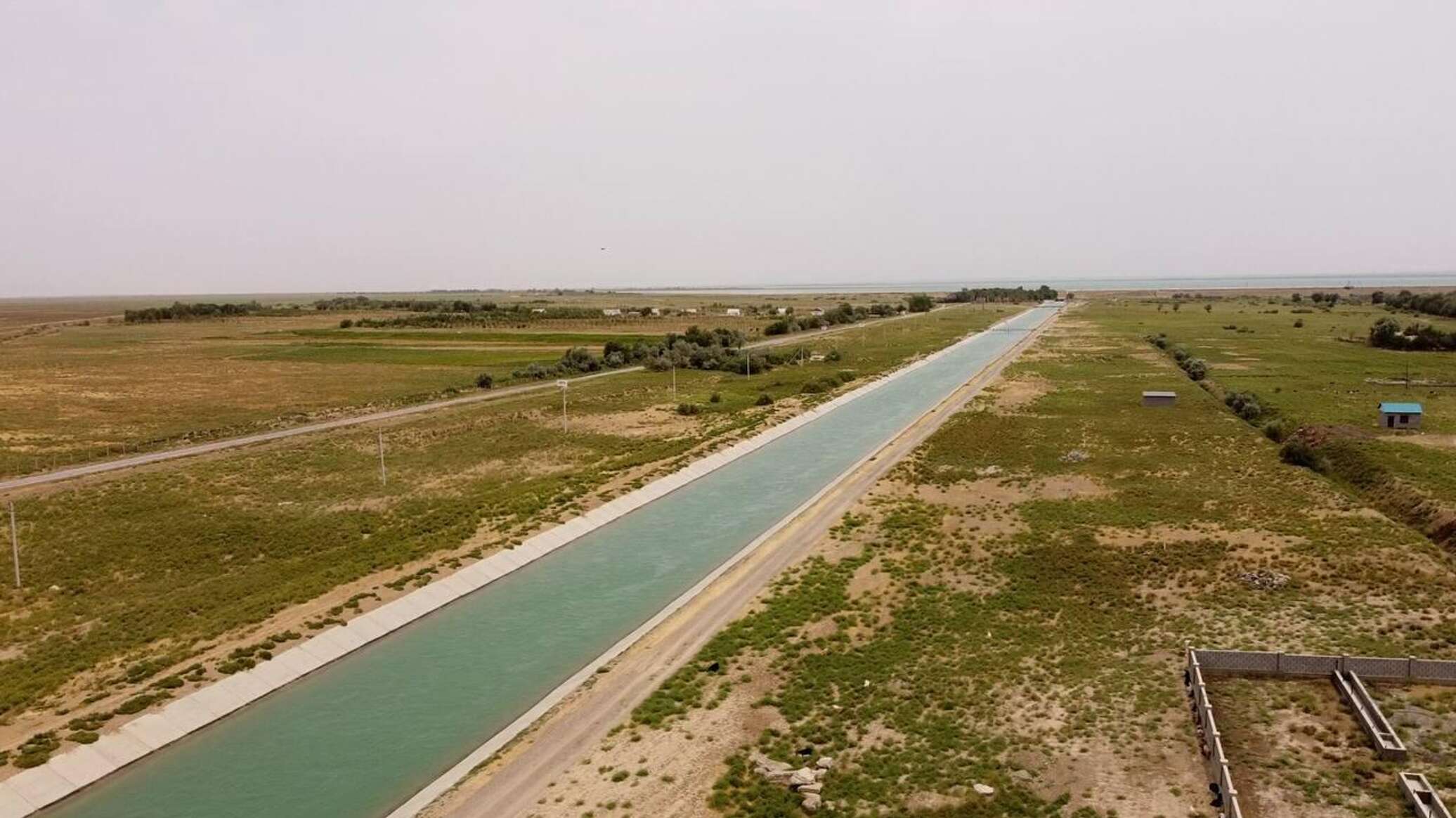
The Ministry of Water Resources and Irrigation, together with the Islamic Development Bank, has launched the reconstruction of 400 km of irrigation canals in the Zhambyl region. This was reported by Qazaqyia.kz citing Sputnik Kazakhstan.
Minister Nurzhan Nurzhigitov, during a working trip to the Zhambyl region, reviewed the progress of projects for the construction and reconstruction of irrigation canals supported by international financial organizations.
Ismail Canal
In the Zhambyl district, the minister inspected construction and installation works on the Ismail Canal, which is 9.2 km long. The works, supported by the European Bank for Reconstruction and Development, began in January of this year. Currently, 3.2 km of the canal have been reconstructed. The project includes concreting the canal, installing water outlets, dam structures, stormwater drainage systems, and constructing a hydroelectric station. The Ismail Canal delivers water from the Asa River to irrigated areas of the Zhambyl district. The canal's capacity is 6 cubic meters per second. The reconstruction will improve water supply to 1,454 hectares of land and reduce losses.
Other Canals
Then Nurzhan Nurzhigitov reviewed the implementation of concreting projects for the Saza, Tomengi Saza, Aitak, Boshakay, Boshakay-1, and Boshakay-2 canals, which began this year. These works are carried out using funds saved under the irrigation network modernization project jointly with the EBRD. In total, the saved funds are being used to implement a project for concreting 14 canals with a total length of 85.5 km in the region.
In the Baizak district, the minister inspected works on the Otemis, Senkibay, and Belkozha inter-farm canal systems. In the Otemis system, concreting, repair, and reconstruction of hydraulic structures are underway on sections totaling 28 km. After the project is completed, the area irrigated through the system will increase to 5,131 hectares. Currently, this facility provides irrigation water to 1,626 hectares of cropland.
On the Senkibay inter-farm canal, a section of 17.8 km has been reconstructed. All works are planned to be completed by the end of the year.
As part of the reconstruction of the Belkozha system, sections totaling about 19.5 km have been lined with concrete, and hydraulic structures have been renewed. Currently, the contractor is working to eliminate identified deficiencies. After the project is completed, the area irrigated through the system will increase to 2,896 hectares. Today, the facility supplies water to 1,860 hectares of crops.
Islamic Development Bank Project
Then the minister reviewed works on the Novo-Mikhailovsky Canal, which is part of the first phase of the Climate-Resilient Water Resources Development project supported by the Islamic Development Bank. In the Baizak district, this project provides for the repair and reconstruction of 17 canals with a total length of over 64 km. The projects are planned to be completed by the end of 2027. In the Zhambyl region, 71 projects with a total length of about 400 km will be implemented.
Minister's Call
"Large-scale projects for concreting and reconstructing canals are being implemented in the region. At the same time, farmers need to more actively introduce water-saving technologies. This will increase the efficiency of the ongoing projects and significantly reduce water losses during irrigation. The state has created all necessary conditions for this in the form of subsidies," said Minister of Water Resources and Irrigation Nurzhan Nurzhigitov.
Sembet and Baizak Canals
In the Baizak district, the minister also reviewed earthworks and concreting works under the project for concreting the Sembet and Baizak main canals with a total length of about 20 km. These works are also carried out using funds saved under the irrigation network modernization project jointly with the EBRD.
MR-3 and MR-4 Canals
In addition, the minister inspected the MR-3 and MR-4 canals. Currently, of the planned 24 km, reconstruction has been completed on 13 km. The project is expected to be fully completed by the end of the year. As a result, stable water supply to 2.4 thousand hectares of irrigated land will be ensured.