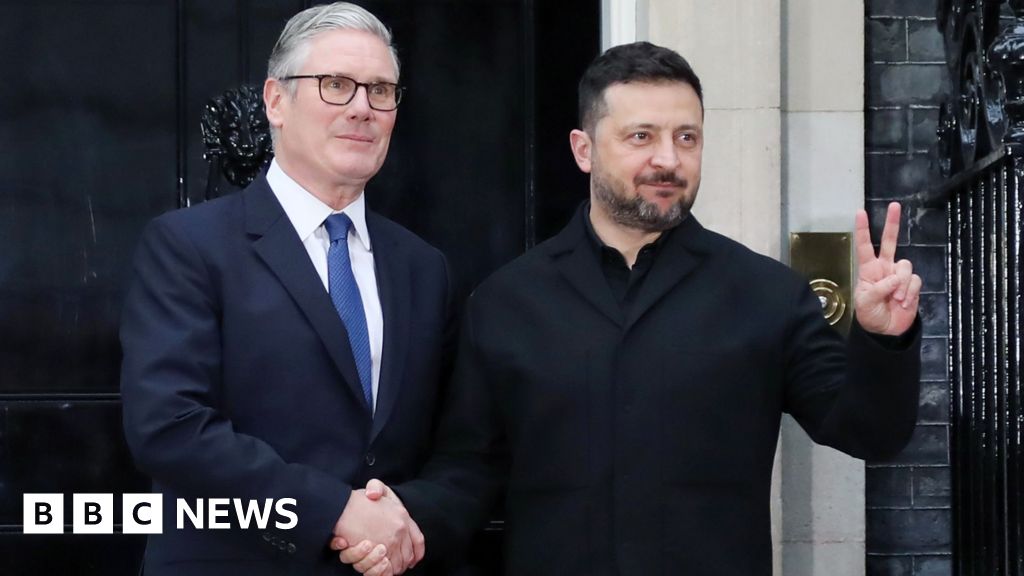
Zelensky's close European allies set five conditions for peace talks
Leaders of Ukraine and its closest European allies – the UK, France and Germany – have outlined five conditions for achieving a "fair and lasting" deal to end the war with Russia. This was reported by Qazaqyia.kz citing BBC News.
In a joint statement after a meeting in London, Volodymyr Zelensky, UK Prime Minister Sir Keir Starmer, French President Emmanuel Macron and German Chancellor Friedrich Merz said they "will stand firmly with Ukraine."
The five conditions include a cessation of hostilities, starting negotiations from the current position on the battlefield, and "reliable" security guarantees for Ukraine.
The leaders confirmed the need for US involvement in the process at a time when US President Donald Trump is focused on the war with Iran.
In December, the US pushed Russia and Ukraine to quickly sign a plan to end the war, which began with Russian President Vladimir Putin's decision in February 2022 to launch a full-scale invasion of the neighboring country.
Recently, the warring parties have intensified attacks against each other: Russia strikes Ukrainian cities with missiles and drones, while Ukraine demonstrates increased capabilities to strike deep into Russia's rear using new technologies.
On Saturday, Ukrainian drones attacked Russia's second-largest city, St. Petersburg, on the last day of a major economic forum. Russian authorities called the attack "unprecedented."
A few days earlier, Kyiv attacked the outskirts of the same city – about 1,000 km from Ukraine – as Putin's flagship forum was beginning.
On the eve of the forum, Zelensky sent an open letter to Putin calling for direct talks to end the war. This offer has been repeatedly rejected by the Russian leader. Putin has said he will stop the war only when Russia's goals are achieved.
The three Western powers that met at 10 Downing Street in London on Sunday make up the so-called E3 group and are among Kyiv's strongest allies. The UK and France lead a "coalition of the willing" to provide security guarantees to Ukraine as part of any future peace process.
They welcomed Zelensky's letter to Putin and supported his call for "direct dialogue between Ukraine and Russia – with the active participation of the US and Europe."
In an apparent reference to Moscow's persistent demand that Ukraine abandon its aspiration to join NATO, they said Ukraine's right "to choose its own security arrangements and alliances must be fully respected."
Before arriving in London, the Ukrainian leader accused Russia of a "vile" attack after Kyiv officials reported that a drone struck a spent nuclear fuel storage facility near the Chernobyl nuclear power plant.
There were no casualties, the fire was extinguished, and radiation levels remained stable.
Separately, according to authorities, at least three people were killed in a Russian strike on a village near Zaporizhzhia in the south of the country.
Zaporizhzhia has recently been subjected to continuous Russian attacks: on Saturday, at least two people died there.
The Russian strike on Chernobyl "partially destroyed" the spent nuclear fuel storage building, Ukraine's state nuclear operator Energoatom said.
The operator reported no casualties, the fire in the building was extinguished, and radiation remains at normal levels.
Energoatom also criticized Moscow for what it called a deliberate threat to nuclear safety. These words were echoed by Zelensky.
"Russia deliberately struck this particular nuclear infrastructure facility," Zelensky wrote in a post on X, calling the building an "extremely important infrastructure facility" and the attack "vile."
Chernobyl is the world's largest non-military nuclear disaster. The catastrophic explosion in 1986 released radioactive materials into the air, causing a health emergency across Europe.
Last year, a Russian drone struck the protective shelter over its damaged nuclear reactor.