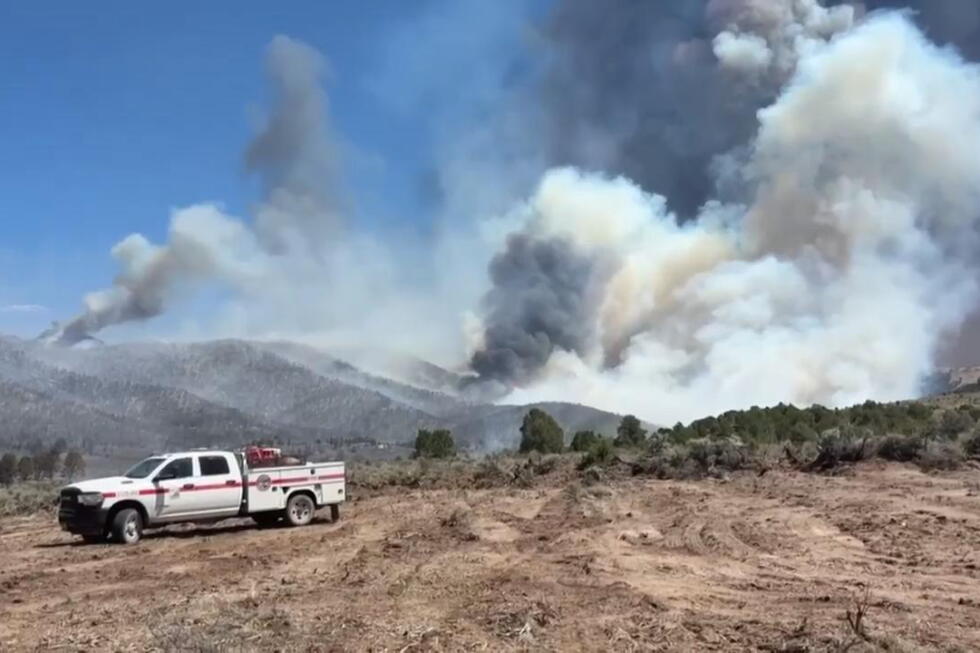
Utah Governor Spencer Cox temporarily restricted fireworks and declared a state of emergency Friday ahead of the July 4th holiday week. This was reported by Qazaqyia.kz citing Associated Press.
The nation's largest wildfire, the Cottonwood Fire in southern Utah, started Monday and reached nearly 111 square miles (287 square kilometers) Friday and was entirely uncontained, forestry officials said. It severely damaged the Eagle Point ski resort in Beaver County, forcing mandatory evacuations.
Towering clouds of smoke could be seen for hundreds of miles, all the way to Colorado.
"This is unlike anything we've seen in recent memory," state forester Jaime Barnes said in a statement Thursday. "We're seeing fires spread farther and faster under conditions that defy historical expectations. Some of the fires we've responded to this year are behaving in ways veteran firefighters simply haven't seen before."
Much of Utah is experiencing severe to extreme drought, while parts of Arizona and Colorado are experiencing severe drought, according to the U.S. Drought Monitor.
Gov. Spencer Cox set the temporary fireworks restrictions through July 5 as the nation prepares to celebrate its 250th anniversary, saying "this year is different."
The National Weather Service issued a "Particularly Dangerous Situation" warning for Utah, a rare alert that's usually reserved for tornado conditions.
"Prepare now for rapid fire growth," it said.
Extreme fire conditions were expected, with wind gusting up to 50 mph (80 kph) and low humidity, across Utah's southwest desert and central and southern mountains, including the area of the Cottonwood Fire.
Rocky Mountain Power issued a public safety power shutoff watch/warning for areas of central, southern and eastern Utah from Friday through the weekend.
Meanwhile, the Iron Fire about 70 miles (113 kilometers) southwest of Salt Lake City blackened 63 square miles (163 square kilometers) by Friday and was 26% contained, authorities said. It forced the evacuation of Eureka, population 1,000, as well as people at a nearby ranch. They were allowed to return Thursday.
Red flag warnings, which mean conditions such as low humidity, warm temperatures and strong winds can create an extreme wildfire risk, were in effect Friday for much of southeastern California, southern Nevada, and northwestern Arizona. The warning extended into Saturday. Winds were forecast at 20 to 30 miles an hour (32 km/h to 48 km/h) with gusts of up to 50 mph (80 km/h).
A wildfire prompted some evacuations last weekend near Sedona, Arizona, burning about several hundred acres of steep and rugged terrain near Oak Creek Canyon.