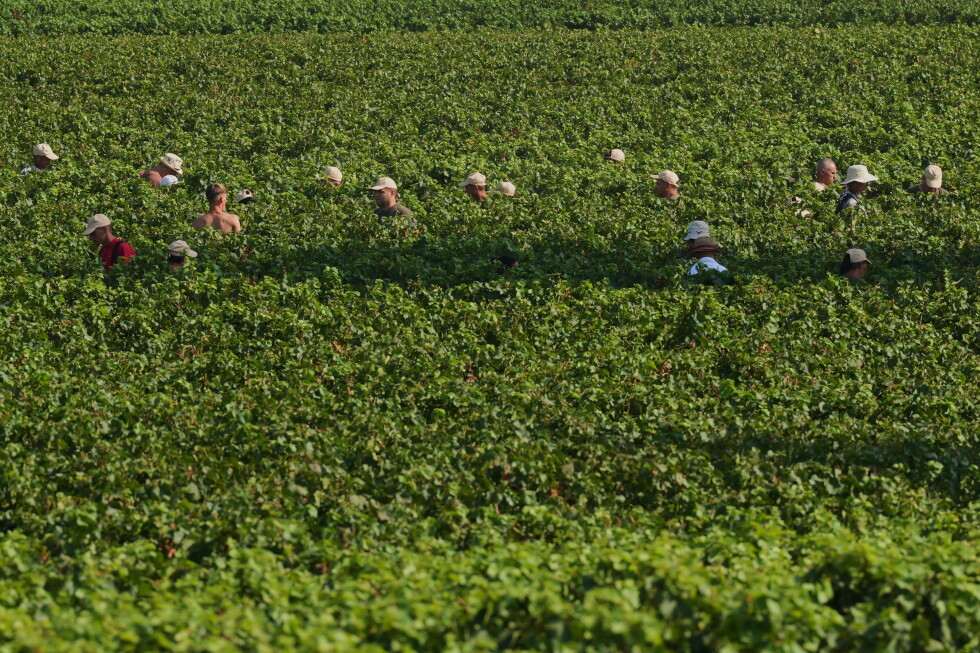
In Corte Franca, northern Italy, workers fan out before dawn to pick grapes destined for Franciacorta sparkling wine. This year, the harvest began 10 days earlier than expected due to record heat. This was reported by Qazaqyia.kz citing Associated Press.
Climate change is narrowing the window for harvesting wine grapes, forcing winemakers to make quick decisions when even a few days can mean the difference between a good vintage and a bad one.
Berlucchi CEO Arturo Ziliani described this period as "delicate, frantic moments." His father, Franco, in 1961 became the first winemaker in the Franciacorta region to produce sparkling wines using the "classic" method, similar to Champagne.
"We did not expect such an early harvest," Ziliani said. Workers are forced to work at night to avoid daytime heat. Photos show workers protecting themselves from the sun with towels.
AP photographer Antonio Calanni captured the harvest on August 6, 2026, in Corte Franca. Workers load crates of grapes onto a tractor for delivery to the winery.
Franciacorta is a renowned wine region in Lombardy, northern Italy. Vineyards are located on hills. Due to climate change, grape ripening times change every year.
According to Ziliani, the entire process must work perfectly. "These are delicate, frantic moments, and everything has to work perfectly," he said. The company tries to preserve quality by harvesting at night.
Heat affects not only Italy but the entire global wine industry. Experts warn that climate change could alter traditional winemaking methods.
Franciacorta is made using the "classic" method, similar to Champagne. The wine undergoes secondary fermentation in the bottle, giving it bubbles.
Ziliani's father, Franco, was the first to apply this method in the region in 1961. Since then, Franciacorta has become a world-famous wine region. Now hundreds of wineries operate here.
Heat increases sugar content in grapes and reduces acidity, affecting wine taste. Therefore, producers try to harvest at the right time.
According to AP, workers start at 4 a.m. Daytime temperatures can reach 40 degrees, making work impossible. Night harvesting helps preserve grape quality.
Franciacorta wines are highly valued worldwide. Due to high prices, producers pay special attention to quality. Climate change poses a serious threat to the region.
Ziliani says they use modern technology to determine the exact harvest time. But heat can change all plans. "We depend on nature," he said.
Antonio Calanni's photos show the hard work of laborers. They use towels to protect from the sun. These images reflect the difficulties of grape harvesting in Italy.
Franciacorta is one of the most famous Italian wines in the world. It is often drunk at celebrations. But climate change could destroy this tradition.
Experts believe that if temperatures continue to rise, wine regions may shift north. This threatens traditional regions like Franciacorta.
Currently, grape harvesting is in full swing in Italy. Workers labor at night and rest during the day. This method is widely used in hot countries.
According to AP, this year's harvest started 10 days earlier. This is a record. In previous years, such an early harvest was not observed.
Ziliani says their team is ready for work. "We are ready for anything," he said. But heat could change their plans.
Franciacorta wines are exported to many countries. This is an important sector for Italy's economy. Therefore, climate change affects not only winemakers but the entire country.
AP photos show workers picking grapes by hand. This traditional method is still used. But some farms are switching to mechanized harvesting.
Heat not only accelerates grape ripening but also affects quality. Sugar content increases, acidity decreases. This changes the wine's taste.
Ziliani says they take all measures to preserve quality. "We must harvest at the right time," he said. But nature always dictates its rules.
The history of Franciacorta began in 1961 when Franco Ziliani created his first wine. Now this region is known worldwide.
According to AP, the harvest began in early August. Usually, this process ends in September. But this year, due to heat, all dates have changed.
The workers' labor is hard. They start before dawn and work until sunrise. This can affect their health. Therefore, they prefer to work at night.
Franciacorta wines are known for their high quality. Their price is also high. But climate change threatens the region's future.
Ziliani says they look to the future with optimism. "We adapt to changes," he said. But it is clear this will not be easy.
Antonio Calanni's photos show the real picture of grape harvesting in Italy. These images have spread worldwide, demonstrating the real consequences of climate change.
Franciacorta is Italy's pride. But to preserve it, we must fight climate change. This is a problem not only for Italy but for the whole world.