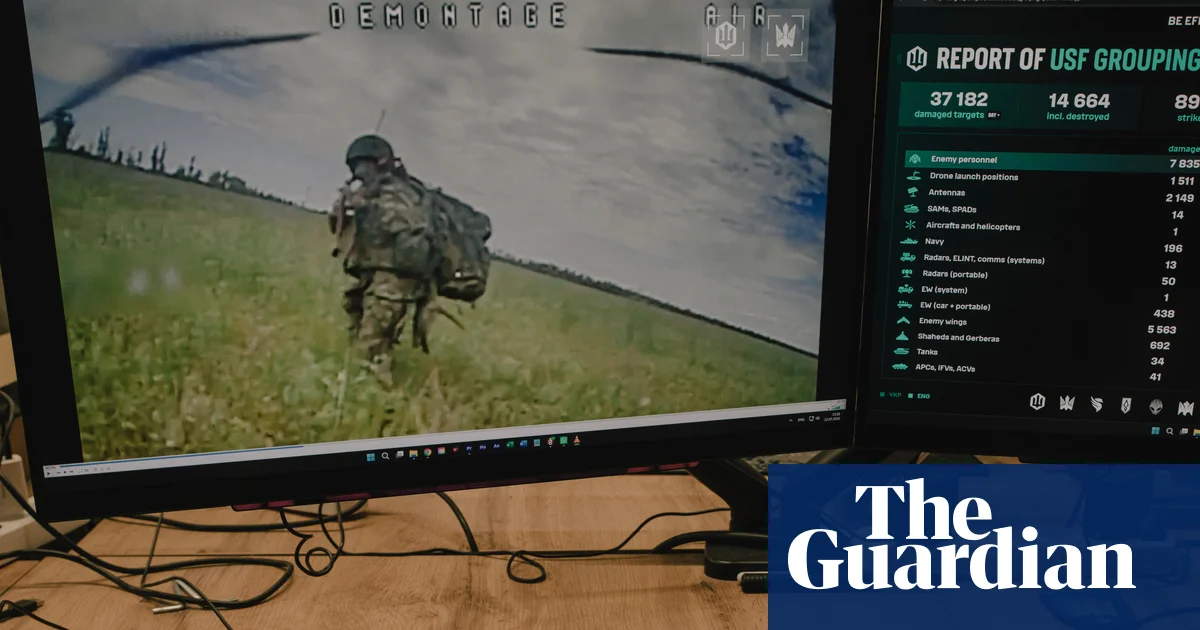
A Ukrainian military editor known by the call sign Catman, defending his work, said the videos play an important role in demoralizing ordinary Russians and revealing the true cost of the Kremlin's unprovoked war. This was reported by Qazaqyia.kz citing The Guardian.
Over the past year and a half, videos of kamikaze drones chasing Russian service personnel to their deaths have become a distinctive genre on social media. They are the brainchild of Robert Brovdi, the head of Ukraine's unmanned systems forces and founder of "Magyar's Birds", named after his call sign.
Brovdi's 414th aviation strike brigade has pioneered the use of battlefield video, much of it recorded by first-person-view drones. The death videos are known as yoblyks, a portmanteau that combines the root of the Ukrainian for "fuck" with an affectionate diminutive form. The closest English translation is probably "fuckling".
Early each morning, a military editor known by his call sign Catman sifts through battlefield clips recorded the previous day, selecting some for a two-minute compilation and adding pulsing or mystical music. A longer online reel is titled "Yoblyks of the Week".
Defending his work, Catman said the videos played an important role in demoralising ordinary Russians and revealing the true cost of the Kremlin's unprovoked war. "My goal is to show Russians that if they mobilise in Ukraine they will be killed, that it's a one-way ticket and death is waiting for them," he said.
He acknowledged that the clips were deliberately arranged to mock the victims, who are sometimes seen throwing sticks at the drones to try to knock them off course, or falling over as they run. Though the moment of death is not shown, the last frame is a closeup of a soldier's face.
"We have a phrase: laughter kills fear. Our main task is to laugh at these enemies and to depict them as helpless. This boosts the morale of our forces," he said. "It's impossible for me to feel sorry for them. It's war, after all, not a movie."
Typically, the Russian soldiers are killed while walking or travelling by motorbike to the frontline. Some are unaware they are at risk from drones, Catman said, and appear to have been tricked by their commanders. "Their training is short. A lot die just two weeks after enlisting," he said.
He described a majority of the soldiers as "banal donkey men" ordered to carry provisions or fuel to exposed Russian positions. Others drag communication cables. Since February, when Elon Musk shut down his satellite internet service Starlink in Russia, officers in the rear have struggled to contact frontline units.
Another member of Magyar's Birds said there was compelling evidence the Russians were routinely misled about dangers. "You can see from the videos a lot of them are not even hiding," he said. "They use their radio sets. A large number are fooled by the lie that everything will be OK, that they are going to their positions and are totally safe."
The brigade has an archive of about 3,600 videos. Only two feature women, both wearing combat uniform and carrying assault rifles. "There is no difference for me. They are all enemies," Catman said.
The videos play an important part in verifying Russian losses, which are running at more than 30,000 soldiers a month killed or injured, according to Kyiv.
Brovdi said he had no qualms about publishing material that many in the west might find distasteful and morally dubious. "God forbid they should ever experience pain. Because those of us in Ukraine who have experienced real physical pain from war would never agree with that perspective," he said.
In daily posts, Brovdi uses language that some might find gratuitous, for instance describing Russians as "worms" pecked by "birds".
He said: "When the war started, everything changed. There was a desire to humiliate the enemy as much as possible, not with typical words but exotic ones. It was only natural that military technical folklore and coinages such as 'yoblyk' found their way into my speech. They existed before AI."
The videos have sparked several trolling subgenres. Some Russian women post photos of themselves saying farewell to their husbands as they leave to take part in what Putin calls a "special military operation". Ukrainians identify the men and subsequently reply with drone footage showing their deaths.
According to Catman, the yoblyks have a wide audience, including inside Russia. "There is very little information there about soldiers who go missing. Some people search and take screenshots. Mothers or wives then post messages saying something bad has happened to their loved ones," he said.
Pro-war Russian bloggers post images on Telegram channels of Ukrainian soldiers dying in battle. Other videos show the killing of unarmed Ukrainian prisoners of war – a crime. The Russian internet includes AI.