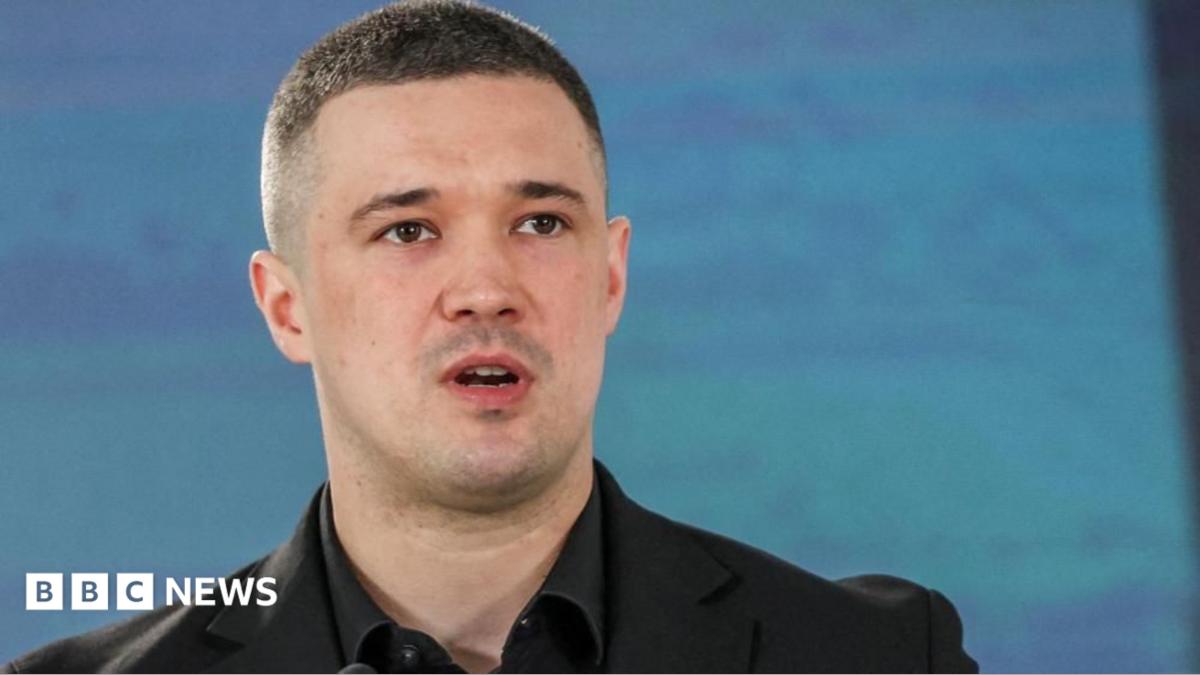
Among Ukraine's battle-weary soldiers and wounded veterans, there's a collective sense of outrage at this week's political developments. President Zelensky's decision not to re-appoint his successful young defence minister, Mykhailo Fedorov, in his latest cabinet reshuffle, has caused bafflement and fury in equal measure. This was reported by Qazaqyia.kz citing BBC.
"My operation is scheduled for tomorrow," says the disfigured soldier, still recovering from his terrible injuries. "I hope when I wake up after the anaesthetic, Fedorov will be back at the Ministry of Defence," the unnamed soldier says in a video posted on Telegram. "Otherwise, everything I was fighting for will have been in vain."
"It is a blatant slap in the face to all service members," said a soldier we're calling Maryna, to protect her identity. "It is truly difficult to put this into words without venting in frustration." Despite the noisy protests breaking out across Ukraine, Maryna doubts popular anger is going to change anything. "A dictatorship is already unfolding here," she says, "with its own petty tyrants who think they have caught God by the beard."
With army chiefs reportedly warning the ranks not to engage in political debate, soldiers are reluctant to speak openly or do so only on condition of strict anonymity. We have given made up names to all those who replied. Another soldier, Natasha, said the protesters with their makeshift cardboard placards, were a long way from the daily brutality of the front line. "Yesterday our positions here got hit by MLRS (multiple launch rocket systems), so nobody cared about Fedorov or the cardboard signs."
But in the messages we've received, there's clear admiration for what Fedorov has been able to achieve. He is identified as the man who has single-mindedly driven innovation in the military, helping to elevate the role of drones and other modern technologies. When I met him in Kyiv last summer, Fedorov described how data was being used to perfect a scheme dubbed "Army of Drones: Bonus", whereby frontline units could earn points for each Russian soldier killed or piece of equipment destroyed. The scheme was popular, credited with speeding up procurement and driving innovation.
Fedorov came across as someone deeply committed to promoting Ukraine's war effort in the most creative ways possible, and, as he put it, "how to use limited resources more effectively." But as members of a military still led by an officer class which emerged out of the old top-down Soviet era system, the soldiers know only too well the sorts of obstacles Fedorov has faced. "If you can't come to an agreement with the old fossils," Natasha said, "they'll eat you alive."
Chief among the "fossils", in the eyes of some of the soldiers who responded, is Gen. Oleksandr Syrskyi, the austere 60-year-old commander-in-chief of Ukraine's armed forces. Regarded as a national hero four years ago, following his successful defence of Kyiv, Gen. Syrskyi's name has since become linked with an outdated way of fighting which places little value on human lives. "Syrskyi commands no authority or respect," Andriy told us. "To us, he remains the General 200," a derogatory nickname referring to a Soviet military code for casualties.
To be fair, not everyone in the military shares such a dim view of their leader. "Currently there is no replacement for Syrskyi in the army," Andrii, a former front-line soldier now working in the General Staff told us. "Yes, he is Soviet-minded and graduated from a military school in Russia, but we do not have another military commander of such calibre. He conducted all the successful operations of this war." One thing is clear: Mykhailo Fedorov and Gen. Syrskyi had clearly fallen out by the time President Zelensky made his move this week.