Ukraine's counter-offensive in the eastern Donbas region, known as Operation Vivaldi, has liberated 277 sq km (106 square miles) in recent months. This was reported by Qazaqyia.kz citing BBC News.
The name reflects the offensive's four stages, or seasons — like the Italian composer's violin concerto. The successful assault blunted an attempted Russian pincer movement that threatened to encircle the key Fortress Belt cities still under Ukrainian control.
While Russia this month pummels Ukraine from the air, crippling its energy infrastructure and killing scores of civilians across the country, at the front, it is Ukraine that has made recent gains. Kyiv says it has inflicted heavy losses — 8,000 Russian casualties in Vivaldi alone, and close to 50,000 along the front in the month of September — and suffered few casualties in return.
The Institute for the Study of War reported that pro-Russian military bloggers had acknowledged the Ukrainian advances, and expressed fears this could lead to more losses for Russia in the future. No Russian official has publicly acknowledged the Ukrainian gains. Russian ministry of defence briefings say only that they were "repelling attacks" in the Lyman region, or "improving the tactical position at the front".
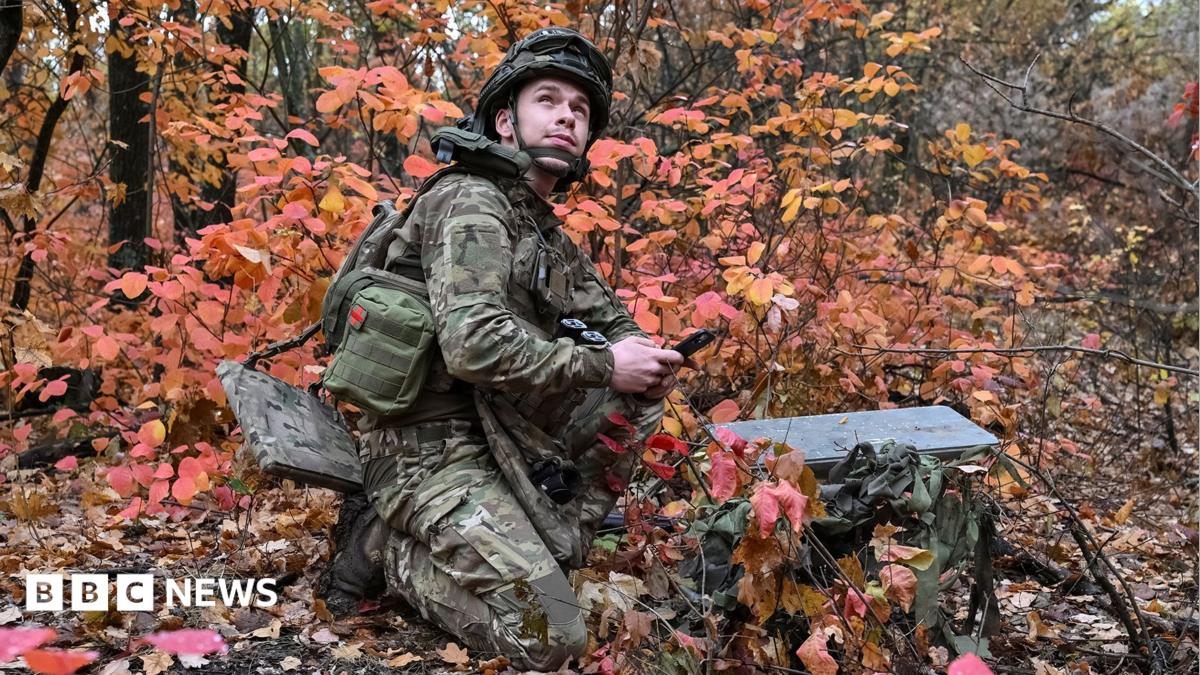
Despite Ukraine's forward moves, Russian drones are still ever-present. Phoenix, Commandant of the Revenge Brigade's Silver Trinity unit, tells me his men face 10 on an average day.
He is fixed on the live stream as a Ukrainian snare swoops in, hovers for a few seconds and drops a net on to the drone, dragging it from the sky. This Russian drone was for reconnaissance, but if it had locked on to the soldiers, another drone carrying explosives would have followed.
This moment of peril illustrates the layers making up the modern battlefield. The command bunker receives live pictures from a hovering camera, while below a Ukrainian attack drone attacks another enemy spotter which would have called in more flying firepower.
Integrated in all of this is Starshield, the military version of Elon Musk's Starlink satellite communications network, providing broadband connectivity across the battlefield.
Ukraine said this week, as Operation Vivaldi concluded, that the system had restrictions imposed without warning, limiting their capability. Musk and media reports suggest the order may have come from the White House. While Ukraine is not wholly reliant on Starshield, it is a key tool in their arsenal, vital for interceptor and mid-range strike drones. And knowing this tool can be restricted without any warning or consultation has sparked major concern in Ukraine.
Beneath the battle for aerial superiority, unmanned ground vehicles scurry back and forth delivering supplies, evacuating the wounded or, increasingly, leading the charge against the enemy.
Everything here relies on digital connectivity — to see, to move, to fly, to communicate, to fire. But at the bottom of this stack, it is still human beings in trenches who are holding the ground.
The weary soldiers have made it safely to the command post. After 95 days pushing forward on the front line there is an emotional reunion.
An infantryman with the call-sign Dealer tells me he feels strong, but it is good to be finally heading home: "It's an impressive operation. Over three months, we moved positions four times."
He tells me the most frightening threat was Russian drones, piloted remotely and determined to hunt down their target.
Commandant Phoenix said the preparation for the offensive was "enormous". "The men trained for months. We had to completely restructure our approach because previously we had been defending, and now we had to go on the offensive."
Robots and drones led the assault on Russian positions and, for the first time, remote-controlled explosive vehicles were dropped behind Russian lines — 250 Russians surrendered. According to Ukrainian commanders, their year-long campaign has freed 16 settlements from Russian occupation.
In Karpivka, a village occupied since April, the Ukrainians found one local resident remaining — 61 year old Volodymyr Zamota, the last man standing when his neighbours fled the Russian advance in 2025. He says he survived for eight months in total isolation.
"As they say, hope dies last," he told me. "I'm the only person left in the whole village, and the village has been almost completely destroyed."
"I thought I would live to old age without experiencing anything like this, but then it happened. It's a terrible tragedy".
That devastation defines the region Ukraine has just recaptured. It's still too risky for residents to return, if they even have a home intact. But Ukraine's soldiers are celebrating this regained ground, the halted Russian advance and the future potential this operation may present.