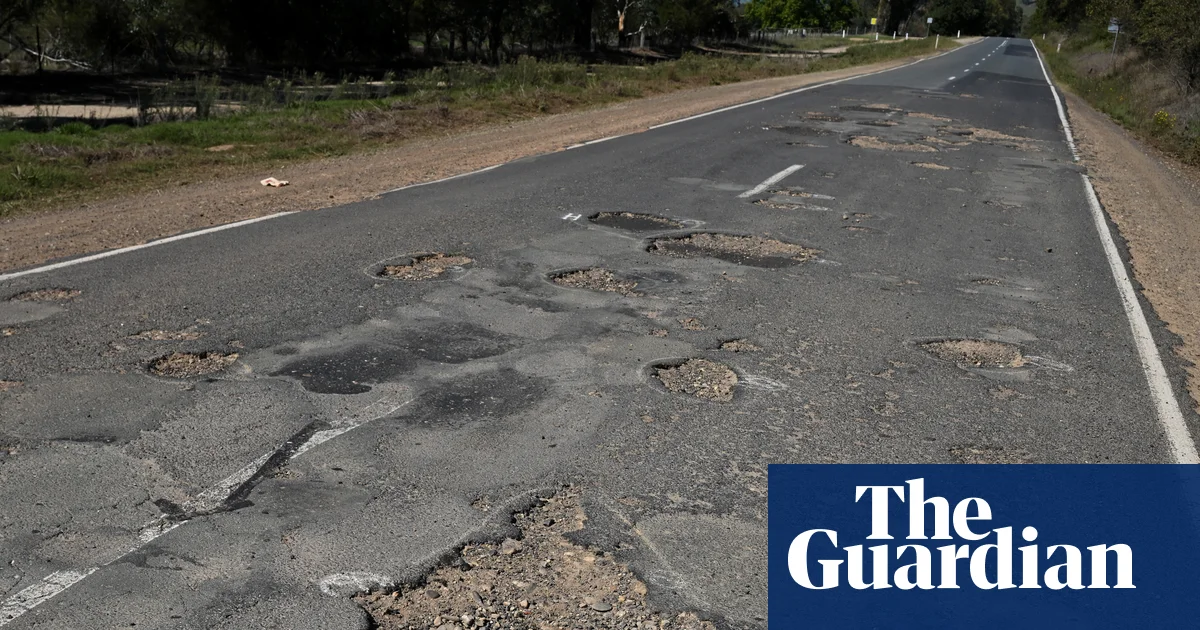
No matter where you're driving in Victoria – rural road, regional freeway or inner-city street – you're bound to encounter a pothole. This was reported by Qazaqyia.kz citing The Guardian.
At a press conference to celebrate the sold-out NFL match played at Melbourne's MCG on Friday, the Victorian premier, Ben Carroll, was heckled on one issue. "Fix the potholes," a punter called out as they walked past the Victorian premier's press conference.
No matter where you're driving in Victoria – be it a rural road, regional freeway or an inner-city street – you're bound to encounter one. Then comes the split-second decision: swerve into another lane, or power through and hope your tyres survive the impact?
For regional Victorians it has been an issue for years. In 2024, the National party began collating images for its "Potholes for All Seasons" calendar, which was distributed to MPs at state parliament last year.
But now potholes have become so omnipresent they could become the defining symbol of the Victorian election in November.
At the Nepean byelection in May, the opposition leader, Jess Wilson, and her successful candidate, Anthony Marsh, made it a central issue of the campaign – going so far as to fill a pothole themselves, prompting an investigation by the transport department.
The headlines have kept coming. In July, the ABC reported that seven cars were forced off the Calder Freeway near Gisborne due to tyre damage from potholes. In August, the Herald Sun reported a dismal 23 Victorian drivers had received compensation from the Transport Accident Commission for pothole damage over the last two years – despite thousands of complaints.
AI-generated ads for the political lobby group Fix Victoria feature potholes prominently. On Thursday, the group stood outside Parliament station handing out bumper stickers that read: "Not drunk, avoiding potholes". At the same time, the Insurance Council of Australia chief executive Andrew Hall was telling reporters they had been "more claims for tyres and rim blowouts" in Victoria than other states, because of potholes.
An auditor general report tabled in state parliament on Wednesday examined more than 23,000km of Victorian roads and found almost half (48%) were rated in poor or very poor condition. It also found they were deteriorating faster than the government could repair them: the gap between the number of road defects recorded and those repaired doubled between January 2025 and June 2026.
According to the auditor general, the Department of Transport told the government before the May budget it needed $3bn a year to maintain road pavement at existing levels while replacing ageing assets.
But the government allocated only $1.04bn in the budget for 2026-27. That same financial year, it is forecast to spend $8.9bn on interest payments on state debt.
Toby Ralph, a marketer and researcher who has worked on more than 50 elections worldwide, said potholes were "devastating political advertising" of the state's poor financial situation.
"They're omnipresent, impossible to spin, and while motorists don't study the state budget when they hit a pothole, they ask: with all the money being spent, why can't you fix this?
"Potholes are the symptom. The deeper problem is a government that needs to get its finances and priorities back in order."
Since becoming premier in July, Carroll has attempted a reset, promising to focus the government on the "basics". He's announced an additional $300m to fix 500,000 potholes by the end of January, using money saved from delaying infrastructure projects and with help from prisoners.
He's committed to a review of TAC claims and promised to bring maintenance work back in-house, which is significant given the auditor general said most major repairs were conducted by four external contractors.
The Coalition has pledged $5bn over four years to fix a million potholes – a 25% increase on current spending.
Some senior Labor sources have described the party's pothole plan as an attempt to "neutralise" the politically damaging issue, an approach questioned by Lissie Ratcliffe, chief of staff for Daniel Andrews when he was premier.
"If you are stuck in the issues that your opponents are stronger and more trusted on, it is very difficult to win from there," she said on the Socially Democratic podcast. She urged Carroll to "change the debate and get it on to a ground where, ideally, we've got a new idea or two and people think we're the best people to deliver".
Others within the party have compared the strategy to New York Mayor Zohran Mamdani's "pothole populism". The democratic socialist has made repairing potholes quickly part of his pitch to rebuild trust in government, telling reporters: "If you want someone to believe in the promise of a transformative vision … you have to first deliver on the thing that diminishes their faith on a daily basis.
"If you are driving your car or you're riding your bike and you hit the same pothole every single day, why would you trust city government in its ability to deliver something that you have never seen at that scale, when it can't even..."