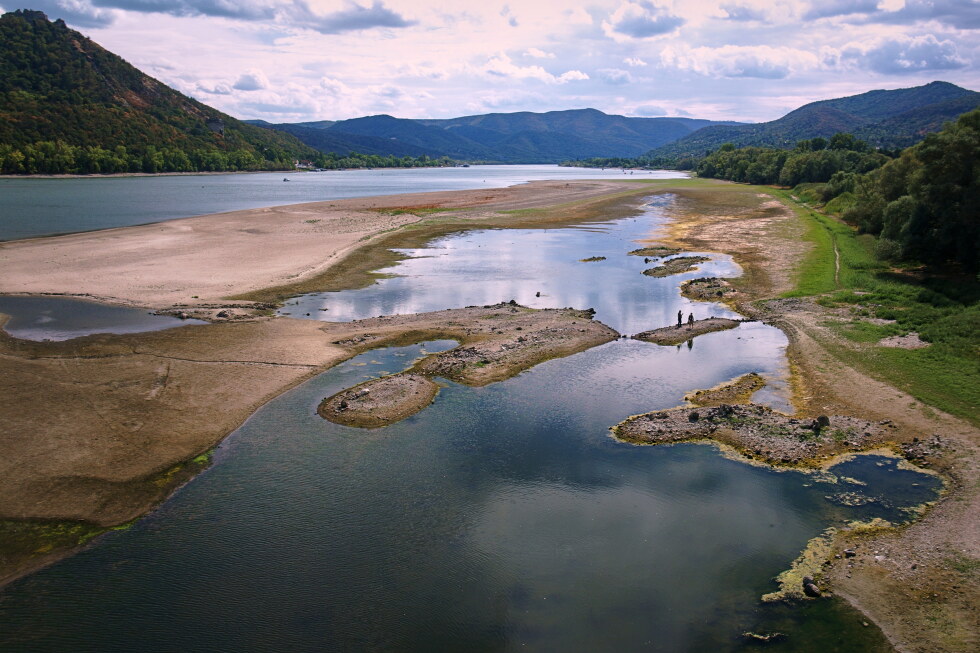
Record-low water levels are offering a stark view of Hungary's worsening water crisis. This was reported by Qazaqyia.kz citing Associated Press.
Years of drought and climate-driven heat are being compounded by a water-management system built to drain precipitation from fields, wetlands and soil.
On Aug. 18, 2026, people walk on sandbanks exposed by record-low water levels in the Danube River after drought and extreme heat near Nagymaros, Hungary. (AP Photo/Bela Szandelszky)
On Aug. 13, 2026, boats lie on cracked soil at a dried-out marina on Lake Velence, Hungary. (AP Photo/Bela Szandelszky)
On Aug. 5, 2026, people walk on a sandbar underneath the Danube's Margareth Bridge in downtown Budapest, Hungary, as the river, which runs through 10 European countries, has receded to never-before-seen low water levels. (AP Photo/Bela Szandelszky, File)
On Aug. 8, 2026, the bed of Lake Garancsi is exposed as the popular tourist destination near Budapest after the lake died out following an extended drought period near Tinnye, Hungary. (AP Photo/Bela Szandelszky)
These conditions highlight systemic problems in Hungary's water management. According to experts, the country's water infrastructure is designed to quickly drain rainwater rather than store it. Under climate change, this leads to increased water scarcity.
According to the Associated Press, the Danube River has reached unprecedented low levels. This could affect not only Hungary but all 10 countries the river flows through.
The Hungarian government acknowledges the need for urgent measures to address the water crisis. However, experts say this problem requires a long-term strategic approach.
Currently, various programs for water conservation and efficient use of water resources are being discussed in the country. But as the impacts of climate change intensify, the effectiveness of these measures is being questioned.
The Associated Press photographs vividly illustrate the scale of Hungary's water crisis. Dried-up lakes and receded rivers are evidence of the country's deteriorating ecological situation.
Debates continue over the need to reform Hungary's water management system. Some experts propose developing water collection and storage infrastructure, while others call for the introduction of water-saving technologies in agriculture.
This issue is not unique to Hungary but is common across Europe. Due to climate change, water scarcity is becoming an acute problem in many countries.
According to the Associated Press, the drop in water levels in Hungary has been ongoing for several weeks. This is also affecting the daily lives of local residents.
Hungarian authorities are forced to take urgent measures in response to water shortages. However, experts believe this may only be a temporary solution.
Currently, new approaches to water management are being developed in Hungary. These approaches aim at efficient water use, taking into account climate change.
According to the Associated Press, the water crisis in Hungary indicates the need to review the country's environmental policy. This issue is relevant not only for Hungary but for the entire world.
The Hungarian government plans to strengthen cooperation with international organizations to address the water crisis. Concrete steps are already being taken in this direction.
In conclusion, Hungary's water crisis is a real consequence of climate change. This situation demonstrates to all countries the need to rethink water management systems.