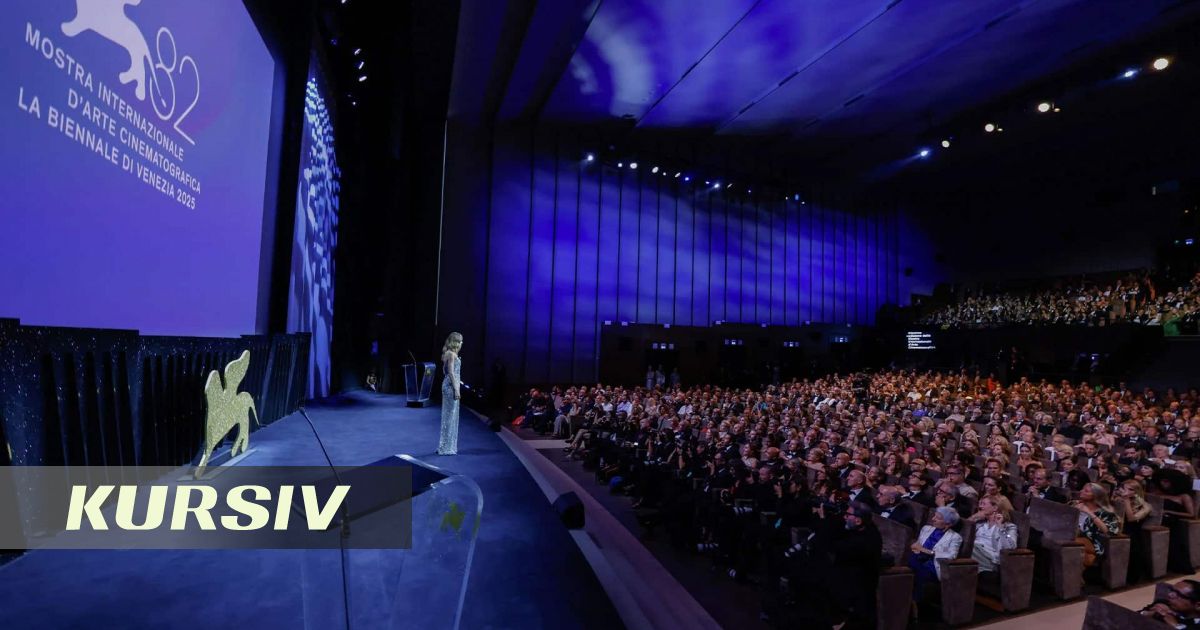
The 83rd Venice Film Festival opens on September 2. Kursiv LifeStyle reports on the program. This was reported by Qazaqyia.kz citing Kursiv Media.
Lack of Women and Barbera's Response
Rarely does a major film festival pass without disputes and scandals. For artistic director Alberto Barbera, this year is no exception. A couple of years ago, Barbera had to defend his decision to include films by Roman Polanski and Woody Allen despite allegations of sexual violence against the directors. Now he faces criticism that the competition lacks women — the list includes only one film, 'The Unknown Woman' by Danish-Egyptian director Mai El-Touki; the rest, with one small exception, are directed by men.
In a comment to Variety, Barbera explained his position: "We are categorically against selecting films based on the gender of their directors, as we do not consider such an approach useful. It is humiliating for women when it is considered that a film was selected because it was made by a woman, not because it is a really good film. If we made a mistake by not including a film made by a woman, let the audience decide whether that is the case after seeing all the films." He added that this year's jury president is director Maggie Gyllenhaal, which is also important.
Ukraine's Protest and the 'DAU' Scandal
Claims against the festival also came from Ukraine's Foreign Ministry. They protested the inclusion of Ilya Khrzhanovsky's film 'DAU' in the competition. This scandalous project by the Russian-born director, created over nearly 20 years, is formally dedicated to the life of Soviet scientist Lev Landau. During filming, 'DAU' turned into a vast cinematic universe blurring the lines between art and reality, spawning a series of films, performances, and installations. Venice will present the so-called 'mother' film, telling about Landau's life, lasting three and a half hours.
Disputes around the project began several years ago when the director first presented it in Paris in 2019. Khrzhanovsky was accused of reproducing the same mechanisms of a repressive and totalitarian system while telling about it. Some participants testified to psychological violence, and in 2020, the films shown at the Berlinale, 'DAU. Natasha' and 'DAU. Degeneration', shocked the public with two episodes. The first showed an allegedly non-simulated rape of a woman (later non-professional actress Natalia Berezhnaya, involved in the scene, denied this information), and the second showed neo-Nazi Maxim 'Tesak' Martsinkevich cutting off the head of a live pig. Khrzhanovsky himself denies all accusations of unethical methods.
Official Kyiv believes that screening 'DAU' could legitimize Russian culture during the war. In addition, Ukrainian authorities point to the involvement of Russian entrepreneur Sergei Adonyev in financing the project, and the fact that the performer of Landau, conductor Teodor Currentzis, received Russian citizenship in 2014. Barbera, who intends to keep the film in the competition, and Khrzhanovsky have already responded to the claims. The latter, in particular, mentioned that he opposes the war and is no longer a Russian citizen (the director has German and Israeli citizenship), and Adonyev did not sponsor this particular film.
Pattinson and 'Prime Time'
The complex relationship between reality and spectacle, law and sensationalism is also the subject of one of the festival's most anticipated films — 'Prime Time' with Robert Pattinson. It is one of the few American films to reach the Lido island — neither 'Digger', nor 'Social Reckoning', nor the third 'Dune', which were expected, made it into the program. In this biopic, Pattinson plays Chris Hansen, host of the show 'To Catch a Predator', which shows the entrapment and exposure of pedophiles. Judging by available materials, Hansen is also portrayed as a kind of 'predator', chasing not so much justice as television ratings.
Documentaries: Musk, Crowe, and Others
Documentarian Alex Gibney, known for his thoughtful socio-political investigative films (perhaps one of the most famous is 'Going Clear' about Scientology), has also prepared an unflattering portrait. Out of competition, his 'Mask' will be shown, dedicated, as one might guess, to Elon Musk and lasting about four hours. Documentary screenings are full of big names — masters such as Wim Wenders, Tsai Ming-liang, Takashi Miike, Viktor Kossakovsky, and Sergei Loznitsa will be presented (the latter traditionally addresses complex Soviet history, and in his new work Imperium compares the RSFSR with other republics, including Central Asian ones). Unexpectedly, actor Russell Crowe joined this row, having made a documentary 'What Builds Love' about his own music group Indoor Garden Party.
Opening Film and Other Contenders
Interestingly, the festival's opening film is also a story about a real mogul — owner of the British tabloid The Sun, Rupert Murdoch, played by Guy Pearce. The director of 'Ink' is Danny Boyle, so one can expect not so much a traditional biopic as a dynamic spectacle in the author's signature punk style, who has already made films about Steve Jobs and the Sex Pistols.
This year, as last year, the Venice competition becomes a refuge for a film rejected by Cannes (in 2025, this forced swap eventually brought Jim Jarmusch the Golden Lion). This is 'Bucking Fastard' (the original title is more hooligan and witty) by living classic of German cinema Werner Herzog. The plot tells of two inseparable sisters who do everything together — for example, fall in love with the same man — and then begin digging a tunnel through a mountain in search of a fictional country. The main heroines are played by sisters Mara, Kate, and Rooney, and Herzog himself was inspired by a real story he heard in the 1980s.
Among other important contenders for victory is Florian Zeller's 'Bunker'.