Giorgia Meloni's government has become the longest-running in Italy since the second world war – a milestone the prime minister is determined not to let pass unnoticed. This was reported by Qazaqyia.kz citing The Guardian.
This was reported by Qazaqyia.kz citing The Guardian.
In the port area of Bari, the capital of the southern Italian region of Puglia, where Meloni hosted the G7 in 2024 and where she spends her summer holiday, preparations are well under way for a festival-style showcase of her rightwing administration.
On Friday, there will be food trucks, water stations and traditional Puglian light shows as part of celebrations to entertain an expected crowd of 10,000 people bussed in from across Italy. Militants from the youth wing of Meloni's far-right Brothers of Italy party have fanned the city's squares and beaches for days, handing out flyers promoting the celebrations while wearing T-shirts featuring the official slogan: Il Governo più stabile, l'Italia più forte (the most stable government, the strongest Italy).
Meloni, who just a few weeks ago was booed at the opening ceremony of the Mediterranean Games in Taranto, further south in Puglia, will address the audience in the evening, surrounded by her coalition allies – Matteo Salvini, leader of the far-right League, and conservative Forza Italia's Antonio Tajani.
"This moment will be written in the history books," said Michele Picaro, a Brothers of Italy MEP and former Bari councillor. "We are the longest government in the history of the Italian Republic and this must be celebrated."
Beneath the triumph, however, the outlook for Meloni is less settled. True, she has enjoyed a political stability that eluded her predecessors. Brothers of Italy is still the country's biggest party. But in recent months, the political landscape has shifted with the emergence of a challenger – not from the left or the centre, but from someone who is even further to the right than Meloni.
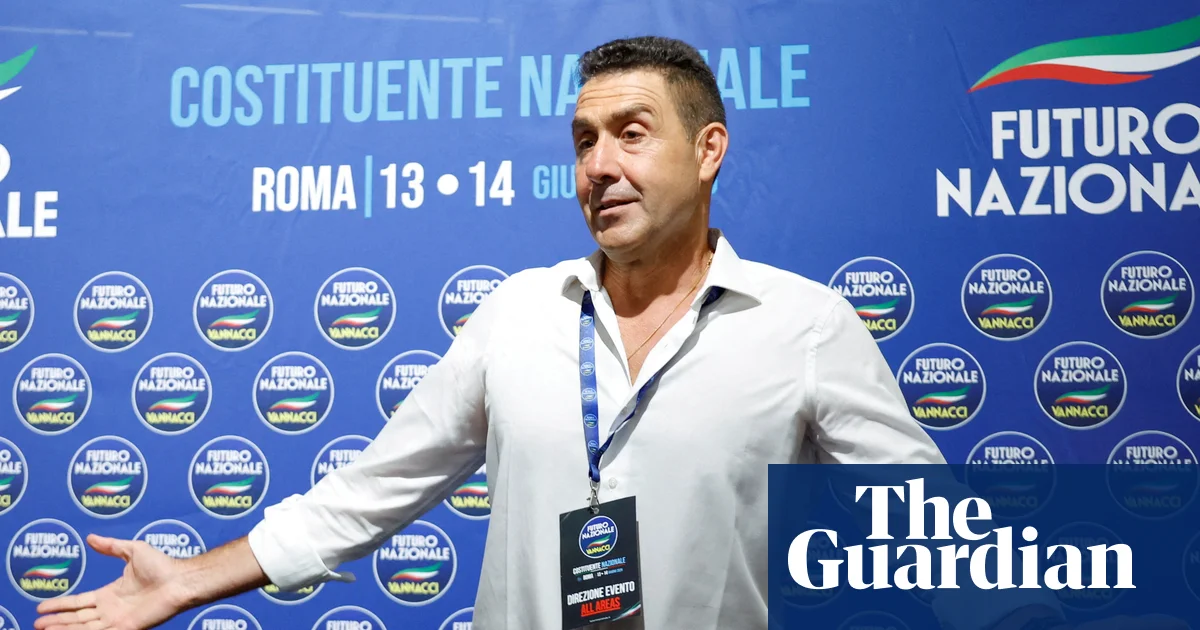
Since its launch in February, Roberto Vannacci, a former army general, has seen his far-right party, Futuro Nazionale, rise to about 8% in the polls, surpassing his former compatriots in the League months ago and this week eclipsing Forza Italia, too.
Vannacci first entered the public eye in 2023 after self-publishing a book filled with racism, homophobia, Islamophobia and antisemitism. The subsequent backlash cost him his army job, but propelled him to the top of the bestsellers list. Helped along by ample coverage in the Italian press, he capitalised on the notoriety and in 2024 was elected as an MEP for the League, later leaving Salvini's party to set up his own.
"I read his book because I always think you need to know the enemy," said Giulia Pastorella, an MP and vice-president of the small centrist party Azione. "And I thought, 'this is exactly the kind of thing you might hear people talking about in the bar.' Here's a military man, who is really a mirror of the worst impulses of people. The scary thing is, I think he's genuine and not a PR construct."
His policies, such as they are, are extreme. Futuro Nazionale's recently published manifesto says that "abortion is not a right" and calls for gay people to be banned from TV between 6am and 11pm so that children aren't exposed to what it describes as "homosexualist" content. It also proposes introducing military education in high schools and a "remigration" plan to remove irregular immigrants and foreign nationals who commit crimes.
On foreign policy, Vannacci has campaigned to stop weapons and financial aid to Ukraine, saying if he could choose between Vladimir Putin or the Ukrainian president, Volodymyr Zelenskyy, he would choose Putin.
In July, he organised a "Futuristic Triathlon" in the northern seaside town of Sanremo, billed as an event to "temper the mind and body" in an echo of the fascist aesthetics and themes of the Mussolini era.
Far from being a treated as a pariah, however, Vannacci's party has proved moderately successful, luring defectors from the three main ruling coalition parties. It is also actively courting disillusioned voters from the Five Star Movement, a key ally in a broad but perennially fractious leftwing coalition led by the Democratic party.
For the government, he represents a dilemma. Meloni, whose Brothers of Italy has neofascist roots, has governed more moderately than many had expected, cultivating a pragmatic and, crucially, pro-Ukraine image abroad while still deploying hardline rhetoric on choice occasions for domestic audiences.
That positioning, however, has left a vacuum on the far-right that Vannacci has exploited. The question now is: how will Meloni respond? Until now her ruling coalition had mostly coasted along, propped up by a strong parliamentary majority. Her government is largely regarded to have been fiscally prudent, but has steered clear of major structural reforms. Instead, it has heavily focused on security and continues to vigorously expand legislation on law and order.
"This government has wasted the huge occasion that stability gave them," said Lia Quartapelle, an MP with the Democratic party. "None of the core issues have been addressed – we have stagnant productivity and growth, salaries that have lagged behind for many years."