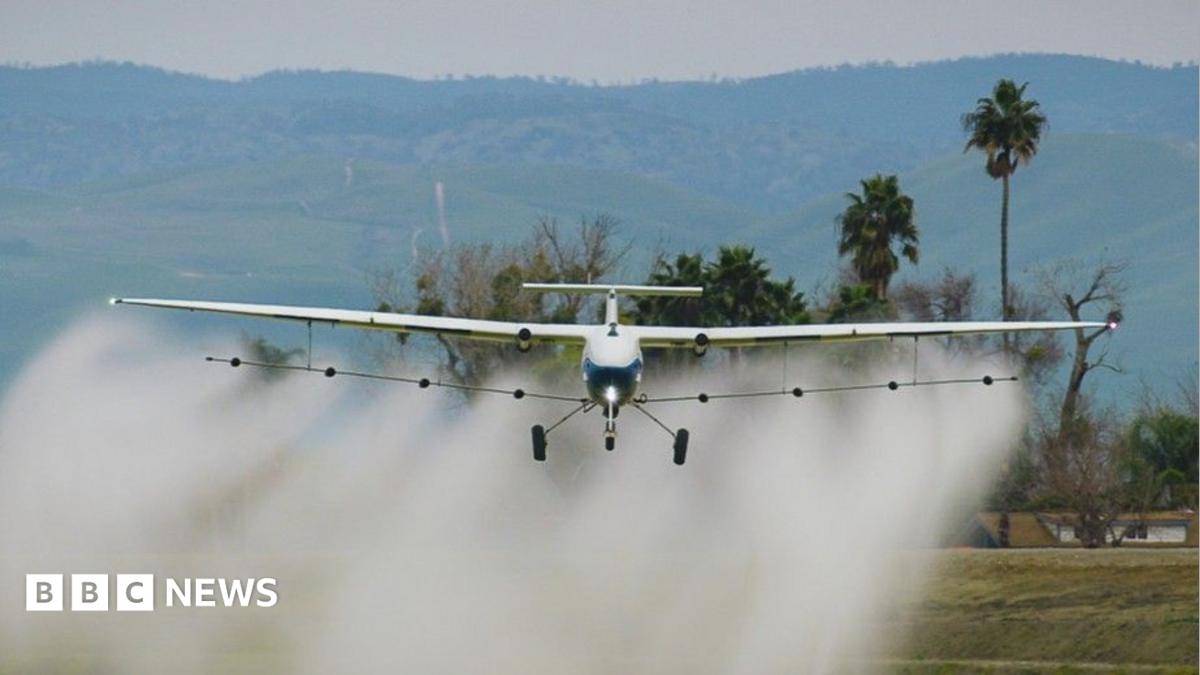
Over an alfalfa field in California's San Joaquin Valley, a small crop-spraying plane is flying scarily low to the ground. There's little risk to humans though, as the plane is pilot-free. This was reported by Qazaqyia.kz citing BBC News.
"We can actually go lower than a human pilot can," says Russ Marotzke, as the aircraft skims over the crop. Flying lower means less spray drift and therefore less chemicals are needed than in conventional manned crop-dusting, he says.
The pilotless plane belongs to Pyka, where Marotzke works as a flight test engineer. Based in a converted Second World War hangar overlooking San Francisco Bay, the start-up makes self-flying aircraft without cockpits, designed either to spray crops or deliver cargo.
It is among a small group of companies racing to bring autonomous fixed-wing aircraft into commercial service. Flying urban air taxis, so called electric vertical take-off and landing (eVTOL) aircraft, have captured much of the attention around autonomous aviation. But a quieter race is also under way to deploy self-flying planes, first for jobs like crop spraying and cargo delivery – and eventually, many of their makers hope, carrying passengers too.
"A fully scaled, ubiquitous passenger operation is the holy grail," says Michael Norcia, Pyka's co-founder and CEO, who envisions a large fleet of minibus-capacity Pyka planes ferrying passengers up and down the US east and west coasts. "There's a decent chance we'll get to that point before the eVTOL industry."
I've come to one of Pyka's crop-sprayer test sites, about 80km (50 miles) east of the company's factory and reached by a bumpy dirt road. Today, Marotzke and a colleague are trying out a software update on a demonstration aircraft. About a dozen Pyka aircraft are already in Brazil where they are used to spray crops such as cotton and soybeans, work previously carried out by human pilots.
The crop-spraying plane is fully electric, with its battery in the nose. It can fly for about 35 minutes and carries up to 300L of spray in a tank in its middle. Pyka's planes are sometimes called large drones, but it seems an understatement: they all have 11.5m wingspans.
Inside a shipping container beside the field, the engineers highlight on a computer the area they want the aircraft to spray. The software then plans the route, taking account of obstacles such as nearby power lines that have already been mapped. The take-off, down a runway beside the field, is seamless. About 15 minutes later, after sensing that it is running low on spray – water for today's purposes – the aircraft lands itself for a manual refill and demonstration battery swap. It then takes to the air again to resume spraying precisely where it left off.
Autonomous flight is different from autopilot. Autopilot assists, much like cruise control and lane-keeping functions in a car. Autonomous systems aim to handle the entire flight, including take-off and landing, with little or no human intervention, using algorithms to process sensor data and control the aircraft.
Self-flying planes have been slower to emerge than self-driving cars, despite operating in what is generally considered a more structured and predictable environment. That is partly because big tech companies "doubled down" on cars, pouring vast sums into the technology, says Mykel Kochenderfer, an expert in safe aviation autonomy at Stanford University. But it is also because aircraft are held to stricter safety standards than cars, creating a much higher bar for deployment. "The consequences for air accidents can just be so severe," says Kochenderfer.
Military interest has been helping propel the technology. Many of the companies have defence contracts to demonstrate and trial their systems, often with fewer regulatory hurdles than on the civilian side, and some are even already supplying military customers. In the US, the largest autonomous fixed-wing aircraft approved for commercial civilian use so far is Pyka's crop sprayer, which won authorization last year. Though operations are limited to a tightly defined agricultural setting and require a ground operator and visual observer. It earlier secured similar approval in Brazil, where rules are more permissive.
Pyka aims to scale up production from around two dozen planes a year currently to 1000 by 2030. Each sells for $550,000, with customers trained to operate them.