UK Foreign Secretary Ed Miliband has announced sweeping sanctions against Israeli settlements in the West Bank. This was reported by Qazaqyia.kz citing The Guardian.
In his speech, Miliband recalled childhood memories of picking oranges on his grandmother's kibbutz, accused Israeli "terrorists" of ethnic cleansing in the West Bank, and said the new measures aim to address a "deeply painful contrast" between rhetoric and reality.
It was the strongest statement on Israel's actions ever issued by the UK government. But will it make a difference to Palestinians living under the omnipresent threat of violence? The Guardian's chief Middle East correspondent Emma Graham-Harrison and diplomatic editor Patrick Wintour analyze the details of Miliband's announcement.
The sanctions
The first measure Miliband announced is a widely anticipated ban on the import of goods from illegal settlements. This is important, not least because these settlements violate international law. The sanctions aim to curb Israel's expansion of settlements in the West Bank.
History of settlements
The number of settlers in the occupied West Bank (including East Jerusalem) has risen from 270,000 in 1993 at the time of the Oslo Accords to about 770,000 today. Settlements are often framed as the project of violent extremists backed by far-right cabinet ministers, but Israel's annexation enjoys longstanding cross-party support.
The E1 project
In August, Benjamin Netanyahu's government opened the tendering process for construction work on the E1 settlement, a vast project for 1,200 homes that would cut across the heart of the West Bank, dividing it in two. Final bids for these contracts close days before the Israeli election next month, and the timing is strategic. "Netanyahu is trying to make E1 an election issue," Patrick Wintour says.
Political context
Miliband's predecessors Yvette Cooper and David Lammy condemned the plans for E1, and Cooper backed international sanctions on individual settlers. But neither went as far as Miliband. "He's a more decisive foreign secretary," Patrick says.
His stance also reflects Labour's desire to win back voters on the left. The post-match analysis from Labour's disastrous May local elections focused on the threat of Reform, but the Greens were a bigger threat to Labour's vote. Miliband acknowledged yesterday that "Labour has not done enough in the face of what is happening", and has announced these sanctions just before a pivotal byelection in Holborn and St Pancras.
Historical context
It's worth remembering where we were just two years ago, when Starmer's government was still resisting calls for a ceasefire in Gaza. Although Starmer became more critical of Netanyahu's government and ultimately recognised Palestinian statehood, Miliband's speech marked a significant shift in tone and substance from this equivocating stance. He framed his intervention not as an argument with Israelis, "with whom the UK has unshakeable bonds", but with the conduct of Israel's government, its illegal occupation of Palestine, and with "settler terrorists", while attacking the Boycott, Divest and Sanctions movement that calls to limit all trade with Israel.
Photographs
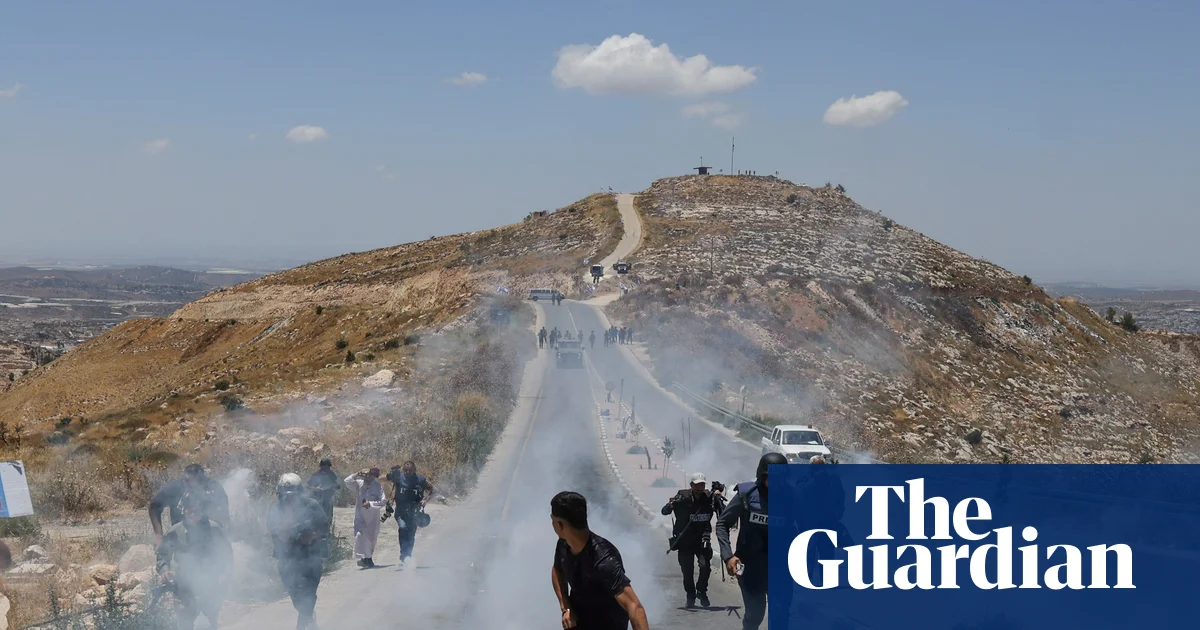
The article shows journalists, protesters and Palestinian landowners, who say some of their land was taken for the Mount Tarousa settlement, running from tear gas fired by Israeli security forces in June. It also shows the Israeli settlement of Maale Adumim near the E1 corridor, where a housing project could cleave the West Bank in two.