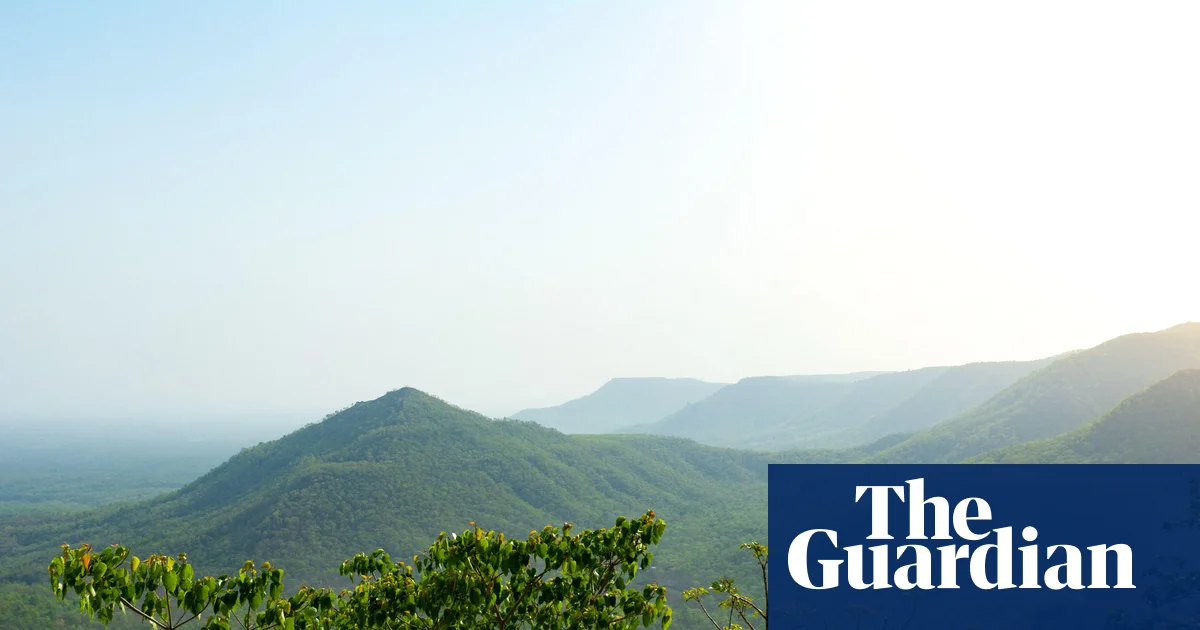
India set out to expand its forested areas a decade ago. Last week, however, we learned that the forest cover programme had barely taken root when the government's auditors released their findings of the flagship Green India Mission. The shortfall of 97.57% from India's initial pledge in 2014 was stark enough to alarm the government's own auditor, who described the progress as 'negligible'. This was reported by Qazaqyia.kz citing The Guardian.
Yet if you ask the government about forest cover, you'll get a far greener picture. This article is written on the day the UK Met Office issued a calamitous warning – 2027 could be the hottest year yet, on account of the strongest El Niño in more than a century. For India, a disrupted monsoon season puts agriculture and millions who depend on it at risk.
The question of what's happening to India's green cover feels far more urgent than an academic disagreement over numbers. The government's last comprehensive report from 2023 (released a year later) touted that forest cover in India has grown since 2021. But other independent assessments have found that forest cover is lower than what the government has claimed in recent years, or that it has reduced.
The discrepancy lies in some creative accounting. Last year, dozens of former civil servants wrote to the government criticising the forest report. They described its methodology as unreliable and nonscientific, pointing to the inclusion of smaller orchards, as well as coconut and rubber plantations, in the calculation of forest cover. 'A lot of the discrepancies are coming from how and what we are counting as forests. We have broadened the definition to include a lot more,' Pooja Choksi, founder of environmental consultancy Ficus Research Consulting, told me.
The government has defended its methodology, saying its definition is internationally accepted and includes tree-covered land outside forests as well as orchards and bamboo and palm plantations.
Even as the government pledged to increase forestation, over the past five years India has approved the diversion of forest land for development projects covering an area roughly equivalent to the size of Hong Kong, according to data shared in parliament this month. The pace has accelerated, with the last financial year seeing the single largest chunk cleared yet.
Mining was the single-biggest sector, accounting for 22% of all diverted forest land, followed by road works and irrigation projects.
The pressure on forests is concentrated in some states. Nearly a quarter of all forest land diverted nationwide since 2021 is in Madhya Pradesh, which is home to the country's largest forest area. Its share is more than double that of the next state, Odisha. Arunachal Pradesh on the north-eastern border with China ranks third for forest diversions, according to government figures shared in parliament.
One research team that mapped 28 years of satellite data from three central Indian coalmine regions, including two in Madhya Pradesh, found the damage from such projects extended far beyond disappearing trees. Water bodies shrank, soil quality degraded and the overall natural ecosystems diminished by 35%.
Perhaps nowhere is this trade-off more starkly visible than in the project proposed in the pristine Andaman and Nicobar Islands, which are home to protected Indigenous tribes. The central government has touted the Great Nicobar Project as a strategic necessity to strengthen India's maritime and defence presence in the Indo-Pacific. The project would divert 13,075 hectares of forest land and cut down, conservatively, at least 700,000 trees to make way for a trans-shipment port, an international airport, a mega township and a power plant for their operation, at a combined cost north of $6.89 bn (Rs 90,000 crore). The project has already led to legal challenges and pushback from the opposition Congress party and environmentalists.
'Situated at the precise intersection of variable sea-level rise and sinking land, the Great Nicobar Project is not merely ecologically destructive or culturally erosive for the Indigenous populations – it is geologically impossible,' geoscientist CP Rajendran wrote in The Wire, arguing that the government is using natural security as a pretext to push a commercial hub in one of the world's most tectonically active zones.
For many such development projects that divert forest land, the answer has been to pour substantial public funds into planting trees and creating forests elsewhere. But experts caution that this may not be as simple a solution as it may sound. Choksi, whose research focuses on biodiversity outcomes of restoration and tree-planting policies, said the rush to meet Paris Agreement targets has made India obsessed with 'green cover' while ignoring other aspects of environmental policy. 'We need to move away from this very one-dimensional view that everything is green cover. What is being planted and where it is planted has a huge impact,' she said.