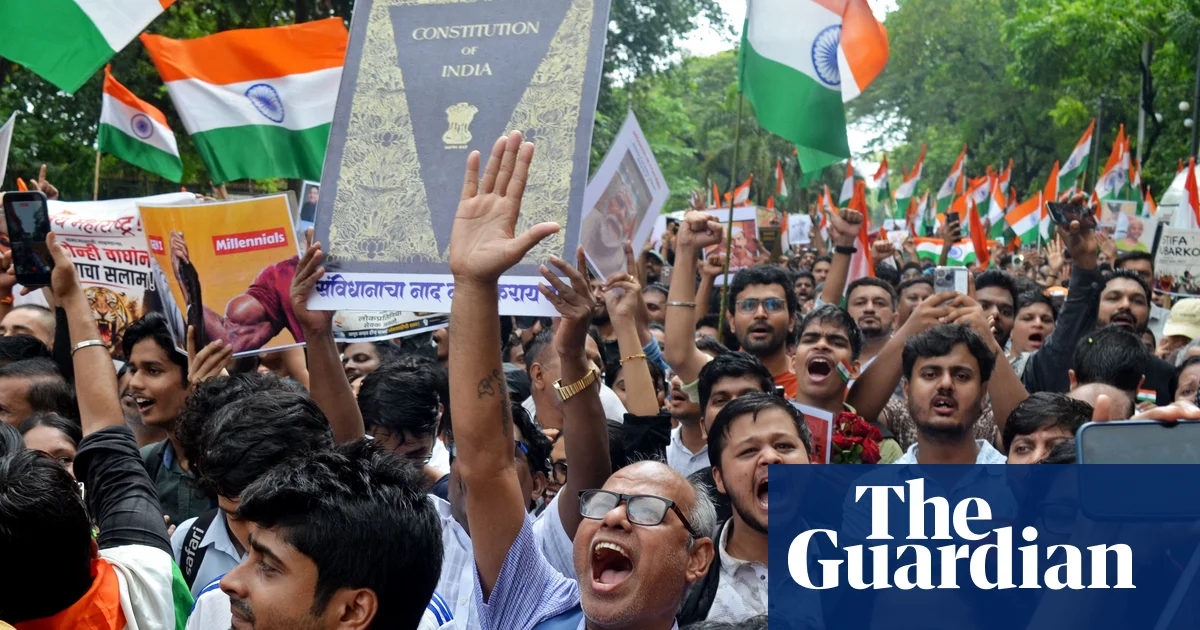
India's youth-led "Cockroach" movement, whose nationwide protests forced the resignation of the education minister, has accused the government of backtracking on its promise not to act against student protesters and has threatened to restart demonstrations. This was reported by Qazaqyia.kz citing The Guardian.
The Cockroach Janta party (CJP), which organised mass protests over exam paper leaks and other irregularities, said it had received reports of hundreds of students being detained or "harassed" by police.
Police cases were filed against students in Delhi, Assam, West Bengal and Bihar, all states ruled by Narendra Modi's Bharatiya Janata party (BJP).
The CJP had agreed to call off the demonstrations on Saturday after the education minister, Dharmendra Pradhan, resigned and senior BJP ministers assured the group no punitive action would be taken against protesters. But on Monday, the CJP accused the Modi government of reneging on the agreement.
"If the government does not honour the agreement and release everyone detained or arrested, we will be compelled to resume the protest," a CJP spokesperson, Ashutosh Ranka, told reporters.
At least 100 people have been arrested, many on stringent, non-bailable charges, according to the CJP.
On Monday, Neha Bora, the head of the All India Students Association, who became an important figurehead of the CJP movement, travelled to Bihar to put pressure on the authorities to withdraw cases against all protesters in the state.
A police officer was suspended in Bihar for using an assault rifle to disperse student protesters on Saturday.
In West Bengal, where the BJP recently took power, the hardline chief minister, Suvendu Adhikari, inferred that all the protesters last week were Muslims. Cases have been filed against many participants under a draconian new state law.
The CJP has set up a legal fund to help cover the expenses of protesters implicated in criminal cases by the police, said Saurav Das, another spokesperson for the group.
The youth-led movement has won millions of followers on social media since it was launched in May by a 30-year-old public relations graduate, Abhijeet Dipke. Hundreds of thousands of protesters, mainly students, rallied last week in New Delhi and other cities, demanding Pradhan's resignation and broader reforms of the examination system.
Demonstrations in the Indian capital turned violent on 20 July when huge crowds attempted to march to parliament from the Jantar Mantar protest site. Police fired teargas and used batons to disperse them, causing clashes and a wave of detentions.
The protests were an unprecedented show of dissent against the Modi government, which has cracked down on critics and opposition over its 12 years in power. Pradhan's resignation was the first time a senior minister in the Modi government had been forced out by public pressure.
The chief justice of India called for an independent investigation after a petition was filed in the supreme court alleging police brutality at the Delhi protest, stating that the "right to peaceful, lawful protest is absolutely guaranteed" under the Indian constitution.
The issue also reverberated in parliament on Monday, as opposition lawmakers demanded a response from the government over last week's police crackdown.
The government has promised to act on the issues that sparked the protests, and announced a panel to oversee an overhaul of India's examination system. On Monday, it introduced a measure in parliament seeking tougher penalties for exam paper leaks.