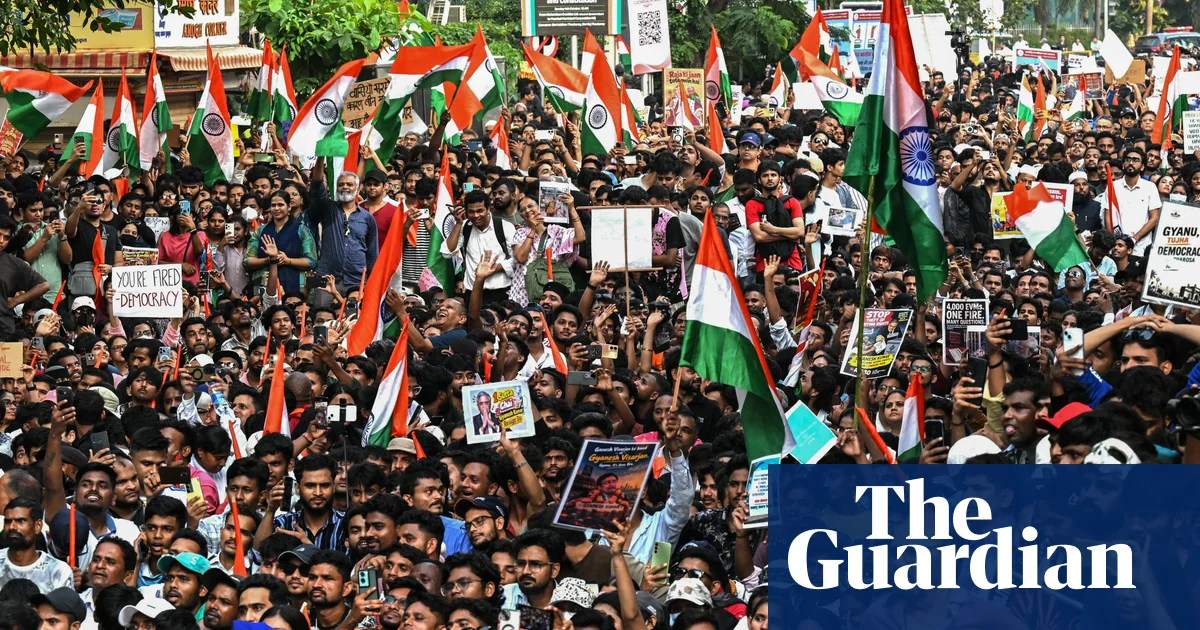
Months of simmering public anger have given rise to a season of discontent in India. In its latest iteration, the demand is for the removal of chief election commissioner Gyanesh Kumar and the scrapping of a controversial electoral rolls revision that has struck 130 million people off the register. Protests have erupted every day over the past week, prompting a violent crackdown on dissenters in the capital. This was reported by Qazaqyia.kz citing The Guardian.
Situation in Delhi
Over the weekend, Delhi was effectively under lockdown, transformed into a militarised landscape of barricades, road closures and paramilitary forces marching through the streets. Ahead of a protest led by the Cockroach Janta party on Saturday, authorities deployed a massive dragnet: 245 trains to Delhi were cancelled, 45 metro stations were shut, liquor shops were closed, internet services were cut off in the heart of the city and activists were put under house arrest.
The founders of the Cockroach party were removed from an Air India flight shortly after it landed at Delhi airport on Saturday. Opposition leaders were held for more than eight hours in various police stations. Video footage showed students and activists being manhandled, beaten and dragged off the streets while some journalists were also swept up in the detentions. A supreme court lawyer assisting those detained was carried away by police, his shirt torn in the process. The crackdown extended to Mumbai, where Tushar Gandhi, the great-grandson of Mahatma Gandhi, was whisked away by the police to prevent him from participating in a local demonstration. On Monday, the Delhi police denotified Jantar Mantar as a designated protest site, instead recommending three alternative locations.
Eyewitness accounts
"I have been in public life and have watched politics for four decades now, and I have never witnessed this kind of preparation for a demonstration. It was extraordinary by any stretch of the imagination," political activist Yogendra Yadav, who was also detained, said of Saturday's crackdown. Despite what he described as "terror unleashed by the state", he said, small groups staged flash protests in several areas of Delhi defying the heavy security presence.
The crackdown was preceded by similarly aggressive police action against Congress party's protests, led by Rahul Gandhi. Dramatic images of police personnel detaining Gandhi and his sister, Priyanka, amid scenes of chaos flashed across screens nationwide.
Government position
The ruling Bharatiya Janata party has defended its position, with spokesperson Ravi Shankar Prasad accusing the opposition of weaponising protests after electoral defeats. "One, Indian democracy has thwarted attempts to incite anarchy. Two, the country will be governed by parliament, not by the streets," he said at a news briefing.
While suppression of protests is not new, what stands out this time is the scale of the crackdown in the capital. Government clampdowns in Indian-administered Kashmir have been far more severe, particularly in 2019, when sweeping restrictions were imposed after the revocation of Article 370.
The ferocity of the state response reflects the high political stakes for Prime Minister Narendra Modi's government, which faces mounting resistance over the Special Intensive Revision (SIR) and questions about the credibility of the electoral process.
The SIR controversy
The latest protests began with a demand for Kumar's resignation after an Indian Express investigation reported that the ECI's two other commissioners, Sukhbir Singh Sandhu and Vivek Joshi, had raised concerns about changes to electoral rolls, registration procedures, and digital systems. While Kumar has not responded to the investigation, the ECI said in a statement that "differing views" were part of the "decision-making process". But the anger runs deeper. The SIR exercise has faced criticism for putting citizens through a trial by fire and leaving the most marginalised in a Kafkaesque limbo. Critics and opposition leaders have gone further, charging that the exercise was designed to benefit the ruling regime.
Former election commissioner Ashok Lavasa told me that the SIR process is unprecedented and unfair, marking a departure from the Commission's traditional emphasis on inclusion. "For more than seven decades the ECI took it upon itself, as a duty, to enrol everyone who was eligible to vote. And that was one of the basic differences between how Indian democracy works and how other democracies function, where you need to apply to get enrolled," he said. Voters accustomed to a "friendly procedure" now face a hostile system, which he said "is not good for democracy" in the long run.
Yadav argued that the SIR controversy has exposed what he describes as a deeper process of democratic capture by the ruling party. "Elections are the only mechanism now left for the regime to stamp its legitimacy," he said.