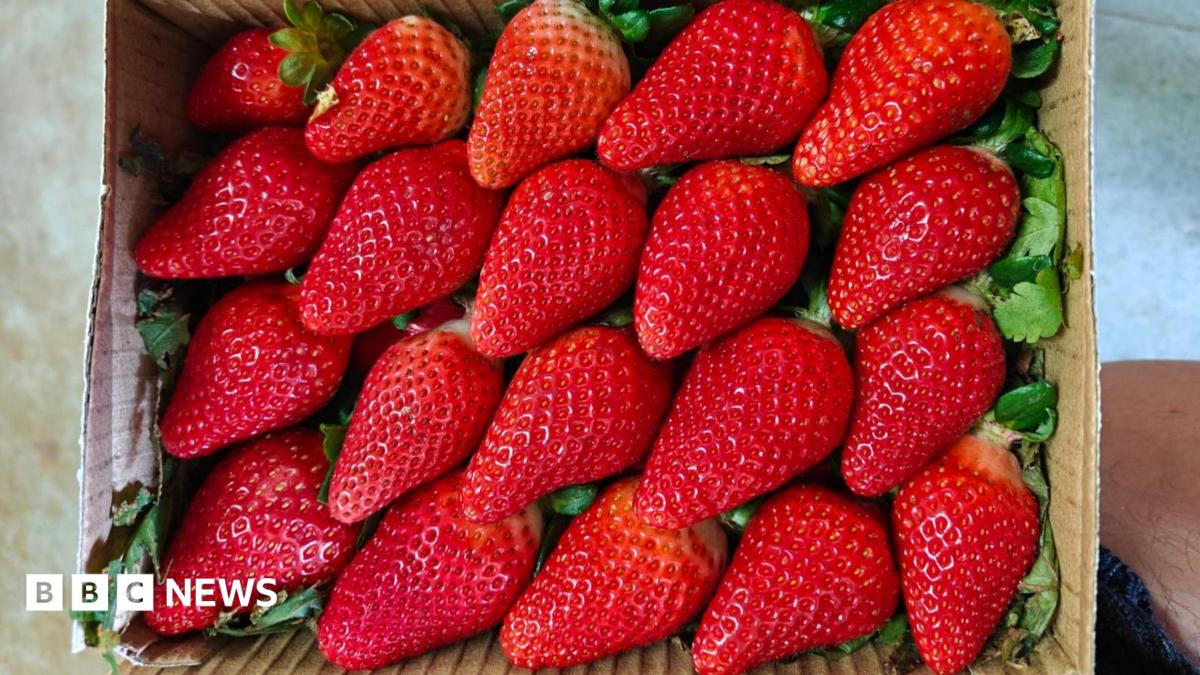
In the west of India, the mountainous region of Mahabaleshwar is home to most of India's strawberry farms. Around 85% of India's strawberry cultivation happens there. This was reported by Qazaqyia.kz citing BBC News.
An altitude of more than 1,000m (3,280ft) gifts the region a long cool growing season between November and March. In addition, light, well-drained soil is well-suited to strawberry cultivation.
But that doesn't mean farmers have an easy life - it's a labour intensive and risky way to make a living. "If you have a field full of strawberries and sudden heavy rains hit, the entire crop is ruined and we have to bear massive losses," says Sheetal Danavle who, with her husband, grows strawberries on half of their three-acre farm.
Strawberry plants have to be replaced every season and are not grown from seed. Instead, farmers buy young plants from suppliers. For Danavle, on her small farm, that's an outlay of $2,500 (£1,900) every year. "If the season goes well, you can earn double your investment. But the climate makes it a huge gamble," she says.
Thousands of farmers grow strawberries across the Mahabaleshwar region, making the fruit one of the most profitable horticultural crops in western India. Despite that success the industry still relies on varieties that are imported from California, Florida, Italy and Spain, as no one in India has developed a domestic plant.
It can take 10 to 15 years for breeders in the US and Europe to develop a top quality fruit and they patent their varieties. "We import the certified mother plant from the breeder abroad," says Nelson Sequeira, the founder and director of Tara Farms Fresh, a licensed strawberry propagator.
Once imported the plants have to go through a government quarantine, before they are planted in a nursery. There the mother plant produces daughter plants and those are then sold to farmers. "One single imported mother plant becomes an engine. That single mother plant will shoot out runners to yield an average of 20 daughter plants - with some advanced growers pushing that up to 30 or 40," says Sequeira.
It's a high-tech and precision operation. "The plants do not touch the ground. We use large industrial pipes split completely in half to form long, rounded gutter containers," Sequeira explains. "Instead of soil, we pack these containers with a specialized coco-peat substrate derived entirely from coconut husk. We then integrate a highly precise drip-irrigation and fogging system to control micro-climates."
Sequeira and other propagators rely on mother plants from abroad - for now. But work at Mahatma Phule Krishi Vidyapeeth (MPKV), an agricultural university in Maharashtra, might change that. MPKV has partnered with the Bhabha Atomic Research Centre (BARC) on a breeding experiment. Researchers are using controlled, low-dose gamma irradiation on plant tissues to induce stable genetic mutations.
"The goal is to fast-track the development of India's first indigenous, climate-resilient strawberry cultivar that matches the large fruit size and firm texture of foreign varieties while natively tolerating Indian heatwaves," says Dr Darshan Shashank Kadam, assistant professor of Horticulture at MPKV.
He admits it could be a long process, with results perhaps in 10 or 15 years. But in the near term they are helping farmers in other ways. "We are developing scientific packages of practices for farmers. We have already standardised planting schedules, fertiliser recommendations and growth regulator applications specifically for Mahabaleshwar conditions," he says.
Large farms with more resources are investing in new technology. Ketan Yashwant Sodha, is the founder and CEO of Berry Fresh Agrotech. He started with traditional open-field farming, but was frustrated by losses caused by the weather.