As conflict intensifies in the Middle East, India's relationship with Israel is deepening. This was reported by Qazaqyia.kz citing The Guardian.
An Amnesty International investigation has revealed that India is now a key part of Israel's weapons supply chain. This represents a fundamental change. For years, New Delhi had primarily been a major customer of Israeli weapons. Now, through joint ventures and manufacturing partnerships, it has become a "significant contributor" to Israel's weapons production, according to Amnesty.
Indian companies, including state-owned enterprises, have delivered drone warheads, artillery shell casings, small arms parts, and military vehicle components to Israeli military suppliers, despite the substantial risk these could end up in weapons deployed in Gaza.
By examining publicly available shipment-level trade data, Amnesty traced hundreds of thousands of weapons components shipped from Indian factories to Israeli military suppliers between 7 October 2023 and 30 November 2025, including:
- 01390,516 small arms parts for military-grade weapons
- 02564,970 parts of explosive ordnance
- 03298 components of military vehicles
Many Western nations, including Britain, have restricted or banned arms supplies to Israel over its conduct in the war, citing risks that the weapons could be used to commit or facilitate violations of international humanitarian law. (The United States accounts for the overwhelming share of major arms transfers to Israel.)
An independent UN commission of inquiry concluded in September that Israel had committed genocide in Gaza, and earlier this year another commission found that Israel is continuing to commit genocide by deliberately targeting Palestinian children. Separately, the International Criminal Court has issued an arrest warrant for Israeli Prime Minister Benjamin Netanyahu, accusing him of committing war crimes.
Yet, the Amnesty report hasn't resulted in any large-scale public debate or political backlash in India, despite some scattered media coverage. Johny believes this is a result of the support for Israel by Modi's voter base. "There is a clear ideological confluence between Hindutva and Zionism," he said. In rightwing circles in India and elsewhere, he argues, Israel is increasingly seen as a bulwark against the expansion of Islam.
Hindu nationalists have long admired Israel, viewing it as a model of a nationalist state that can assert itself in a volatile neighbourhood. Author Pankaj Mishra chronicled this affinity in a 2017 essay, writing that his grandfather was among high-caste Hindus who saw Israel as an example of how to deal with Muslims "in the only language they understood: that of force and more force".
The war on Gaza doesn't appear to have significantly shifted views. A Pew Research survey published in June found that more Indians view Israel favourably (32%) than unfavourably (28%). This is in contrast to the decline of support for Israel in many Western countries, including the United States, since the war.
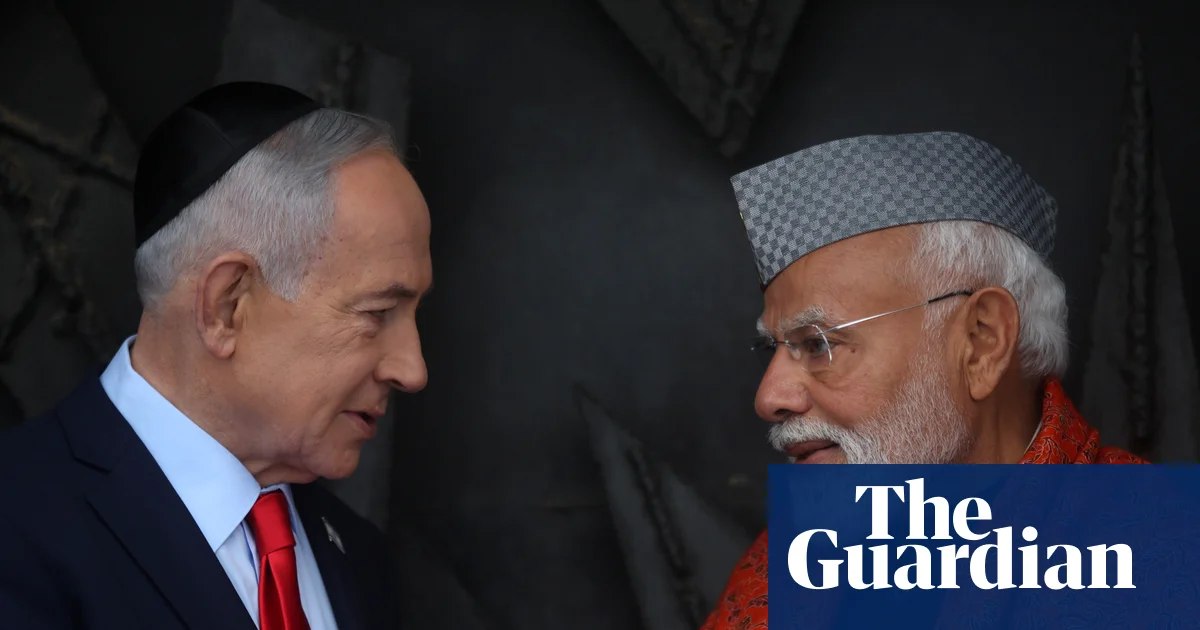
Modi, for his part, has cultivated a personal rapport with Netanyahu. In 2017, he became the first Indian prime minister to visit Israel, and Modi's visit to Israel earlier this year came just 48 hours before Israel and the United States launched their attacks on Iran. The optics of Modi hugging Netanyahu on the tarmac, coupled with New Delhi's noticeably muted response at the outbreak of war, were a clear sign of where India's political establishment stands. It has not gone unnoticed. In July, after the US vice-president, JD Vance, rebuked Netanyahu by calling the US Israel's "only powerful ally" left in the world, Netanyahu shot back: "We have some other friends, like a small country called India. It has 1.4bn people, and boy, do we have tremendous support there."
The government has previously declined to give a direct answer about weapons supplies to Israel. When asked in parliament in 2024, external affairs minister S Jaishankar said that information is not in public domain and that exports of military products are guided by "national interest". Amnesty identified three state-owned Indian companies – Munitions India Limited, India Optel Limited and Advanced Weapons and Equipment India Limited – supplying Israel with weapons.