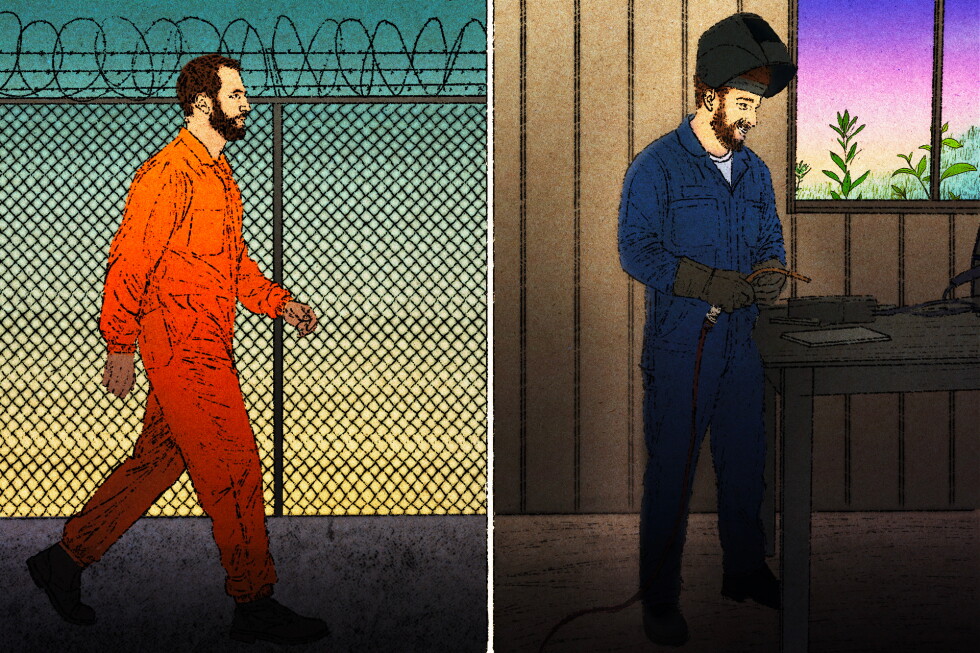
NEW YORK (AP) — Don Christian had never held a regular job when he left prison. A conviction at age 19 for selling drugs kept him confined through young adulthood and into his early 40s. When he got out after serving 23 years and started looking for work, "I had to start from the bottom. The very, very bottom," Christian said. "I was willing to work anywhere. I just wanted to change my life." This was reported by Qazaqyia.kz citing Associated Press.
This was reported by Qazaqyia.kz citing Associated Press.
Having a criminal record, as an estimated 1 in 3 American adults do, creates hurdles for people seeking employment, especially in fields that require licenses, according to the Vera Institute of Justice, a nonprofit that aims to end mass incarceration. Meeting with parole officers, a need to secure stable housing and other conditions of release, along with discrimination, compound the typical challenges of job hunting.
"Even when they come home with skills and credentials, they see fewer job opportunities and they earn less money than people who don't have convictions," Ruth Delaney, who directs a higher education initiative at the Vera Institute, said.
After Christian's release, his parole officer suggested applying for a job at Toyotetsu, an auto parts manufacturer. The company hires former inmates through a second-chance program. Christian, now 53, got a welding job there and began rebuilding his life.
"I had to learn on the go, on the fly," he said nine years later. "I already had my mind set — I wasn't going to fail."
Here are strategies shared by former inmates and reentry specialists for finding work after incarceration.
Education
People incarcerated in prisons with educational programs can build job skills by taking college-level courses or pursuing a professional certification. Inmates interested in seeking a degree from an eligible college or university can apply for a federal Pell Grant to help cover the cost. The grants were unavailable to incarcerated students for decades, but the Vera Institute and other groups persuaded Congress to restore access.
Incarcerated people who pursue college programs have 48% lower odds of returning to prison than those who do not, according to Vera Institute research. "People who go home and are able to get living-wage jobs do better during reentry," Delaney said. "They're able to get jobs that can support themselves and their families."
Ryan Cuellar, who went to jail at age 18, received federal financial aid after his release to learn paralegal skills, which he then used to get his record sealed. He eventually earned a master's degree and now works as a sales consultant for a tutoring company.
"I can't drive home enough how much determination you need to have for yourself," Cuellar said.
Prison Work Experience
Prison work experience is another way to gain skills that are worth including on a resume. You don't have to spell out that your employer was a correctional institution, according to Laura Rivero, an instructor at Leap for Ladies, a nonprofit that teaches employment, entrepreneurship and life skills to women in prison.
Someone who worked in the kitchen of a Florida prison, for example, could list "State of Florida" as the employer and describe the experience as "operated commercial dishwashing machines" or "prepared and served foods in a high-volume dining facility," Rivero said.
Christian took up welding in prison, which helped him land his first job at Toyotetsu. He still is at the company, where he mentors new employees. He is taking social work classes with the goal of earning an associate degree and helping other former inmates transition into working life.
Employer Initiatives
A number of U.S. companies, including large employers like JP Morgan Chase and Virgin Atlantic, work intentionally to hire people with criminal records. The Business Roundtable, a non-profit organization, also works in this direction.