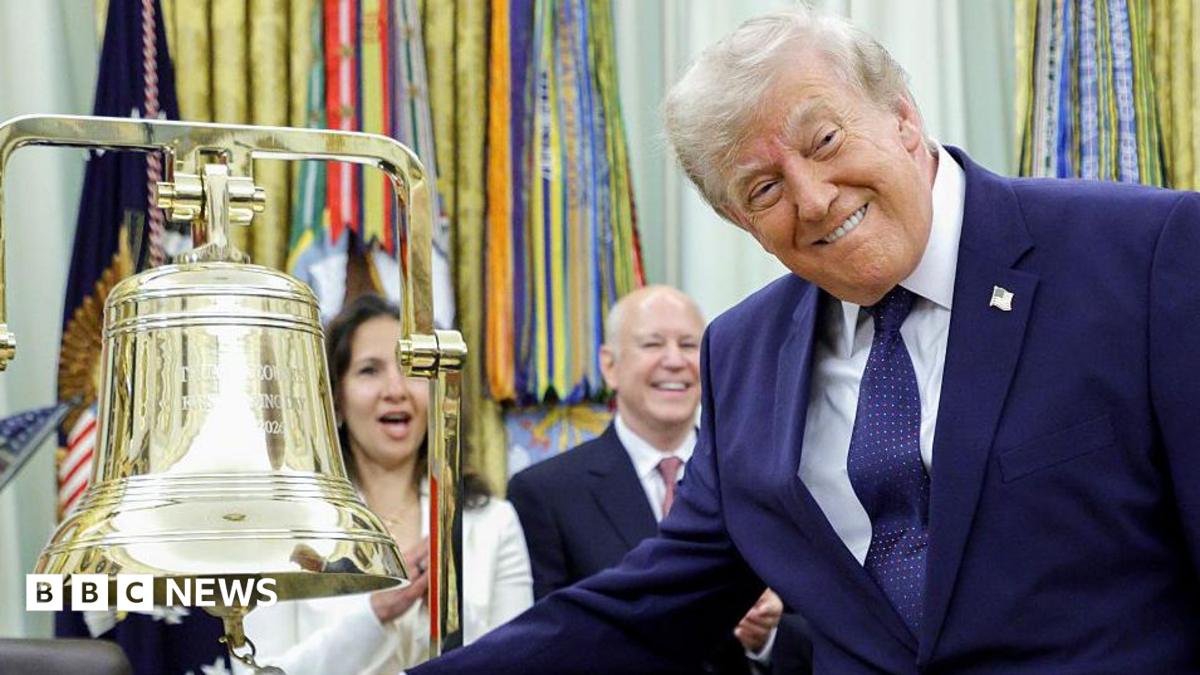
The launch of Trump Accounts, a new savings scheme aimed at encouraging investing among American children, was marked with an historic ringing of the Wall Street opening bell in the Oval Office this week. This was reported by Qazaqyia.kz citing BBC News.
But not everyone is convinced the project will prove a success in giving new generations a stake in the so-called American dream, with sceptics suggesting that it will not live up to the hype.
The savings accounts are now available to all US children under the age of 18, with babies born between 2025 and 2028 qualifying for a $1,000 contribution to kickstart savings. Families, friends and employers can contribute up to $5,000 per year per child, who can access the funds when they turn 18.
By law, the money must be invested in a low-cost index fund designed for long-term growth. While the money grows tax free, withdrawals are subject to taxes and a possible 10% penalty if made before the age of 59 and a half. To avoid such a penalty, the money must be assigned to pay for higher education, buying or building a first home, or for personal emergency expenses.
Trump Accounts add to other existing tax-efficient savings schemes such as IRAs or 529 plans. According to a Congress report, Trump Accounts are a new form of traditional individual retirement account (IRA), but differ because of certain rules.
The White House has been keen to push the scheme, arguing that it offers millions of children a way into stock ownership in the US, which it says has historically been "unevenly distributed".
However, reaction has been split. Will McBride, chief economist at the Tax Foundation think tank, says the scheme is too complicated to sign up to, which will lead to a "minority that benefits" — parents who are "relatively well-informed, relatively well-off".
Andy Blocker, head of policy at Edward Jones, believes the $1,000 contribution will remove a "barrier of having nothing to start with". He says: "If by year-end more families have a clear on-ramp to begin saving and investing for their children's financial futures, that's success."
Adam Michel, director of tax policy studies at the Cato Institute, says the idea is admirable but warns it might "not live up to the rhetoric". He notes the main benefit is the $1,000 starting subsidy but suggests many families would be better off using existing savings accounts. He also points out penalties for early withdrawal: "Trump Accounts do not fix that problem."
It is understood some six million families had signed up before Trump Accounts went live on 4 July, which is a fraction of the tens of millions of children who could be eligible. The White House said the $1,000 subsidy for babies had been deposited into more than half a million accounts so far. About 3.6 million children were born in the US in 2025.
The White House said American families had "contributed nearly $125 million to Trump Accounts" so far. Trump Accounts estimates the $1,000 starting pot could rise to $6,000 by age 18 even without further contributions, based on historical S&P 500 averages, but warns actual results may differ.
If $250 a year was added, the pot could be worth $19,000 by age 18. It could be as high as $271,000 if the maximum $5,000 a year is contributed.
The scheme has backing from big business names including BlackRock, which said about 40% of Americans have no exposure to financial markets. Visa and Dell have also pledged support. The Dell family will seed Trump accounts for kids with $250.