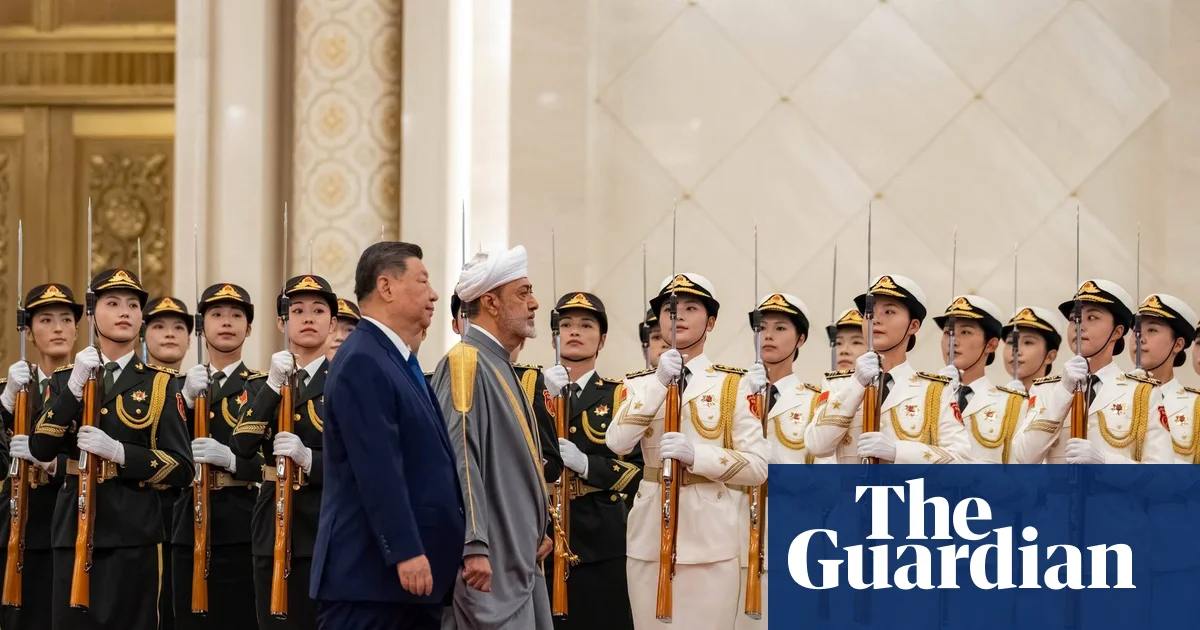
China has held a flurry of meetings with Gulf leaders in a sign that Beijing is stepping up its diplomatic efforts in the Middle East. This was reported by Qazaqyia.kz citing The Guardian.
The diplomatic salvo comes before a highly anticipated meeting between Donald Trump and Xi Jinping when the US president is expected to attend the Apec conference in Shenzhen, China, on 18 and 19 November.
Xi held talks with Haitham bin Tariq, Oman’s sultan, in a historic state visit to Beijing on Monday. Haitham’s trip to Beijing is the first time that an Omani head of state has visited China since the two countries established diplomatic relations nearly 50 years ago.
President Xi’s foreign minister, Wang Yi, met Saudi Arabia’s national security adviser, Musaad bin Mohammed Al Aiban, and the deputy secretary of Iran’s national security council, Ali Bagheri Kani.
According to a Chinese readout of the meeting, Xi warned that the Middle East should not become an arena for “great power rivalry and geopolitical conflicts”. He said: “China has always been actively committed to stopping conflict and promoting peace, and hopes to contribute wisdom and solutions to resolving the regional security dilemma.”
Wang said after his separate talks that China was willing to “play a constructive role in helping the region emerge from the shadow of the pandemic and achieve lasting peace and stability”. In his meeting with Bagheri Kani, Wang said China supported Iran “in safeguarding its sovereignty and security”. According to China, the Iranian official said his country looked forward to China “playing a more important role in international and regional peace”.
When the US and Israel launched joint strikes on Iran in February, China was credited with pushing Tehran toward ceasefire talks in Pakistan, bolstering its status as a regional mediator.
Beijing’s influence in the Middle East is “no longer what it used to be”, said Shen Dingli, a Shanghai-based scholar of international relations. But he added: “Given China’s increased investment and trade in the region … its influence cannot be ignored.”
As the war has dragged on, China’s diplomatic efforts have been muted. Its biggest economic leverage over Iran is the fact that it buys about 90% of the Middle Eastern country’s crude oil exports. Between April and June, it slashed its crude imports by 30%, with the total in June plunging to the lowest level in a decade. That saved the global economy from a major spike in inflation. According to some estimates, China’s cut in oil imports shaved $30 or more off barrel prices of Brent crude, a global benchmark.
Beijing has otherwise done little to broker peace in the Middle East. That is partly because it does not see the conflict as being its responsibility to resolve. In March, Wang said the war “should never have happened” and that the US and Israel would find “no popular support” for the strikes.
China is also a beneficiary from the damage that the fighting has done to the US’s global reputation. According to findings published in July by the Pew Research Center, a Washington-based thinktank, China is now viewed more favourably than the US in a majority of 36 countries surveyed.
The pain caused by the long-term disruption to the strait of Hormuz, the waterway through which much of the world’s oil and gas flows, also poses a risk to China’s economy. Shortages of energy cause inflation, which risks reducing global demand for Chinese goods.
Tehran and Washington are locked in intensive talks to reach an agreement, which could include reopening the strait. Trump has repeatedly threatened to renew military action against Iran after Tuesday’s midterm elections in the US, a move which would cause alarm in Beijing.
Trump’s desperation to reach a deal in the Middle East may also provide an opportunity for China to present itself as a regional peacemaker, bolstering Xi’s status before their meeting. Beijing brokered a detente between Saudi Arabia and Iran in 2023 but since then its diplomatic impact in the region has been limited.
Shen said China’s desire to improve diplomatic relations with Middle Eastern countries as well as the US were “mutually reinforcing” trends.
China’s foreign ministry spokesperson, Mao Ning, said on Monday that China would send special envoy Zhai Jun to Iran, Oman and Saudi Arabia in early to mid-November.