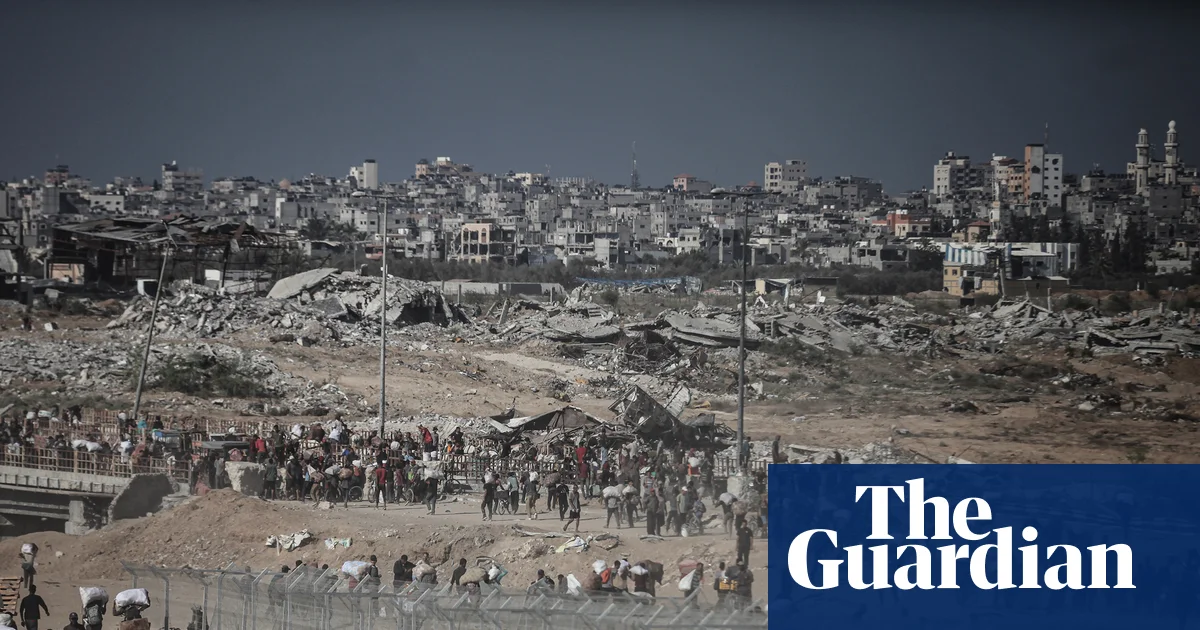
The Gaza recovery plan being pursued by Donald Trump's Board of Peace (BoP) has shrunk dramatically from an ambitious blueprint for the reconstruction of the whole territory to a small pilot project in the south of the strip. This was reported by Qazaqyia.kz citing The Guardian.
Even the envisaged pilot scheme – involving a temporary camp for a tiny fraction of Gaza's 2 million displaced people, with a Palestinian administration, police and a small international security force – is not expected to take shape before the end of the year.
Incremental steps have been announced in recent weeks. A few Moroccan and Kosovar officers have arrived in Israel where they are intended to be the kernel of an International Stabilization Force (ISF), tasked with protecting the pilot camp. A logistical base for this future force to store vehicles, equipment and other material is nearing completion at the Kerem Shalom crossing between Israel and Gaza.
However, preparatory work on the pilot camp near the southern Gaza city of Rafah has not begun, nor has construction of the camp's ISF support base. Satellite images of the area show disturbed earth but no new structures. Substantial progress is not expected before Israel holds elections on 27 October, which could bring down Benjamin Netanyahu's far-right coalition government.
Israel has routinely violated the Trump-brokered ceasefire since it was declared last October, blocked any reconstruction work and severely limited flows of humanitarian aid into Gaza. Western diplomats in Jerusalem believe the best hope of progress in Gaza is a new Israeli government, but it is far from clear whether any successor coalition would be substantially more flexible.
One diplomat in Jerusalem argued that the BoP had no choice but to make the most of very limited progress, as an admission of failure would open the way for extreme factions in the Israeli government with radically different plans for Gaza. "The aim is just to keep something going, keep the ball in play, because if you stop there are others with a more extreme agenda just waiting to jump in and take over, and they are talking about wholesale population transfer and colonisation," the diplomat said.
There is growing apprehension that Netanyahu, facing the threat of electoral defeat, will gamble on a new all-out offensive in Gaza before the October vote.
Israel has carried out frequent strikes on Gaza killing more than 1,100 Palestinians since the October ceasefire and Israeli forces have repeatedly moved forward from the ceasefire line agreed in October which split the strip roughly evenly between Israeli- and Hamas-controlled sections. The Israeli army now directly occupies more than 60% of the territory and has created a buffer zone beyond that.
A return to full-scale war would probably sweep away even the BoP's modest pilot plan.
Israeli officials have repeatedly suggested that a return to war is inevitable on the grounds that Hamas has refused to disarm. Hamas has said it would be willing to lay down its weapons under certain conditions and took part in negotiations in Cairo over the weekend on possible disarmament mechanisms.
The Cairo talks with the BoP covered the disarmament of Hamas and rival Israeli-backed militias inside Gaza, who would receive the surrendered weapons, how they would be stored and whether assault rifles would count as offensive weapons or personal arms.
However, reports from the Egyptian capital suggested progress on decommissioning weapons was unlikely while Israel continued to carry out airstrikes and creep ever further into Hamas-held territory. "As long as Israel doesn't commit to a gradual withdrawal from the Gaza Strip and to changing the reality there, there's no basis for talks," a Palestinian source told Haaretz.
The high representative for Gaza appointed by the BoP, Nickolay Mladenov, was widely criticised for echoing Israeli talking points in a May report to the UN security council, when he blamed Hamas for the stalled peace process with no direct mention of Israeli violations.
The limited pressure put on Israel has been more discreet. Aryeh Lightstone, the Trump administration's lead negotiator in Israel who also serves as a BoP adviser, wrote to the Netanyahu government privately in June, calling for a relaxation of restrictions on "dual-use" humanitarian aid entering Gaza, which have stopped the shipment of essential items such as water pipes and solar panels. Lightstone's letter – first reported by the Israeli public broadcaster Kan and confirmed by an official with knowledge of its contents – also asked for the coalition's clearan