President Donald Trump's additional tariffs on Canada have led to the closure of a paper mill in the town of Témiscaming, Quebec. This was reported by Qazaqyia.kz citing BBC News.
As you cross the Ottawa river into Témiscaming, Quebec, the paper mill takes up much of the horizon. The town itself was built over a century ago, around the mill and the region's forests filled with pine, birch, spruce and fir. Now, the main employer and economic anchor sits idle after trade talks broke down between Canada and the US and President Donald Trump imposed more tariffs on the country.
Most of the mill's 360 employees are out of work, kept afloat for the moment with partial pay from government tariff-relief.
For some, like Nadine Suley, the shuttering of the mill could mark not just a lost livelihood, but a lost way of life. She is not "a city girl", and is heading out moose hunting later to take advantage of the short season, like much of the town. She quips they'll all need the free meat provided by the animals this year.
"It's not just a job. It's our home," Suley says, adding that the US tariffs on her town feel like "a personal attack".
In early October, American owner RYAM went ahead with an "economic shutdown" of the mill for "an indefinite period". Property values in Témiscaming fell almost overnight, and "For Sale" signs dot the yards of modest middle-class homes that make up most of the town.
There are fears that essential service people - from grocery store clerks to the doctors at the small local hospital - could also be on their way out.
"If the mill goes down, it'll turn into a ghost town," says Ronnie Raymond, who like many in the town comes from a family of mill workers. "There'll be nothing, nothing left. There's no work for anybody, really. It's scary."
At a high level, Canada's economy has weathered the ongoing trade war with the US, its largest customer. The national unemployment rate has remained largely steady at around 6.5% since Trump's tariffs were first implemented. It's been coupled with tepid but consistent economic growth.
But a closer look at the numbers shows pockets of deep pain in industries directly hit by US tariffs of up to 50%, like steel, aluminium, automobiles and - in the case of Témiscaming - lumber, pulp and paper. It raises questions about whether the Carney government is doing enough to help those struggling while a trade deal remains elusive.
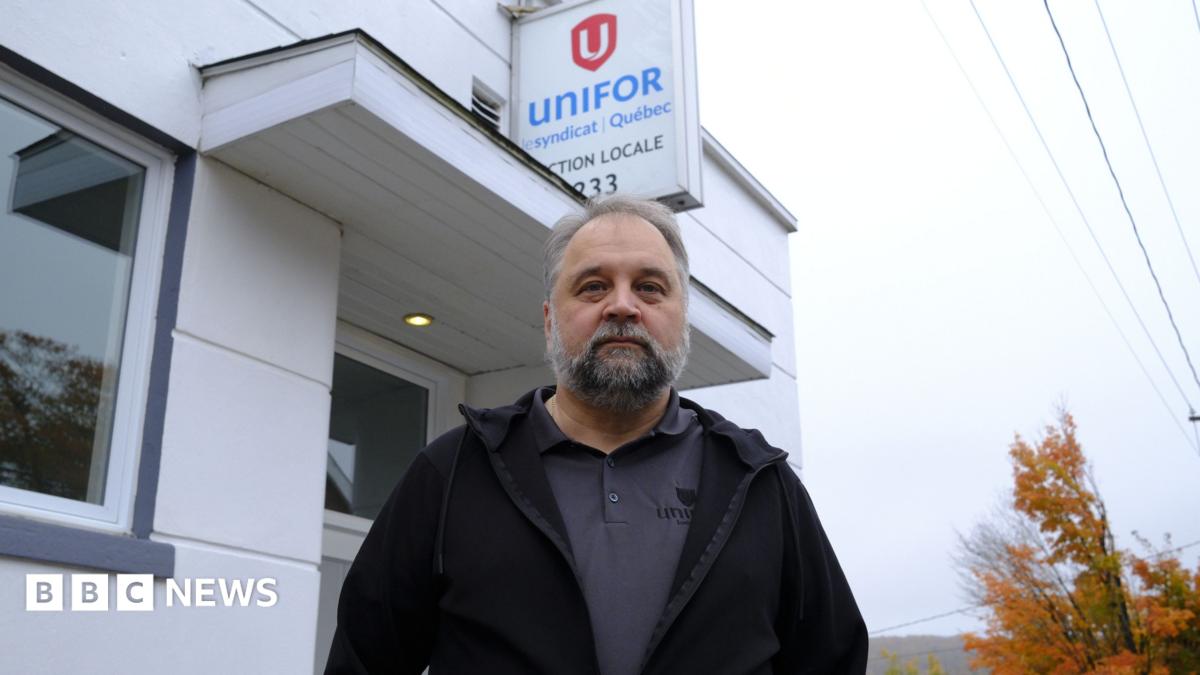
"If there was 10% of job loss in Toronto or Montreal or Quebec City or Vancouver, it'd be all over the news, and it'd be a lot of pressure on the governments to do something," says Stéphane Lefebvre, an employee and union leader, whose father and grandfather also worked at the mill.
That economic pain could have ripple effects on the entire forestry industry in the region, including saw mills and trucking. One local contractor told the BBC he has already had to lay off 13 people.
The last time the town faced a threat this existential was in 1973, when the mill's then-American owner threatened to shut it down, prompting the local workers and managers to come together and purchase it. They turned it into Tembec, a Quebec-owned, international company with branches across North America and France.
The workers now hope to do it again, mobilising a coalition of locals who want to buy the plant back from RYAM, which purchased it in 2017.
"We're hoping that lightning will hit twice," Lefebvre says, speaking inside the town's union hall. But he contends that they cannot do so without significant help from Prime Minister Mark Carney and the Quebec government, either in the form of tariff relief or financial support.
Suley notes that the prime minister has placed emphasis on "buy local" and supporting Canadian workers since he was elected. Backing the town's bid to buy back the mill, she says, would be a way for Carney to fulfil that pledge.
In an email to the BBC, RYAM said it would not comment on a potential sale of the plant or any prospective buyers.
Mayor Alain Gauthier doesn't blame RYAM for its decision. He calls US tariffs "a bomb to shut down our manufacturing in Canada". He wants Ottawa to retaliate with its own duties on the board products coming into Canada from the US, currently tariff-free.