The sound of YMCA by the Village People booming through the badlands of North Dakota could only mean one thing: Donald Trump's 250th anniversary travelling circus had reached a remote corner of America more familiar with bison, wild horses and bighorn sheep. This was reported by Qazaqyia.kz citing The Guardian.
The US president visited Medora on Wednesday to dedicate a $450m library and museum honouring Theodore Roosevelt, the 26th president, in the region where he roamed as a cowboy and big-game hunter in the 1880s.
In what critics saw as his latest effort to cloak himself in the mantle of great men of history, Trump delivered a speech that drew comparisons with Roosevelt, whose face is carved into Mount Rushmore in neighbouring South Dakota, but notably said little about his predecessor's environmental legacy.
Even by the haphazard standards of the America250 events so far, Wednesday's extravaganza was bizarre. Trump's trip marked the debut of a refurbished Boeing 747 gifted by Qatar that will serve as Air Force One, featuring a red, white, dark blue and gold paint scheme selected by the president.
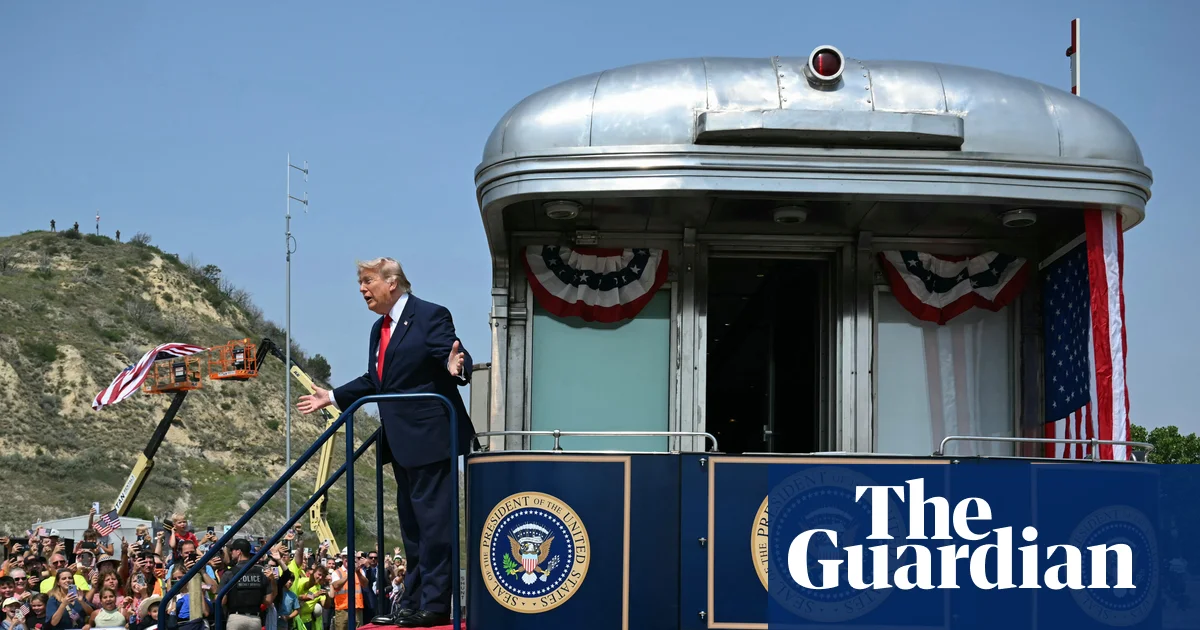
Against a dramatic landscape of eroded hills, deep ravines and layered rock, Trump then emulated Roosevelt's whistle-stop tours by taking a short journey on a train painted red, white and blue with bunting and the words "Freedom", "Liberty" and "1776-2026".
The train halted at a railroad crossing with horn blasting and bell ringing as a crowd, who had waited in the sun for three hours in the company of a Roosevelt impersonator, chanted "Go, Trump!" and "USA! USA!" Trump, who has previously shown little interest in railways, disembarked at the same spot as the 24-year-old Roosevelt more than 140 years before.
His motorcade to the library was accompanied by horseback riders dressed like Roosevelt's "Rough Riders", the nickname given to the military unit that Roosevelt led up Cuba's San Juan Hill in 1898 during the Spanish-American war. A big trail of horse manure was left behind on the road.
Trump toured the new 96,000 sq ft library, which overlooks a national park named for Roosevelt because of the formative years he spent in the Badlands. He visited a room named after the interior secretary, Doug Burgum – a former North Dakota governor – and his wife Kathryn, and conversed with a digitally animated version of Roosevelt.
Trump recalled later: "I had a conversation with Theodore Roosevelt: 'What did you think about the Panama canal? Is that your greatest achievement? How do you feel about the fact that the Democrats gave the Panama canal away for one dollar to Panama?'"
The president then appeared at the nearby Burning Hills Amphitheatre against the backdrop of a western stage set normally used for a local musical, complete with ersatz railway station, telegraph office, stable, blacksmith, dance hall, apothecary and Rough Riders Hotel. There were 25 Rough Riders standing rigidly behind him. A giant white "Medora" sign loomed from the hill above.
Trump delivered a meandering, hour-long address despite a faulty teleprompter, never taking a sip of water even as the audience perspired in withering heat. "I'm honoring Theodore Roosevelt - that is, the man I have long admired," he said. "I don't admire too many people, I have to tell you – not a lot of people out there."
Trump announced that the National Endowment for the Humanities will award the library $750,000 to support its first year. He praised the artistry, scholarship and technical skill on display in the museum before previewing his own presidential library: "We're going to build a museum in Miami – they gave me a lot of ideas."
Now in his second term, Trump seems increasingly concerned with his legacy and place in history. He has previously spoken admiringly of Andrew Jackson, Richard Nixon and Ronald Reagan; a big portrait of Reagan hangs prominently in the Oval Office. On Wednesday he cited Abraham Lincoln and Dwight Eisenhower, the last president to use the train that Trump rode in on.
But his principal focus was Roosevelt, whose presidency fell at the halfway mark between the declaration of independence and the present day. Like Trump, Roosevelt was a privileged New Yorker who would be accused of imperialism and warmongering and survive an assassination attempt.
The differences, however, are profound: Roosevelt, who was 42, remains the youngest person to become president; Trump, now 80, was the oldest ever elected. Roosevelt won the Nobel peace prize; Trump has not. Roosevelt, who preached "the strenuous life", might have taken a dim view of Trump's diet of McDonald's and Diet Cokes.
And Roosevelt, who ran for a third term in the White House but fell short, once said: "Patriotism means to stand by the country. It does not mean to stand by the president."
Trump told his audience on Wednesday that much of the conversation on Air Force One had revolved around Roosevelt and his larger-than-life adventures. "He had a freakin' wild life," he said. "He didn't want to be quiet. He wanted to be great."
He praised Roosevelt as "a great he-man" and "a proud man", insisting: "I'm a proud man, I'm proud of our country. I'm proud that two years ago we had a country that was a laughing stock all over the world, and now we h"