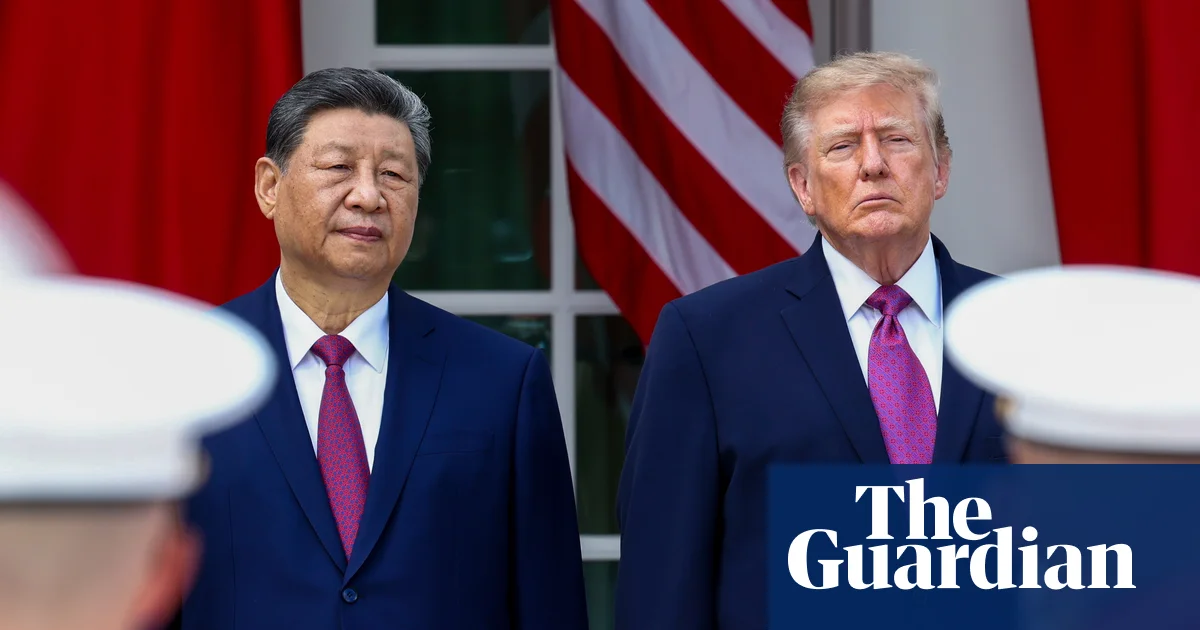
US President Donald Trump welcomed Chinese President Xi Jinping to the White House on Thursday. This was reported by Qazaqyia.kz citing The Guardian.
"One is an authoritarian who represses the media with a strong allergy to democratic elections. The other is head of the Chinese Communist party," the publication writes.
Trump welcomed Xi to the White House, setting the stage for a scene quite unlike anything the august old building has seen over more than two centuries. "Remarkably, this is our first time meeting together here at the White House, and as President Xi has already seen, a lot has changed since he was last here," the US president observed.
While Xi remained poker-faced, only a brief look around a grand foyer bedecked with American and Chinese flags would have verified Trump's statement. On one wall, where an official portrait of Barack Obama once hung, was the dramatic image of a bloodied Trump with fist raised urging his supporters to "fight!" after a failed assassination attempt.
And while Chinese state media had been welcomed onto the White House grounds, many US journalists had not, thanks to Trump's ban on CNN, MS Now and Politico. Michael McFaul, a former US diplomat, described the vivid contrast as "wrong and embarrassing."
That was hard to deny, given that China ranks 178th in Reporters Without Borders' press freedom index, ahead of only North Korea and Eritrea (the US, for the record, is down to 64th). But it also made perfect sense because, whereas past presidents sought to make China more like the US, Trump evidently aspires to make the US more like China.
The deference was deafening. On Wednesday night he and his wife, Melania, travelled to Joint Base Andrews in Maryland to greet Xi off his plane — a schlep that US presidents rarely make for foreign leaders — and rolled out a literal red carpet for his strongman soulmate.
Chuck Schumer, the Democratic minority leader, observed on X: "If you're a foreign authoritarian, Trump won't just invite you to visit America, he'll roll out the red carpet for you..."
"I met President Xi at the plane (Airport!) yesterday and he looks strong, vibrant, and fit — Better than ever," a gooey-eyed Trump gushed on his Truth Social platform. "Madam Xi, of course, BEAUTIFUL!"
Protocol error! When the president wrote "Madam Xi," referring to Xi's wife Peng Liyuan, he should have said "Madame Peng," which is how she is recognised.
Xi is such a star that he got two welcomes. On Thursday morning, there were more flags, more trumpet blasts, and another red carpet as the Trumps emerged from the White House south portico to greet Xi and Peng.
Then it was on to the grand foyer for statements — with no reporter questions allowed, of course — before the two delegations, including Vice-President JD Vance and wife Usha, sitting in neat rows. Trump went first. You can tell when he's on his best behaviour because he (mostly) sticks to the teleprompter.
Trump touted his "truly great friendship" with Xi and claimed the two countries had made strides on trade since his trip to China in May. "During this visit, we will also discuss pressing issues concerning security, technology, and 'super intelligence,'" he said, using his alternative name for artificial intelligence.
The president, ever nostalgic for the 20th century, suggested that the second world war offers a lesson on how the competitors can work together. "Brave American pilots volunteered to come to China and fight for the very survival of the legendary country," he said, referring to the Flying Tigers air corps that helped defend China against Japanese invasion. "They were just unbelievable." He added that it was US marines' interactions with Chinese citizens that inspired them "to adopt a Chinese phrase that they still use today: gung ho."
Rarely does Trump appear at an event and not end up behind the microphone for longer than any other speaker on the bill. But it was Xi, speaking more substantially, who looked like he owned the place. Trump, sitting behind with hands clasped together, had the appearance of junior partner. Xi said he was ready to work with the president to "steer the giant ship of the China-US relationship on a steady course toward the future."
Xi had a charm offensive of his own. "President Trump and I have respect for each other," he said. "We have built personal rapport and stayed in touch." He announced Thursday that 100,000 young American students would be invited to study in China over the next five years. Better still, he revealed China will send two giant pandas — Ping Ping and Fuchuan — to a zoo in Atlanta.
Then he got to the meat in the sandwich, insisting that the countries can "co-exist in peace" and their competition "should be a healthy one." "The Thucydides trap can be overcome," Xi declared, in a tacit acknowledgement that China is threatening to displace the US as the world's superpower.