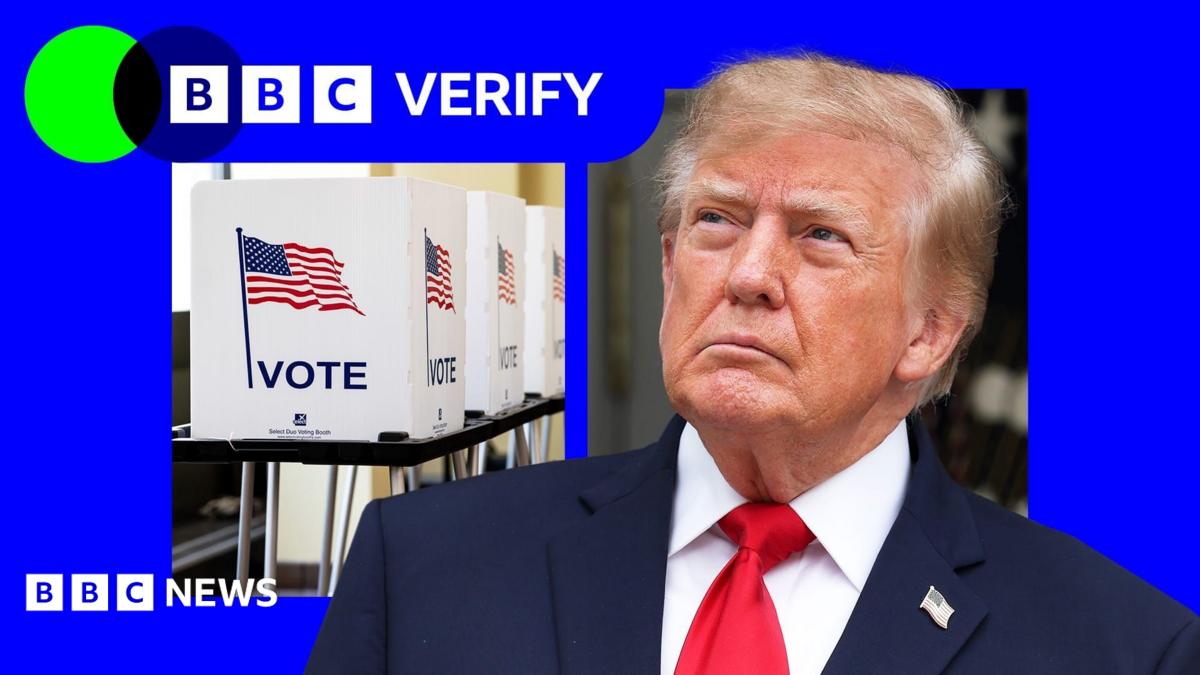
President Donald Trump has offered a $1m (£750,000) reward to people who report cases of voter fraud in the US which lead to a conviction. This was reported by Qazaqyia.kz citing BBC News.
Ahead of the midterm elections on 3 November, Trump has been casting doubt on the security of the vote - alleging "rampant" cheating in postal voting and non-citizens voting. However, studies suggest actual cases of these are extremely rare.
BBC Verify has taken a look at the evidence and Trump's proposed changes to the voting system.
For years, Trump has made repeated unsubstantiated claims that postal voting leads to widespread fraud. He has also encouraged Republicans to vote by mail in the midterms and has said he has cast his ballot by post in the past.
The president has been unsuccessful in his push for Congress to pass an act which would only allow people to vote by mail if they are disabled, ill, serving in the military, or travelling.
The majority of states allow people to vote by mail without having to provide a reason, and in the 2024 presidential election about 48 million people cast postal ballots.
Trump signed an executive order last year which directed the US Postal Service to only deliver ballots to voters on lists of citizens compiled by government agencies. It also sought to require states to use the same envelope style for postal votes.
However, the order was rejected by the US Supreme Court which called such changes so close to the midterm elections "arbitrary and capricious" - but said it could revisit the issue afterwards.
US states have different rules for verifying postal ballots, but every state matches certain voter information on the ballots against what they have on file to check they are eligible and most also conduct signature checks.
Studies of multiple US elections suggest postal vote fraud has been extremely rare.
The Brookings Institution policy research think tank looked at the 2016, 2018, 2020 and 2022 elections and found an average of about four cases of fraud out of every 10 million postal votes.
The report used a database kept by the Heritage Foundation - a think tank which has been aligned with Trump in the past - which records cases of electoral fraud that have ended in a conviction.
We looked back in the database over the last 20 years and found it has tallied 325 convictions as a result of the fraudulent use of postal ballots.
A 2020 study by the American Statistical Association looked at cases of voter fraud in eight states which send postal ballots to all eligible voters and found no evidence that voting by mail increased the risk of voter fraud overall.
For example, according to the study, Oregon recorded 40 fraud cases between 2000 and 2020 having sent out more than 100 million postal ballots over that period.
Trump has claimed non-citizen voting is widespread, and prior to the 2024 election he said Democrats were allowing millions of migrants into the US "so they can vote, vote, vote".
It is illegal for non-citizens to vote in US federal elections - punishments can include a prison sentence, a fine, and deportation.
The voting act the president has pushed Congress to pass would require voters to show a government-issued photo identification before they cast their ballots, as well as proof of citizenship when registering to vote and ongoing citizenship verification.
Critics have raised concerns that stricter voter ID requirements could harm voter turnout as people may not have a passport or the required government-issued photo ID.
"We don't have a national ID card that the government gives out, unlike a lot of countries. Drivers licence is most common but it doesn't identify your immigration status so the ID that most Americans carry around wouldn't be enough for you to vote," says Jonathan Diaz, a voting rights expert at the Campaign Legal Center.
A 2023 survey by the liberal-leaning think tank Brennan Center for Justice suggested that about 21.3 million voting-age American citizens, or about 9%, do not have documents proving citizenship readily available.
However, others argue that there has been no noticeable impact from existing voter ID laws.
"When scholars look at the effect of voter ID laws - either what the conservatives say on fraud or what progressive groups warn against about voter suppression - there doesn't seem to be a lot of proof that either has happened," says Walter Olson, an election expert at the conservative Cato Institute.
A number of largely Republican-run states have tightened voter ID requirements in the last couple of years. There have been 21 restrictive voting laws enacted since the 2024 election to establish stricter ID requirements, according to a study by the Brennan Center for Justice.