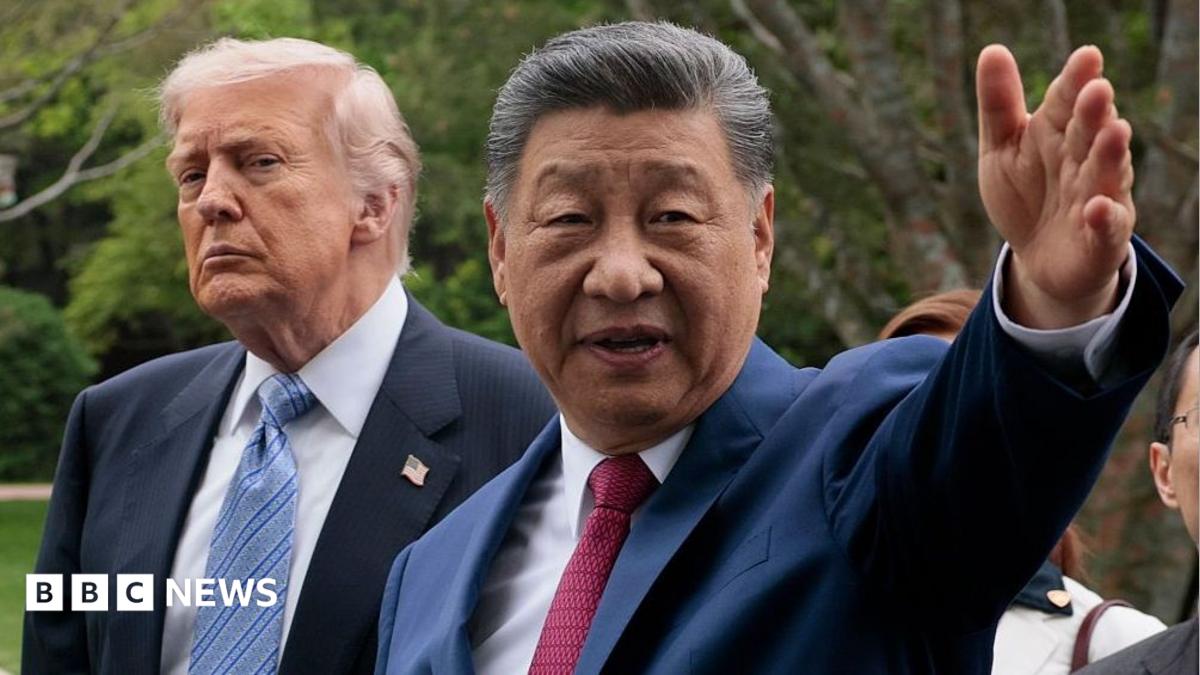
US President Donald Trump has been blunt about his AI ambitions, as well as about who he considers the US's main rival to be: China. This was reported by Qazaqyia.kz citing BBC News.
His Chinese counterpart, Xi Jinping, has not said anything so forthright - but it seems he holds a similar view. "China very much sees it as a race, they very much think China should be the leading force in AI - they see AI as a power maximiser," says Rebecca Arcesati, from the Mercator Institute for China Studies.
AI has been a cornerstone of China's technological ambitions for more than a decade. For Trump, beating China to AI supremacy outweighs any risks of the technology to humans - something he has described as "a hoax". China's foreign ministry warned that "narratives of threat" and confrontation hinder global AI governance, calling for cooperation.
It means when the two presidents sit down on Thursday there will be few more important topics than their AI ambitions - and what they say and decide will matter to the whole world.
There's no doubt the US and China are global leaders in AI but who is ahead depends on how success is measured. American companies lead on so-called frontier models. In February 2025, an AI model by China's DeepSeek "briefly matched the top US model" and as of March 2026, Anthropic's top model led the pack "by just 2.7%", according to researchers at Stanford University.
Part of the US advantage stems from the vast sums being invested in leading AI companies. Another factor limiting China's ability is the sweeping government restrictions placed on US companies that prevent them from selling advanced microchips to Chinese firms.
Despite the chip restrictions, new AI models are coming out almost monthly in both countries. Many companies are racing to develop artificial general intelligence (AGI). The Chinese AI industry has so far focused not on creating frontier models but releasing what is known as open weight models. Chinese open weight models are being released at a rapid pace, with benchmarks showing the country's top models trailing US rivals by only a few months. Models such as Moonshot AI's Kimi K3 have become popular in China and overseas.
Beijing's focus is more about deploying the technology across its economy, China analyst Lizzi Lee from the Asia Society Policy Institute said. "AI isn't the moon landing," she said. "The US may lead at the frontier, while China could still gain enormous economic and geopolitical leverage by making capable AI cheap, open and ubiquitous."
AI is also very energy hungry, and China is very well placed there, Rebecca Arcesati told Tech Life on the BBC World Service. "Chinese AI companies are able to access the electricity they need for a much lower cost and that really is an advantage," she said.
In robotics, China has become the world's biggest manufacturer of robots, with more than two million working in the country's factories, the International Federation of Robotics estimated. The nation is also the world's biggest maker of humanoid robots, accounting for more than nine-tenths of global shipments in the first half of the year, according to Chatham House.
Chinese AI developers have showed "remarkable resilience and innovation" in spite of the shortage of advanced American chips, analyst Lian Jye Su from tech research firm Omdia said.