Donald Trump's immigration policies have become significantly tougher during his second presidential term. This was reported by Qazaqyia.kz citing BBC News.
When he famously stepped onto the golden escalator at Trump Tower to announce his candidacy for his first presidential term in 2015, he accused Mexico of sending drugs and crime north of the border. Immigration has been a constant rallying cry ever since.
Some of his first-term ambitions to stem the flow of would-be immigrants were constrained by the courts. But restraints have been weaker in his second term, with a more accommodating Supreme Court and tens of billions of additional enforcement money from Congress.
Who should be allowed to live in the US remains a big issue on the minds of voters in the upcoming midterm elections, which are largely seen as a referendum on the Trump presidency.
He promised a closed border and mass deportations in his successful 2024 campaign, and few can deny that he's delivered on both. But even among those who voted for a tougher stance, there is a concern that the crackdown has gone too far.
His signature policy has played out in five key ways.
Border crossings plummet
Crossings exploded during Joe Biden's presidency, with over 4.5 million migrant "encounters" recorded at the southern border in 2023 and 2024 alone. This reflected the massive numbers of people headed north to the US border.
His administration eventually brought the monthly figures down significantly by restricting asylum claims and removing migrants entering the US illegally without processing.
When Trump returned to office, that stream of migrants became a trickle. Border encounters plummeted. By the end of Trump's first year in office, the chaotic scenes that had generated headlines around the globe during the Biden administration had largely gone.
On a trip to the border city of El Paso, Texas, in November 2025, for example, the BBC found quiet streets where there had previously been makeshift camps housing thousands of migrants granted parole in the US to await immigration proceedings.
To achieve what he often describes as the "most secure" border in US history, the Trump administration has taken an aggressive, multi-pronged approach. That has included effectively freezing asylum applications at the border, ending "catch and release" of detainees into the US, deploying troops to the border and pressuring Mexico to clamp down on the flow of migrants headed north.
"President Trump promised the American people a secure border, and the data proves he delivered," Homeland Security Secretary Markwayne Mullin said in a statement on 16 October. "The results could not be clearer: strong enforcement works."
Border wall construction accelerates
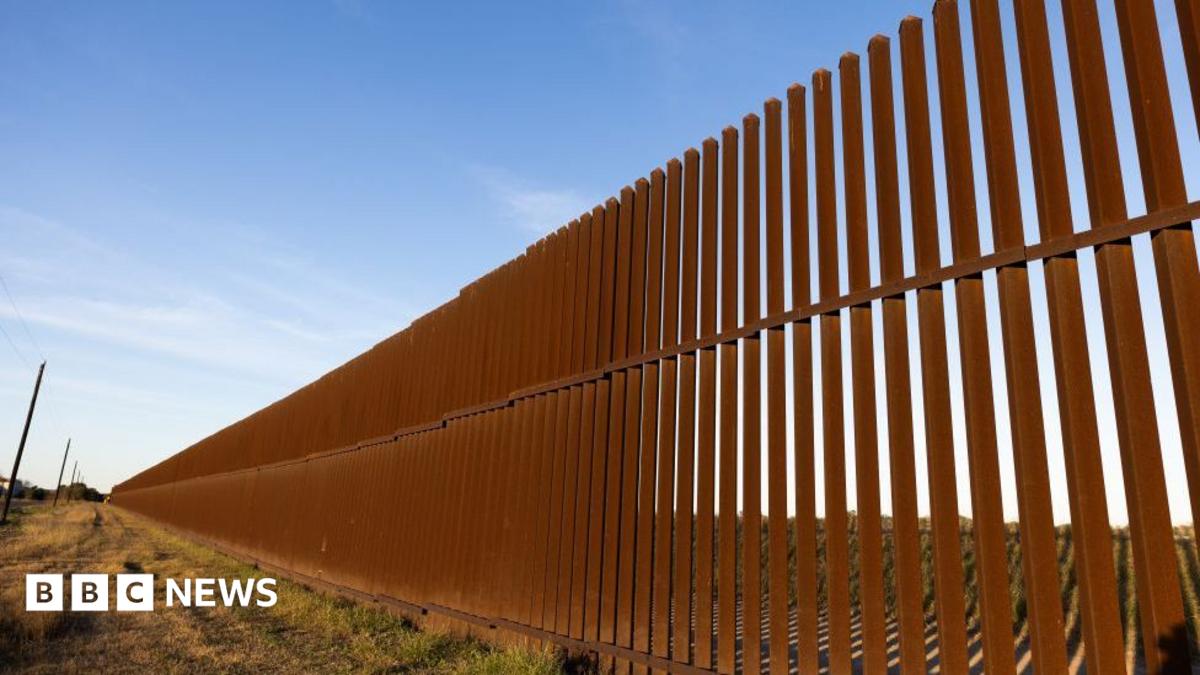
A vow to build a "big, beautiful wall" at the nearly 2,000-mile (3,218km) US-Mexico border was a signature promise of Trump's 2016 campaign.
Progress on it has speeded up in his second term, boosted by $46.5bn (£34.7bn) in new funding from Trump's "One Big Beautiful" spending bill.
According to government figures, about 644 miles of "primary wall" — closest to the border — existed before Trump returned to the White House, in addition to 75 miles of "secondary" wall set slightly further inside the US. Since then, 250 more miles of new wall have been completed, including primary, secondary and waterborne barriers, along with the technology that helps detect illegal crossings. An additional 1,443 miles of barriers are currently under construction.
Experts, however, paint a more complex picture of what has been actually built rather than just improved or updated. Additionally, the impact the wall is itself having on the broader immigration figures is up for debate.
"Since new wall construction has really begun in earnest, there has been no significant change in the number of people crossing the border," said Aaron Reichlin-Melnick, an immigration enforcement expert at the American Immigration Council. There is no indication the border wall has reduced migrant crossings, he added. The reduction has been more down to Trump's policies and messaging.
Trump, for his part, continues to point to the wall as a successful policy and continues to claim that Mexico paid for it.
"I'm the King of the Wall," Trump said at a rally in Kentucky on 17 October. "By the way, Mexico did pay for that wall. I charged them tariffs and I charged them costs like they've never paid in history."
Detentions and deportations rocketing
Most of the headlines generated by Trump's immigration policies have come from the US interior, where operations by Immigrations and Customs Enforcement (ICE) agents to round up people they say are in the US illegally have rocked cities across the country.
During his campaign, Trump promised an immediate start to what he described as the "largest deportation operation in American history", which officials said would begin with people who have committed crimes first.