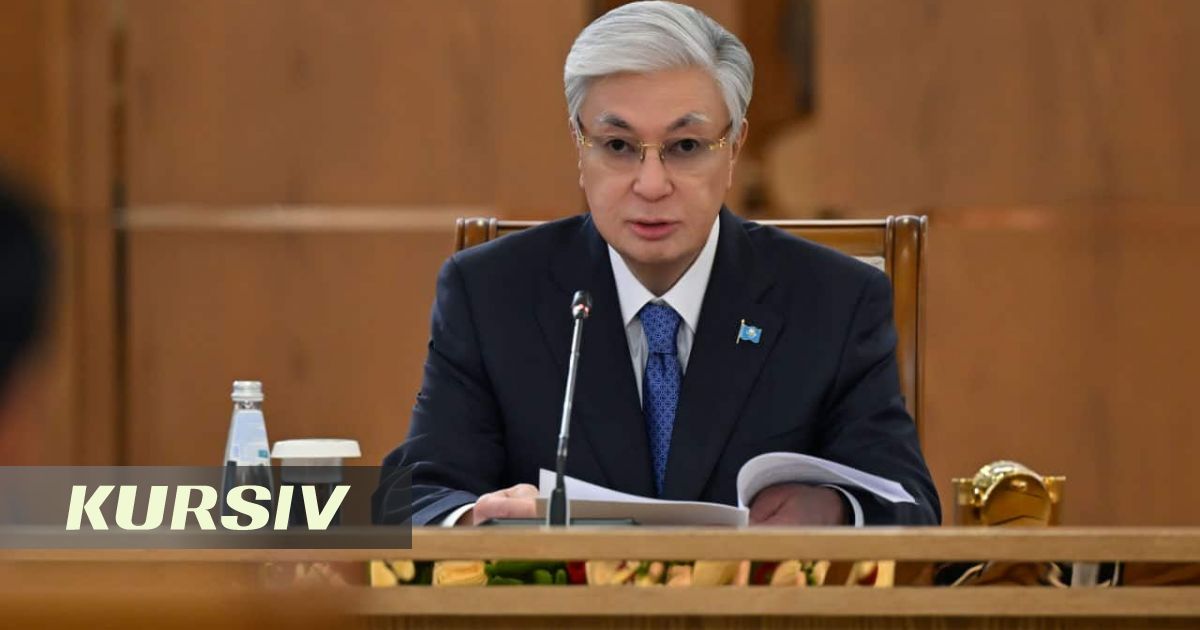
President of Kazakhstan Kassym-Jomart Tokayev believes that large-scale transformations in the country are impossible without changing public consciousness. Not only laws and state institutions must be renewed, but also citizens' attitudes towards responsibility, work, and compliance with rules. This was reported by Qazaqyia.kz citing Kursiv Media.
At the August conference, the head of state stated that the success of reforms directly depends on society's readiness to accept ongoing changes.
"For historical changes that determine the future of our nation to be successful, first of all, public consciousness must be renewed," Tokayev said.
This is not only about education and upbringing. Modernization of public consciousness is considered one of the main conditions for the further development of the state. New opportunities cannot be fully used if they are assessed through old ideas and acting according to habitual patterns.
The publication compared Tokayev's position with the principle of Chinese reformer Deng Xiaoping: "Liberate consciousness, seek truth from practice."
However, this is not about copying China's political or economic model. The history, state structure, and social conditions of the two countries differ significantly. However, Chinese experience shows that large-scale reforms are often preceded by a revision of established ideas.
After the formation of the PRC in 1949, China chose the socialist path of development. However, some political and economic campaigns of the 1950s–1970s led to severe consequences.
The "Great Leap Forward" policy caused a crisis in industry and agriculture, and the "Cultural Revolution" of 1966–1976 weakened education, science, culture, and the system of state administration.
After Mao Zedong's death in 1976, China's leadership faced a choice: continue the previous course or seek new approaches. Reformers led by Deng Xiaoping proposed evaluating decisions not by ideological attitudes, but by their practical results.
In December 1978, Chinese authorities shifted the main emphasis from class struggle to modernization and economic development. The country began creating special economic zones, attracting foreign capital and technology, and introducing new mechanisms for managing agriculture.
Instead of a single "correct" model, the authorities began testing different approaches and retaining those that proved effective in practice. Subsequently, this helped China significantly increase its industrial and economic potential.
The author of the publication calls the habit of expecting the state to solve all problems one of the main obstacles to renewing public consciousness.
Demands are constantly addressed to the government, akimats, and leaders, while citizens' personal responsibility often fades into the background. However, the success of reforms depends not only on the actions of state bodies, but also on society's readiness to participate in transformations.
Another obstacle remains the attitude "it has always been this way." The age of a tradition or habit in itself does not prove its correctness. If society and technology change, outdated management methods must also be revised.
It is impossible to fully use modern technologies while maintaining previous bureaucratic approaches. A similar contradiction arises when the state updates legislation, but citizens continue to follow informal rules.
The third problem remains the desire to solve issues through acquaintances and personal connections. Such practice hinders the strengthening of the principle of equality of all before the law.
A legal state is formed not only through the work of courts, law enforcement agencies, and other institutions. For this, it is necessary that every person recognizes their own duty to comply with the law and refuses attempts to circumvent established rules.
Tokayev assigns special importance to the education system and teachers in changing public consciousness. Technologies can change everyday life, but a person's worldview is largely formed by teachers.
The President previously set the task of developing a new ethics in society based on the principles of law and order, cleanliness, and culture. Among the key values that need to be instilled in young people, he also named patriotism, hard work, and the pursuit of knowledge.
Renewal of consciousness does not mean imposing new attitudes on citizens from above. It implies that a person independently revises their habitual way of thinking.
Along with the question "What should the state do for me?", citizens are encouraged to think more often about what they themselves can give to society and the country.
Laws and state structures can be changed relatively quickly, and for economic development, enterprises can be built and technologies introduced. However, without people's readiness to accept new rules, even large-scale reforms risk remaining incomplete.