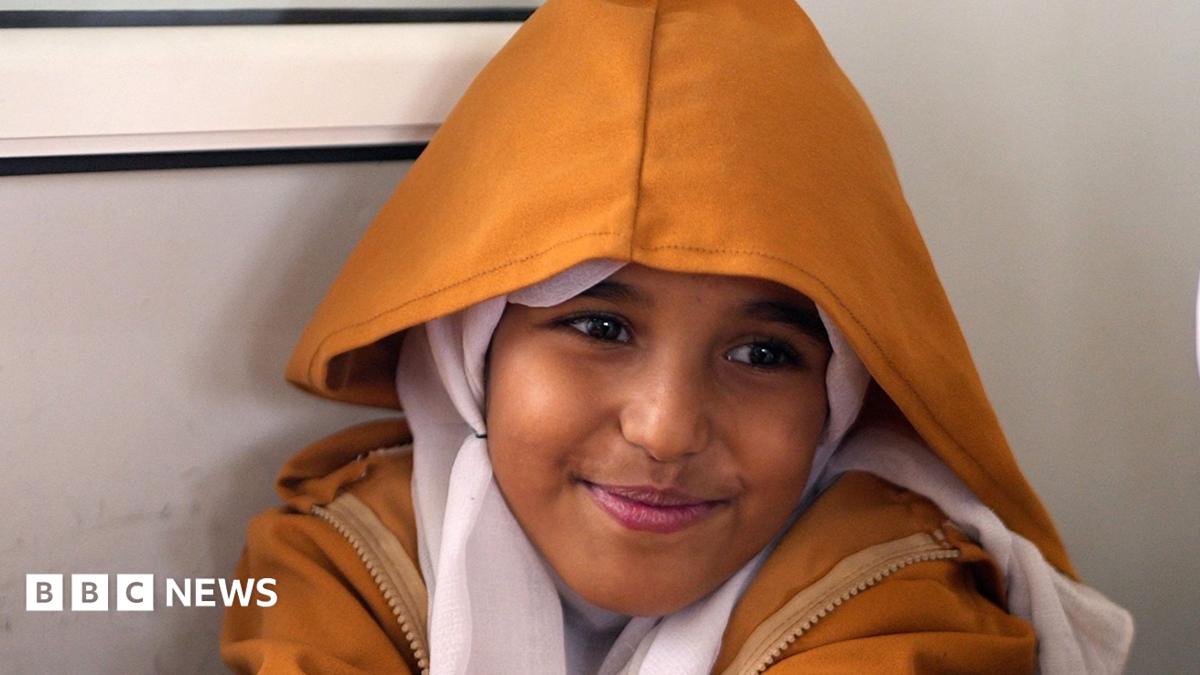
Every morning at 6am, 10-year-old Rafeef and her younger brother get ready for school, putting on their cream and brown uniforms. This was reported by Qazaqyia.kz citing BBC News.
She always looks forward to seeing her friends and learning about everything from maths to Arabic and Islamic studies. She can't wait to start studying English next year.
But for Rafeef, the journey to school involves far greater risks than crossing roads or missing the bus.
Her school in Taiz, south-western Yemen, stands on a mountain at the edge of a valley known as no-man's land - a heavily contested front line in the civil war between forces supporting Yemen's internationally recognised government, which is backed by Saudi Arabia, and the Iran-backed Houthis.
On one side of the school is government-held territory, on the other are Houthi sniper positions.
Rafeef's home is further down the mountain. Every time she goes to school, she has to walk uphill with her back towards the snipers. "I'm afraid," she says.
According to Unicef, roughly 3.2 million children in Yemen were out of school even before the war escalated last month. It says thousands of children have been killed or maimed since the war began in 2014, while thousands more have been recruited by armed groups on both sides.
Yet despite the risks, Rafeef says she does not want to stop going because she loves seeing her friends and it is her only chance to be with them. She begins naming the children in her classroom.
Going to school is the only time Rafeef's parents let her go outside. They say they are keen for her to get an education and have the chance of a better life. Rafeef hopes to become a doctor.
Rafeef's family moved to Taiz from the coastal city of Hudaydah nine years ago, seeking safety when Houthis took control there.
Rafeef says that two years ago there was a mortar attack outside her new home. "Everyone was out except for me and my brother. Then a mortar came out of nowhere… shrapnel blew through the door and into the house." Her arm was broken and there is still a scar where she was hit.
And in recent days the conflict has intensified. On Sunday the Houthis cut off a vital supply route linking Taiz to Aden, which meant they were able to effectively encircle Taiz. Control of that route has kept shifting.
Residents have told the BBC they are afraid the Houthis could seize the city at any moment.
Government forces have made gains in other areas this week, they say, retaking control of strategic points on the Bab al-Mandab Strait - a key shipping chokepoint - and launching an offensive to try to regain control of the capital, Sanaa.
Homes in Taiz are mostly scattered across the slopes, but many have been abandoned by families fleeing the fighting.
Twice, we try to visit the neighbourhood where Rafeef and her family live, but a community leader advises us it is too dangerous.
On the first occasion, residents of the neighbourhood tell us that three people have been shot by snipers. On the second, we are told of another shooting.
At Rafeef's school, one of the teachers, Abdel Raqeeb al-Obaidi, 45, takes us on to the rooftop to show us what he says are Houthi military camps, barracks and sniper positions in the mountains.
Standing on the rooftop, a Yemeni security adviser accompanying us suddenly tells us to go back inside. We are visible from these positions and could be shot, he says.
Abdel Raqeeb laughs, acknowledging the danger. He says the school has been fired on before. "The situation may explode at any moment while we are sitting in class or sleeping or we are in school or we are out on the street. We do not know how our future is and how tomorrow is."
For Abdel Raqeeb, the risk has become routine. His familiarity with it is unsettling.