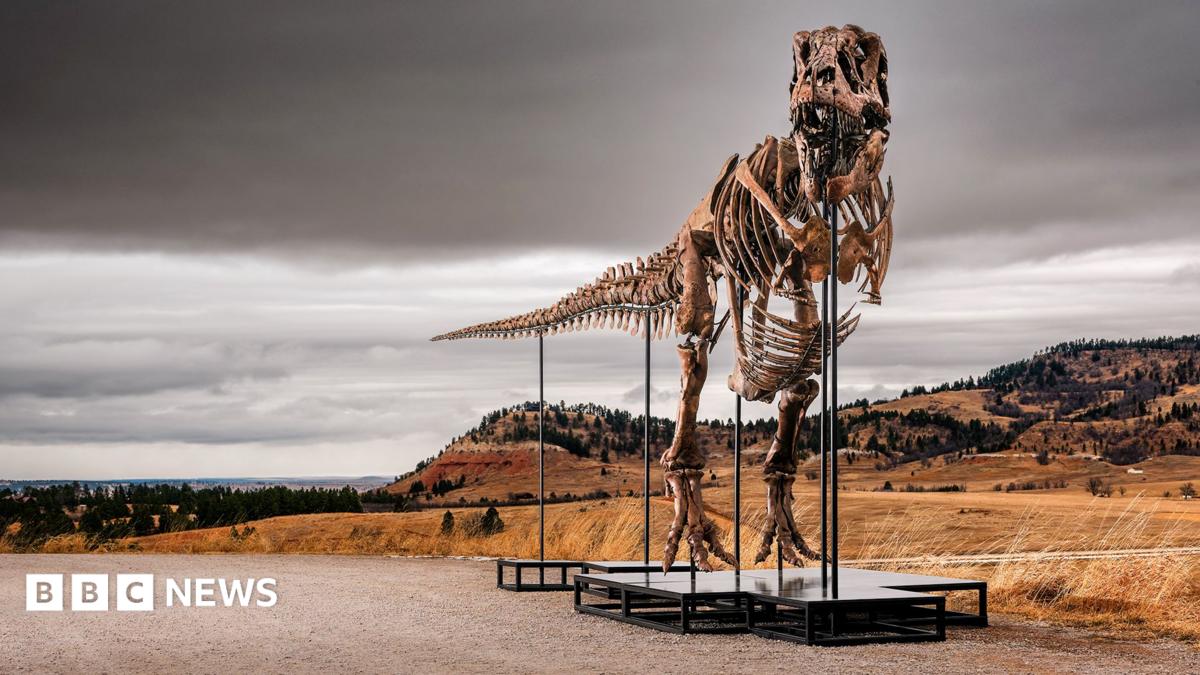
Tyrannosaurus rex Gus could become the most expensive fossil ever sold, but it's a problem for scientists. This was reported by Qazaqyia.kz citing BBC News.
In 1997, Sotheby's hosted its first natural history auction selling fossils and other wonders of our prehistoric world. It was a niche event mostly attended by the world's museums looking for specimens to add to their collections. On the books that day was a Tyrannosaurus Rex called Sue - she was eventually sold for $8m (£6m) to the Field Museum in Chicago.
Nearly 30 years later, on Tuesday, another T. rex will make an appearance at the annual auction - one of the most complete specimens of this kind ever found. And this time it is not just scientists who are dinosaur-hunting but also the super-rich. The new specimen, known as Gus, has already been valued at $30m but it could fetch more, possibly even becoming the most expensive dinosaur ever sold.
It adds to a growing debate in the natural history world – should specimens of such scientific importance be reserved for museums and their scientists? Or - as auctioneers would argue - should fossil hunters be rewarded for their discovery of dinosaurs lost to science and saving them from a second extinction?
Cassandra Hatton, global head of natural history at Sotheby's, knows very well the lengths some fossil scientists - palaeontologists - are willing to go to in the search for these creatures. And for many of these hunters, the ultimate prize is the Tyrannosaurus Rex. This dinosaur that lived millions of years ago hardly needs describing, having been immortalised in our culture by appearances in films like King Kong and Jurassic Park, and as the namesake of an English rock band.
"The people that look for these fossils will spend months out in the field with tents and their food in their backpacks and they're camping out in the middle of nowhere with the rattlesnakes and the bugs and the mountain lions," she explains. This is South Dakota - Badlands country - where Gus was eventually discovered 67 million years after roaming our planet.
But finding it is almost the easy part, explains Dr Fiann Smithwick, an independent palaeontologist who has been collecting and preserving fossils for the past 20 years. "Suddenly when they're out of the ground, they're out of equilibrium, and that normally means they start to decay, fall apart." Thomas Heitkamp and the team that discovered Gus - named after the late Gary "Gus" Licking, a cattle rancher whose land it was found on - spent three years carefully excavating. "But it's not the full year," Cassandra Hatton explains. "You can only dig during the field season. So you have to wait till the ground has thawed. And then you are furiously digging until the ground freezes again [in September]."
In 2023, the dig was complete, but the team was only halfway through the recovery process. They then spent a further three years documenting and reconstructing the T. rex back in the lab. Tuesday's auction will be a payday that has been a long time coming for the team, and could be the biggest yet. Gus has the highest pre-sale valuation at $30m. The record for a dinosaur auction is currently held by Apex, a Stegosaurus sold by Sotheby's in 2024 for $44.6m - but that was 11 times what it had originally been valued at going into the auction. If you are inclined to put a bid in this time, your starting offer cannot be lower than $19m.
For some of the oldest and largest museums in the world dealing in fossils, even this is out of reach. "We're already priced out of having access to many, many specimens," explains Prof Susannah Maidment, dinosaur researcher at London's Natural History Museum (NHM). The five most expensive dinosaurs sold at auction have all been since 2020, including Stan a T. rex sold for $31.8m in 2020 - the guide price had been $6-8m. And this, she says, is "really problematic". "There's no substitute for having the real fossil. If we're going to do any sort of study, the number one thing is we need to understand the anatomy. We need to know what's real," Prof Maidment explains.