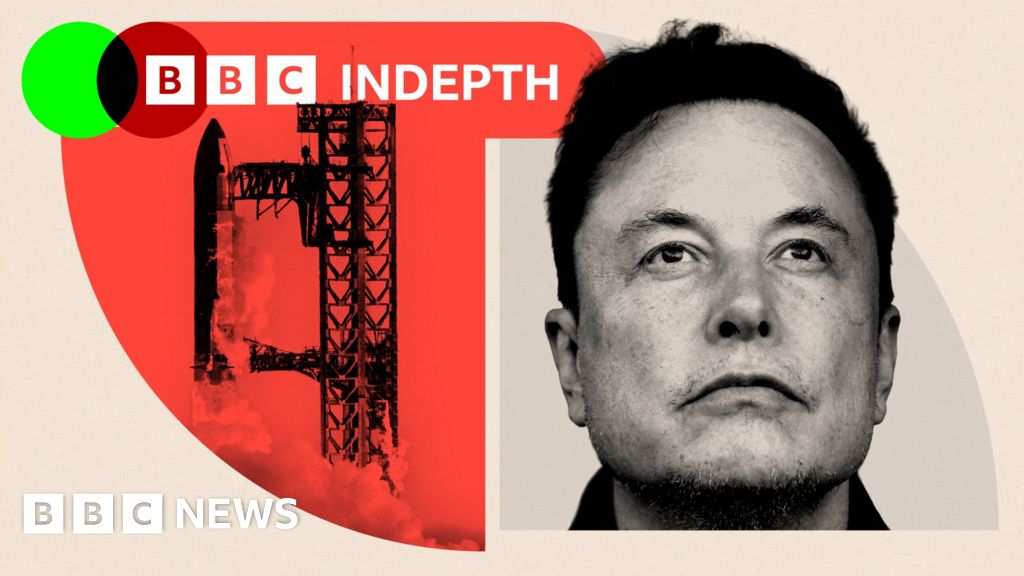
At 07:25 am, 13 October 2024, at Starbase, near Boca Chica on the Texas side of the US/Mexico border, on the launch pad stands the biggest rocket ever made. Its engines fire and it climbs into the skies over the Gulf of Mexico to cheers and screams in the SpaceX control room. But the launch is not the main event. Seven minutes later, the massive rocket booster that blasted the craft towards space starts falling back to Earth – until its engines reignite as planned. It slows its descent and guides itself with pinpoint precision so it can be captured by a clasp called Mechazilla, or "the chopsticks", by engineers who have achieved something that's never been done before. This was reported by Qazaqyia.kz citing BBC News.
Amid the whoops and high-fives in SpaceX's control room, Elon Musk tells his millions of social media followers that this is a "big step towards making life multiplanetary" - a reusable rocket that will slash the costs of launching things into orbit, to the Moon and one day to Mars.
On 12 June, trading will begin in a chunk of shares in a company that, up to now, only Musk and a select group of rich private institutions have been able or invited to own. More than one UK stockbroker has told the BBC that there has been "a surge" in interest in signing up for the chance to buy shares. UK retail investors are likely to be allocated around £1.5bn worth of shares. Simon Belsham, Chief Client Officer at Hargreaves Lansdown said: "While we recognise this IPO might not be right for everyone, it's an exciting moment for many of our clients. We're expecting this might be a first foray into investing for many."
The chance for normal Earthlings to buy shares in SpaceX is one of the most important moments in the history of stock markets and will almost certainly make Elon Musk the world's first ever trillionaire. On the first few pages of the prospectus is this modest mission statement: "To build the systems and technologies necessary to make life multiplanetary, to understand the true nature of the universe and to extend the light of consciousness to the stars."
But SpaceX isn't just about rockets – it's a bet on the future of artificial intelligence (AI). The success or failure of its imminent partial sale to the public is an important test of investor optimism that AI will hoover up large parts of the world economy. SpaceX is valued at $1.75trn, putting it comfortably in the top 10 most valuable companies on Earth. That is a staggering valuation for a company that lost nearly $5bn last year.
SpaceX is in fact several businesses in one company. It designs rockets as well as manufacturing and launching its own and other people's satellites. Its launch capabilities dwarf that of any other company – or indeed country on Earth. Its Starlink communications network has proven to have crucial geopolitical importance during Ukraine's defence against the Russian invasion. But even the most optimistic estimates value this part of SpaceX at around $300bn - less than 20% of SpaceX's $1.75trn target valuation.
The real bet is on AI because bundled into SpaceX is Elon Musk's AI company xAI, along with plans to create data centres in space and human-crewed bases on the Moon and Mars. Of the $28.5trn market that SpaceX has identified for its services, $26.5trn of that is in AI. To believe that, you need to believe that the AI industry will be comparable in size to the entire economy of the United States or all of Europe. Many think this is Musk's Icarus moment. "I think it's an Elon Musk ego project," says Sinead O'Sullivan, an economist who has worked for Nasa in the past.