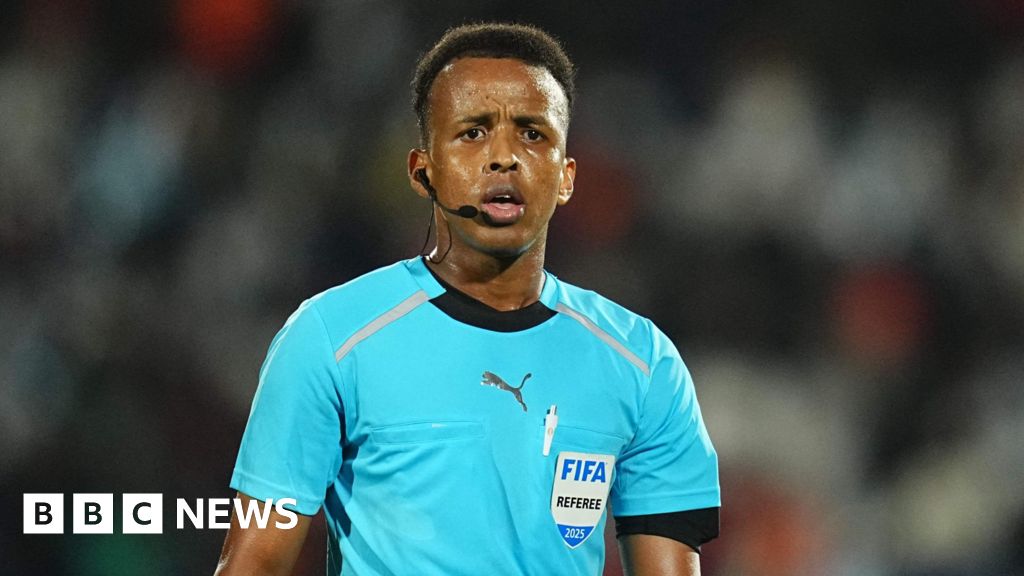
FIFA referee Omar Artan has been denied the opportunity to officiate at the 2026 World Cup after being refused entry to the United States. This was reported by Qazaqyia.kz citing BBC News.
The 34-year-old Somali was set to become the first man from his country to play an on-pitch role at the finals, but was turned away by border officials in Miami despite holding a diplomatic passport and a single-entry US visa.
"Every referee's ambition is to go to the World Cup," Artan told BBC Somali in an interview before leaving home. "When you are selected, you feel that all your hard work was worth it. It was a moment where everything came into focus."
Artan, who was named the best male referee in Africa last year and officiated two matches at the recent Africa Cup of Nations (Afcon), had been hailed as "a symbol of inspiration for the new generation of Somalis" by President Hassan Mohamud after being included in the list of FIFA match officials.
The Somali government is mounting diplomatic efforts to resolve the issue, but Artan looks set to be excluded from the World Cup after rising through the officiating ranks in a country troubled by conflict in recent decades.
The US State Department told BBC Africa that it welcomes "legitimate travellers" to the World Cup and adjudicates each visa application on a case-by-case basis "after rigorous review and thorough vetting." It also cited "national security and public safety" as other factors in their visa process.
For now Artan remains in Istanbul, Turkey's largest city, following his removal from US soil, but it is believed he will return to Mogadishu, Somalia's capital, on Wednesday.
Artan's refereeing career began in Mogadishu on neighbourhood pitches after a leg injury ended his playing days. He unexpectedly first picked up a whistle during a local match when a dispute over the referee prompted players from both sides to ask him to take over. He accepted and remained in the role.
Artan went on to officiate in organised competitions in the city, although much of his early development came while overseeing informal and semi-organised fixtures. A key influence was Osman Jama Dirac, the former head of referees in Somalia, who provided technical guidance and personal support during a period when Somali football operated with limited institutional structure and little international exposure.
"He was like a father to us," Artan said. "He did not just lead referees, he took care of us. If you were in Mogadishu and had nothing, he would make sure you ate, he would take you to a restaurant."
However, Dirac was killed in August 2017. Artan spoke of the timing with restraint: "He was preparing me to become an international [referee]. He would have been proud to see a Somali reaching this level."
Artan became a FIFA-listed referee in 2018 and steadily moved through the African game, overseeing high-profile continental fixtures. In January 2024, he became the first Somali to referee at an Afcon game, taking charge of the Group E match between Tunisia and Namibia. He was recognised by the Confederation of African Football (Caf) as its top male official in November, before being appointed to oversee the second leg of the African Champions League final last month.
In April, praise came from President Mohamud after Artan was named among the 52 referees for the World Cup: "I commend the effort, professionalism, and integrity shown by referee Omar."
It was a proud moment for Artan, who knew it was a milestone achievement: "My family, Somali people, the federation and young referees all shared that feeling. It became hope for them that a Somali referee can reach that level."
In the months leading up to the tournament, Artan described an intensive preparation routine: "Every morning I was on the pitch. Preparation for the World Cup is not small work... physically, mentally, and in knowledge. In World Cup football you are dealing with world-class referees at the highest level. You have to reach that standard and stay there."