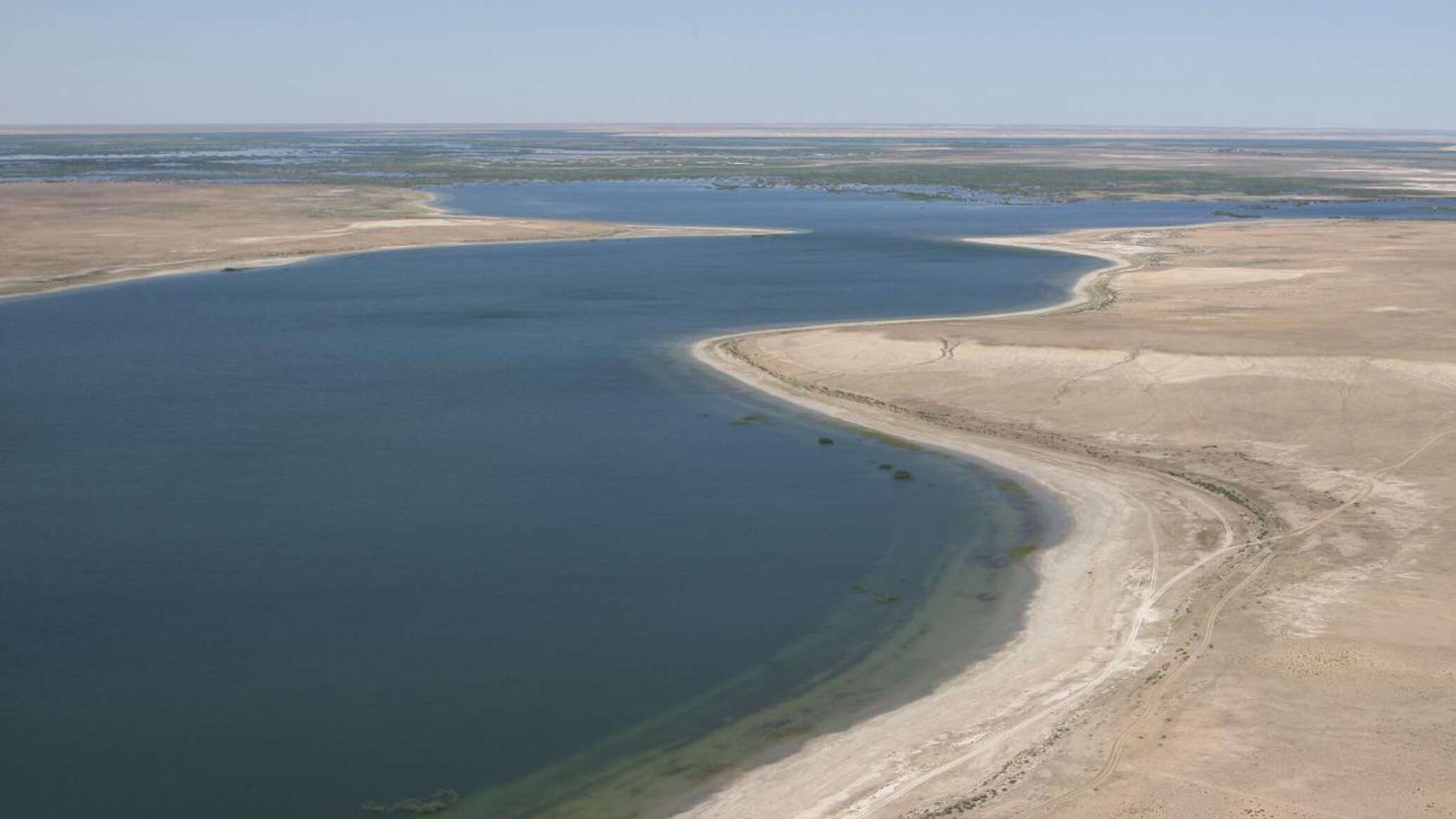
Water volume in the North Aral Sea has reached 23.4 billion cubic meters. This was reported by Qazaqyia.kz citing Sputnik Kazakhstan.
Over more than 20 years, the area of the North Aral Sea has increased by 36%, water volume has nearly doubled, and mineralization levels have halved. This has contributed to the recovery of living organisms and the ecosystem of the water body.
"In order to maintain the achieved indicators, the Ministry of Water Resources and Irrigation annually sends at least 2 billion cubic meters of water through the Syr Darya riverbed," the statement said.
The government, together with the World Bank, has developed the next stage of restoration of the North Aral Sea.
"The project envisages reconstruction of the Kokaral dam and raising the water level to 44 meters under the Baltic system. Over the next 5–6 years, it is planned to increase the water area to 3,900 km² and the water volume to 34 billion m³," experts say.
To date, 3,400 tons of saxaul seeds and halophyte plants have been sown on the bottom of the Aral Sea, and 56.2 million saxaul seedlings have been planted. The total volume of forest reclamation work has reached 1.1 million hectares.
To provide scientific support for the work carried out in the region, a branch of the Kazakh Research Institute of Forestry and Agroforestry has been established. In addition, a separate base for growing planting material is being formed: construction of a 33-hectare forest nursery capable of producing 3 million seedlings per year has been completed. A forest nursery is also being created on the dried bottom of the Aral Sea.
Kazakhstan is also strengthening scientific and interstate cooperation on preserving the Caspian Sea. Every year, 130 rivers flow into the Caspian Sea, bringing an average of 290 km³ of water. The bulk of it belongs to the Volga River – about 80%, while the share of the Ural is 3.5%.
The project "Enhancing Resilience under the Conditions of Caspian Sea Level Decline," implemented with the support of the Government of Japan, has been launched. The project envisages the use of scientific data and digital tools to assess and mitigate the consequences of the Caspian Sea shallowing.
Together with the UN Development Programme and international partners, a set of projects is being developed aimed at managing marine and coastal resources, developing a circular economy, improving the waste management system, and reducing pollution from plastic waste.