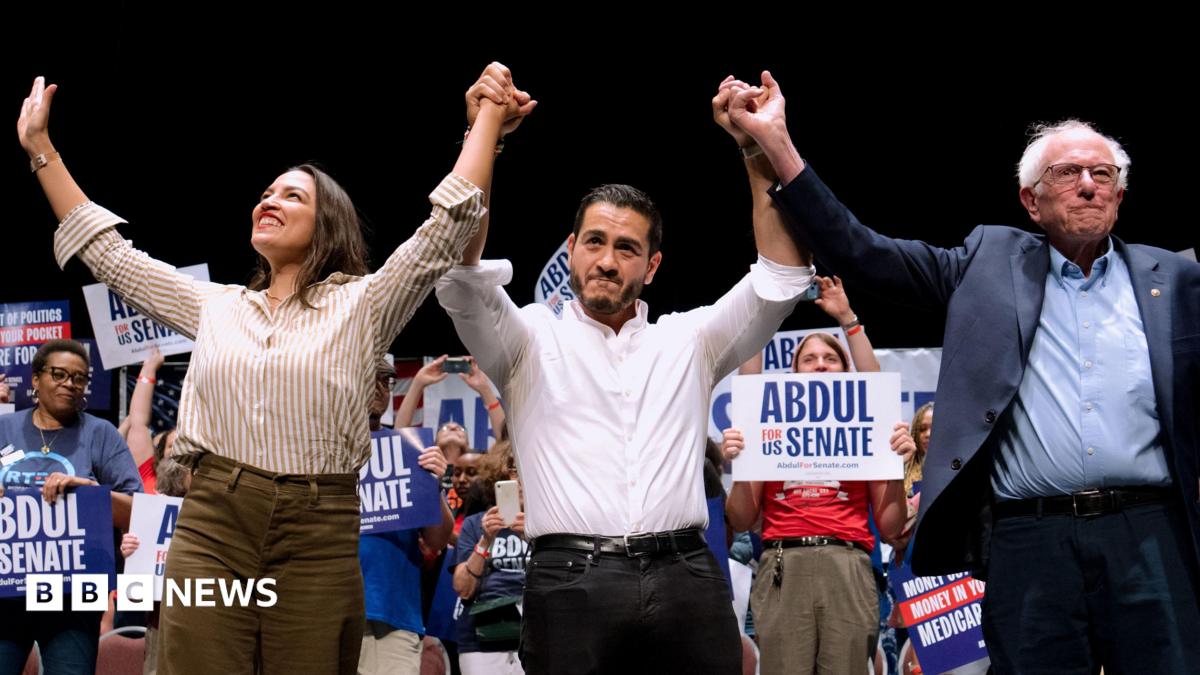
On a Saturday evening in Michigan, the skies still hazy from drifting Canadian wildfire smoke, hundreds of voters packed into Detroit's opulent 104-year-old Opera House, rising from their seats to cheer loudly as Senator Bernie Sanders and Democratic Representative Alexandria Ocasio-Cortez took the stage. This was reported by Qazaqyia.kz citing BBC News.
As two of the leading figures on the American left, Ocasio-Cortez and Sanders were there to champion Senate hopeful Abdul El-Sayed - a doctor running on a platform of universal healthcare. His supporters carried signs with El-Sayed's slogan "Medicare for All", and wore shirts urging the end of immigration enforcement and US aid to Israel.
But they were not the only ones tuning in. Voters and politicians across the country are watching to see if El-Sayed can earn the Democratic nomination to run for Senate in November's midterm elections. His opponent - Congresswoman Haley Stevens - is an experienced politician with deep pockets, thanks in part to large corporate campaign donations. The two represent the divisions within the Democratic Party as it seeks to take back control of Congress. On one side is the centrist establishment, backed by traditional power players. On the other is the left wing of the party, exemplified by Sanders and Ocasio-Cortez as well as New York City Mayor Zohran Mamdani.
But while left-wing Democrats have seen a wave of victories during this summer's primaries - including in New York and Colorado - what remains to be seen is if they can claw back support from disillusioned working-class voters, who flocked to President Donald Trump in 2024. In Michigan - which voted for Democrat Joe Biden in 2020 but Trump four years later - the open Senate seat is a must-win for Democrats. The seat had been held by one of their own, and if the party hopes to make gains in the Senate, and halt Trump's agenda, they will need to keep a hold of it. Whoever wins the primary on 4 August will be competing against Trump ally Mike Rogers come 3 November.
At Saturday's rally, some in the crowd felt hopeful, as Ocasio-Cortez promised El-Sayed represented the "politics of the future". But miles outside the venue, other voters were less certain of his ability to beat Stevens - or to secure a victory for the Democrats by touting policies like healthcare for all and staunch opposition to Israel's military campaign in Gaza. "This may not be the moment for progressives," said Colleen Houlihan, a 74-year-old from Ferndale, Michigan who is likely voting for Stevens. "I want radical change in the country, but we've got to start with this administration and it's got to be an electable candidate to get power back in sane hands."
El-Sayed is locked in a tight race against Stevens, a moderate Democrat who has pitched herself as the more experienced congresswoman and earned the endorsement of Michigan's governor Gretchen Whitmer as well as outgoing Senator Gary Peters. It is not the only test of progressive power in a midwestern battleground state, as self-described Democratic socialist Francesca Hong attempts to secure a win in the governor's race in neighbouring Wisconsin just a week later. Some political experts and voters questioned whether the current momentum would be enough to win over voters in the politically diverse, and historically working-class, midwest. "They got a big win electing Mamdani mayor of New York City, but also, it's New York City," said Adrian Hemond, a political strategist in Michigan. "They have been much less able to win in some more traditionally purple areas."
On a humid morning before Saturday's rally, Corie Johnson was knocking on voters' doors for the first time in her life. The 35-year-old has always voted for Democrats, but said El-Sayed is the first candidate she has felt excited about. "We're not so stuck in our ways," she said of millennial voters. "I think that's why he's gaining so much momentum." Walking by the rowhouses on the streets of Hamtramck, a small town within Detroit, Johnson and her fellow canvassers were attempting to carry on a pitch they had heard from El-Sayed in a meeting just moments before. "Money out of politics, money in pockets, Medicare for all," El-Sayed and his group of volunteers chanted together in the campaign's Detroit office.
The former Wayne County health director's policy plans - including universal healthcare and an annual wealth tax on billionaires - represent a pivot for a Democratic Party that has seen one of its lowest favourability ratings in recent years. In 2025, the number of Democrats who viewed their own party positively fell by 12% to 67%, according to a Gallup poll. Despite his left-wing stances, El-Sayed has avoided the label claimed by many of his peers: Democratic socialist. But he is still taking lessons from their wins, especially Mamdani, whose social media skills and laser focus on affordability helped propel him to victory in New York. El-Sayed's affordability platform - including his focus on health insurance - is why Les Lukacs of Monroe, Michigan, is voting for him. The longstanding Democrat who does not have health insurance said he would not vote for Stevens in November if El-Sayed lost the primary. "We can barely afford groceries and gas," he said. "I have to make sacrifices - and healthcare is one of them."
Polling from the last year suggests healthcare costs remain among the top issues for voters in the November midterms, alongside the rising cost of gas, groceries and housing. El-Sayed told the BBC that the Democratic Party must fight for voters' attention.