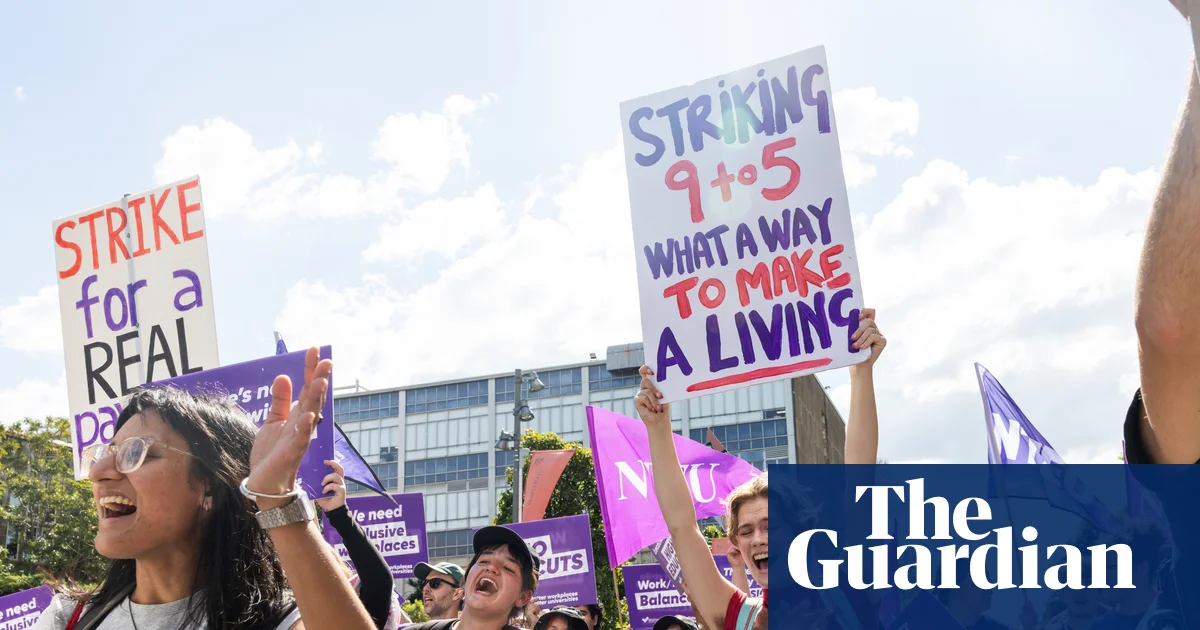
Thousands of University of Sydney staff walked off the job for 24 hours, demanding stronger protections around the use of artificial intelligence and job security. This was reported by Qazaqyia.kz citing The Guardian.
The strike involved around 2,000 members. From 7am, about 500 people were stationed at picket lines at each entrance of the inner Sydney campus, armed with flags, banners and megaphones. The university advised students that "almost all" scheduled classes would move online, while others were rescheduled or cancelled.
Trust issues
According to an internal survey conducted before the strike, in the faculty of arts and social sciences, 0% agreed with the statement: "I trust the University of Sydney to act in the best interests of staff, students and the broader community." This lack of trust, along with longstanding concerns over staff protections from AI, workload fairness and job security, prompted the strike.
Peter Chen, branch president of the National Tertiary Education Union (NTEU) at the University of Sydney, said management had rebuffed the union "at every opportunity" to enforce appropriate protections around AI use.
"Higher education is the canary in the coalmine," he said. "Where we go on AI … will travel through the rest of the economy."
Union demands
Vince Caughley, NSW division secretary of the NTEU, noted that the university's own green paper described AI as the most "fundamental transformation" education had seen, pointing to AI chatbots already used to teach online-only classes at other universities.
"We are asking for best practice, we are asking for due diligence," he said. "Not their own commercialisation aims and certainly not the interest of venture capital."
The union was confident it would reach an agreement with management within the year but had concerns over the lack of senior leadership at the table, including the provost, Prof Annamarie Jagose. The last bargaining process represented the longest running industrial action at an Australian university, and the prospect of future strikes remained active.
University response
A spokesperson for the University of Sydney said it was "continuing to engage" with the union and maintained industrial action was "premature."
"We agree using AI ethically requires a human-centred approach, and our … principles and guardrails that govern use have been developed in consultation with our community," they said.
"We support many of the objectives of the unions' claims, but believe it's more appropriate to implement many of these through relevant policies, instead of in the Enterprise Agreement."
Broader concerns
There are broader concerns, some interlinked and widespread in the sector: growing class sizes and reduced student satisfaction, and a new proposal for teaching-only roles with no research component or scope for future growth.
Prof Laura Shepherd from the school of social and political sciences, part of the bargaining team, said students often sacrificed a "huge amount" to come to the university, including spending $50,000 on degrees.
"They come here … for quality and access to research leaders," she said. "I think we should be very ashamed if we allow anything in the enterprise agreement that threatens that."
Protests
The University of Sydney's NTEU branch is the largest in Australia, and the university has long been a hotbed for activism. As management approaches its fifth month of bargaining, it also grapples with continued opposition to its response to Gaza and restrictions on protest.
New restrictions were introduced following the university's pro-Palestine encampment in 2024, which received intense scrutiny during this year's royal commission. On Wednesday, keffiyehs and pro-Palestine banners stood out among purple NTEU flags and signage.
The Student Representative Council was also striking in solidarity with staff and picketing online classes. Its education officer, Dana Kafina, said the university's "draconian" protest restrictions were a motivation.
"In the wake of … suppressions of free speech and activism, and some of the lowest rates of student and graduate satisfaction in the country, we have had enough," she said.
Despite the presence of campus security and police, the picket lines had a jovial atmosphere. Some blasted music on speakers, others banged drums and chanted with abandon.
Kurt Iveson, a professor of geography, was among them, running a quiz on his megaphone. He has been with the university for 20 years and wants AI protections that ensure "the tech is serving our purpose, rather than us serving the tech."