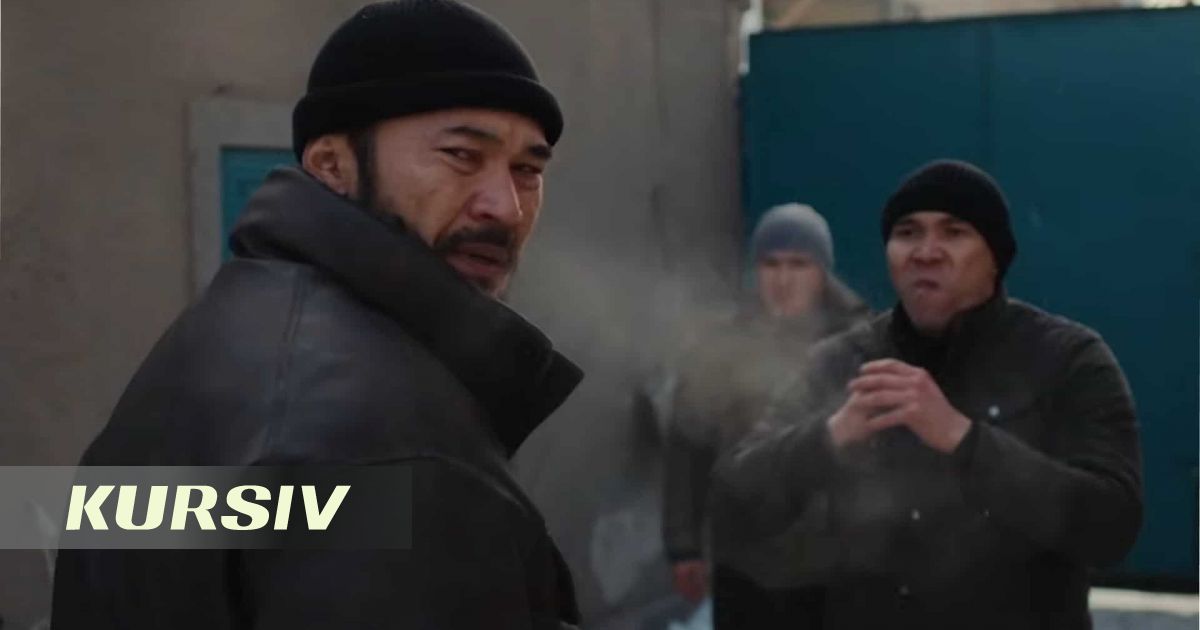
A new action film, Shymyr, is now showing in Kazakhstan. It tells the story of a mysterious tractor driver who dispenses justice. The screenplay was written by Adilkhan Yerzhanov, but unusually, the director's chair was taken by someone else: Anvar Matzhanov, the author of the hit comedy Taptym-au Seni and the melodrama Perishte. Although the action unfolds outside the village of Karatas, Yerzhanov's recognizable style is immediately apparent. The film easily reveals the hallmarks of his favorite genre, the western, and the protagonist joins a gallery of taciturn, genuinely dangerous characters who follow their own moral code. How Matzhanov handled transferring the plot to the screen and where the trick of Shymyr lies is explored in a Kursiv review. This was reported by Qazaqyia.kz citing Kursiv Media.
Plot: From Tractor Driver to Avenger
The sullen tractor driver Shymyr (Yerkebulan Daiyrov) travels from his village to the city to buy spare parts from an old army friend, Yeldos (Yermek Bektasov). Yeldos is in serious trouble: he has lost heavily gambling and now owes a lot of money to gangsters. In desperation, Yeldos tries to hang himself, and a criminal gang breaks into his house to take his 15-year-old daughter, Aisulu (Alau Kairatkyzy). Shymyr steps between them, but the girl is still kidnapped and handed over to the criminal authority Sanzhar (Azamat Satybaldy), for whom even the police work. The hero turns out to be the only one who can save Aisulu, especially since he has a personal score to settle with Sanzhar. On his path, Shymyr meets Leila (Akbota-Nur), a prostitute with a flighty character but a heart of gold, and soon the lives of their offenders predictably turn into hell.
From Karatas to Almaty: From Yerzhanov to Matzhanov
The plot, which has evidently relocated from the cult Karatas village, lands in a much more concrete and real urban environment—that of Almaty (in one frame, for example, the Kazakhstan Hotel is prominently featured). At the same time, it passed from the hands of screenwriter Adilkhan Yerzhanov, who wrote it together with Ainur Mubarova and Kuanysh Tokhanov, to director Anvar Matzhanov. Somewhere in the mind, a comparison automatically arises with Quentin Tarantino entrusting his new story about Cliff Booth to David Fincher, although the Kazakh favorite of world film festivals, who manages to release several works a year, is hardly constrained by the same strict rule regarding the total number of his films. But in the end, the traditionally intricately woven Yerzhanov text, in which, as usual, revenge and violence intertwine with love and justice, received a decent, engaging embodiment on screen from Matzhanov, who had previously dealt mainly with comedies and melodramas that, it should be noted, brought in very good box office.
Social Texture and Mythology
In Shymyr, a thoroughly recognizable social and everyday texture (the source of misfortune here is betting shops, from whose deadly embrace it is almost impossible to escape) is combined with sweeping mythological content. The title character himself, not without reason deprived of even a name (Shymyr is merely a nickname) and endowed with a vague military past with a medal for courage, embodies another iteration of either a knight without fear or an unkillable terminator, as one of the gangsters darkly jokes. The instrument of retribution in his proletarian hands (there is a temptation to compare him with Jason Statham, who has tried a number of professions on screen, from builder to beekeeper, but invariably returns to his main "business") becomes an impressive-sized wrench, which upon the first clash with opponents is stained with their blood, stubbornly rushing out even through the blur made for cinema release in some scenes.
Genre Remix and Gender Trick
The film can be viewed as an honest, clearly made action movie without unnecessary pretensions (unlike other works by Yerzhanov, there are no complex quotes from Hamlet, as in Turgaud, or Machiavelli's The Prince, which illustrated the plot in Goliat, although it is still difficult to resist symbolism altogether—for example, the corrupt policemen are named Adilet and Miras), and at the same time as a solid genre remix with nods to Oldboy and John Wick, and finally as a parable about the eternal confrontation between good and evil. Matzhanov quite skillfully guides viewers through a criminal-urban hell, seasoned not only with a good portion of action scenes staged by Nomad Stunts, but also with unexpected yet entirely appropriate humor.
It is precisely for this humor that Akbota-Nur is responsible in Shymyr, playing the brothel worker Leila, who gradually transforms from a damsel in distress into, if not a savior, then at least the main character's machine-gun-armed partner. Recently, Yerzhanov's plots often rest on the fragile, unstable, and therefore curious union of male and female characters drawn into the whirlpool of events. Continuing thus the tradition of Dala Qasqyry and Turgaud with their interestingly posed gender questions, Shymyr ultimately pulls off one trick. Successfully masquerading as a brutal, overtly macho film where men sort things out among themselves, by the finale it turns out to be merciful and sympathetic only to the fate of its heroines, seeing in them perhaps the only answer to what happened. And even though the main villain Sanzhar rightly notes that after him there will certainly be others (after all, he himself is merely a link in a solid vertical of power and violence), there will also be those capable of throwing another challenge to evil.