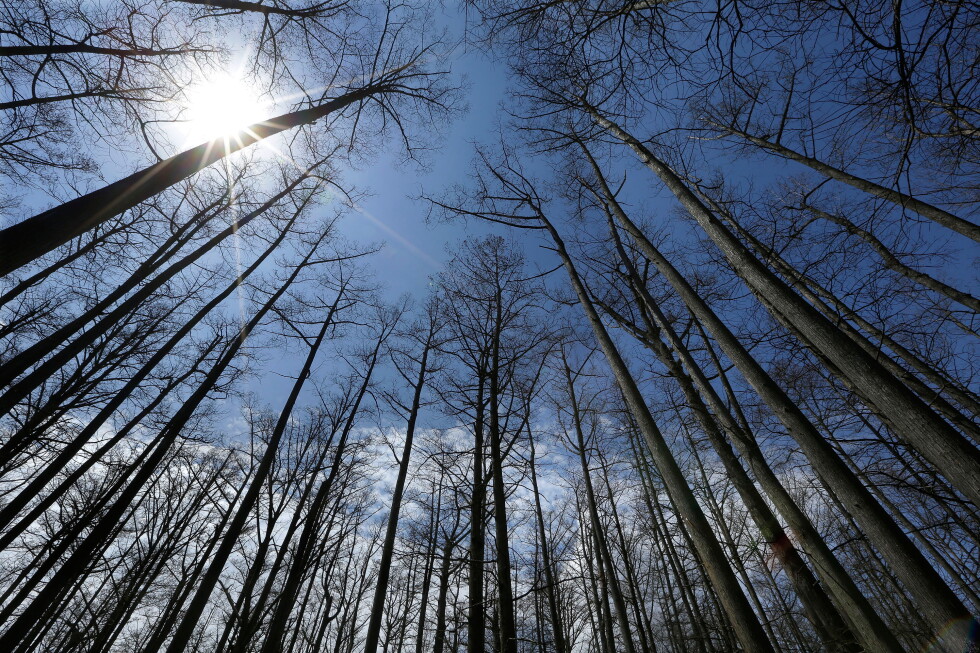
A federal judge this week ordered the U.S. Forest Service to suspend a commercial logging project in southern Illinois' Shawnee National Forest, finding the 2024 approval of the project under President Joe Biden violated the Endangered Species Act. This was reported by Qazaqyia.kz citing Associated Press.
An East St. Louis judge ruled Monday that the agency improperly approved the project in October 2024 without waiting for a final "biological opinion" from the U.S. Fish and Wildlife Service. That opinion, completed six weeks after the Forest Service approved the logging project, identified the roughly 70-acre project area as home to the federally protected Indiana bat.
Environmental groups sued the Forest Service last summer, alleging the agency's own August 2024 assessment of the area disclosed Indiana bats had been detected in the project area. The assessment, an internal, nonpublic document, concluded that even if the Forest Service implemented all legally required mitigation measures, the logging project would be "likely to adversely affect" the endangered bats.
The groups alleged the agency's "decision memo" approving the project that fall was "written to falsely suggest that the Forest Service's surveys detected no endangered bats in the project area" and did not mention or even cite its August 2024 assessment in the memo.
But the Forest Service argued that it hadn't violated the Endangered Species Act because it didn't commit any resources to the project until early 2025 — well after the Fish and Wildlife Service issued its final opinion approving the project so long as the Forest Service agreed to certain mitigation measures.
Additionally, the Forest Service maintains the other agency's opinion contained "no new information" that wasn't included in its own assessment and points to mitigation measures included in both agencies' project directives. Therefore, the Forest Service argued that nothing about the project's approval would have changed had the agency waited for the final opinion in 2024.
The Forest Service further argued that the project approval wouldn't change in 2026 even if a court vacated the decision memo and ordered officials to take the final opinion into account before reapproving it. But U.S. District Judge Nancy Rosenstengel didn't buy that argument.
"An agency cannot evade the jurisdiction of the federal courts merely by promising that it will not change its mind even if a court orders it to reconsider; otherwise, an agency could act as arbitrarily and capriciously as it wished and simply moot every challenge that came its way," she wrote in her 27-page opinion. "Fortunately, this is not the law."
Indiana bats, found primarily in Midwestern states, were first identified as endangered in the mid-1960s. According to the Fish and Wildlife Service, by 2019 the population had declined by half in the five decades since, and has been particularly affected by white-nose syndrome since its 2007 arrival in North America.
While the bats spend winter hibernating in caves and mines, colonies of Indiana bats typically spend the warmer months roosting in the peeling bark of large, often dead trees. The Fish and Wildlife Service's final opinion advised against the Forest Service doing the logging project between April and October.
But the Forest Service's project approval contained no directives on timing, and the logging company the agency contracted for the job began its work in mid-August 2025. By the time Rosenstengel issued a temporary restraining order halting the logging project eight days later, the contractor had already thinned out 40 of the 67 acres constituting the project area in rural Pope County along the Ohio River.
Though the judge dissolved her order less than two weeks later, the contractor still hasn't returned to finish the job in the year since it left. Rosenstengel pointed out the lack of urgency to complete the project undercut the Forest Service's arguments that vacating its project approval would result in harm.