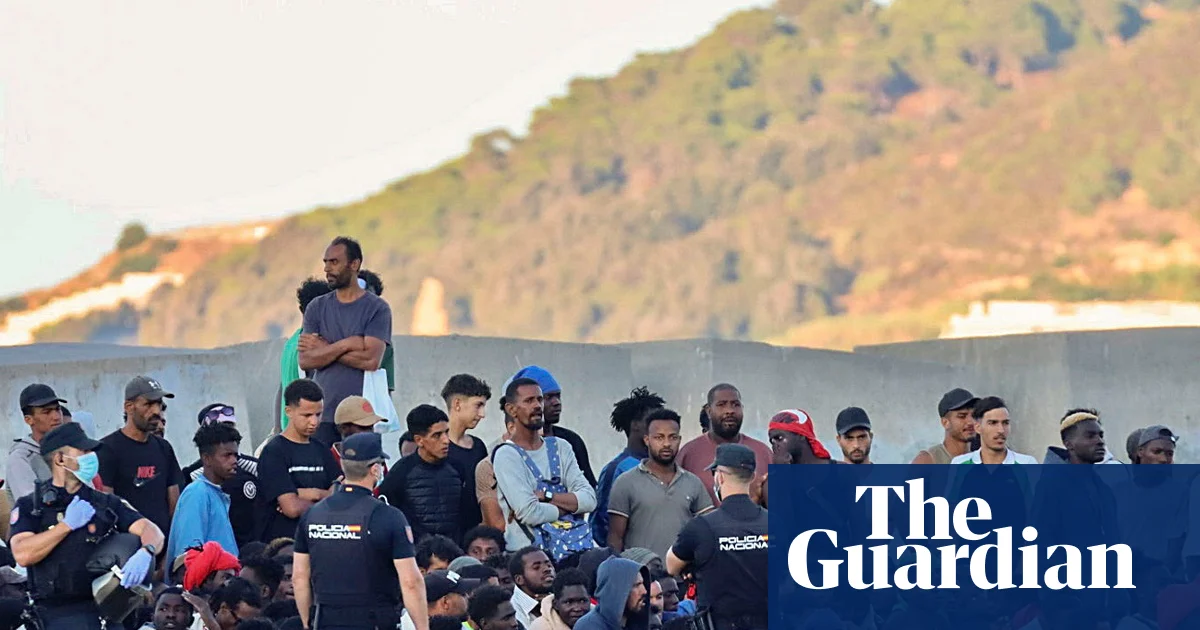
According to Spanish officials, around 2,500 migrants remain in Ceuta following last week's massive border rush from Morocco. This was reported by Qazaqyia.kz citing The Guardian.
The events in Ceuta lasted seven days, but the human cost and disunity within the EU will take longer to fix. At the end of last week, more than 70,000 people swam or waded into the tiny Spanish enclave in north Africa from neighbouring Morocco. The exact circumstances in which the heavily securitised border came suddenly to be open are still unclear.
At least 88 people died: some drowned, others were trampled in the crush. Social media hyped a distorted version of events. Far-right parties, already driving the agenda on migration across Europe, weaponised the story. Spain's EU allies engaged in a war of words – not over the plight of those caught up in the tragedy, but over who let them into EU territory.
Italy and Denmark jointly led the way there, accusing Madrid of failing to secure the EU's only land border with Africa. Although Ceuta is not even in the EU's Schengen passport-free travel area, Giorgia Meloni, the far-right Italian prime minister, performatively suspended Schengen rights for travellers entering Italy from Spain. Meloni and her Danish counterpart, Mette Frederiksen, wrote to the EU demanding emergency talks on tightening the bloc's external borders. They enlisted the backing of all but five of the 27 EU leaders.
Faced with such an unusual lack of support, Spain's Pedro Sánchez could only protest about the "selfish, polarising and unlawful" response of his EU allies. By Monday the vast majority who arrived in Ceuta had gone back to Morocco. None attempted to reach the Spanish mainland. Of those left stranded on the streets of the city, many were unaccompanied children.
By then, Donald Trump, Elon Musk and Israeli ministers had weighed in to decry Europe's "migrant invasion", and Ceuta had begun to function, wrote Jonathan Liew, "as a kind of border porn for the global far right". Paul Taylor, a senior fellow with the European Policy Centre, says there was a shamelessly cynical interest for some EU leaders to pile on and isolate Madrid. The reaction was very different in the past, when Poland and Lithuania faced migrant incursions weaponised by Belarus.
Taylor: "Most EU governments are conservative or rightwing-led and have an interest in scapegoating Spain, which is governed by a socialist-leftist coalition, and in helping Spain's rightwing opposition ahead of a general election due next year, and in trying to win back voters in their own countries who are defecting to rightwing populists."
Within the EU, Sanchez has swum against the tide, standing up to the Trump administration over Gaza, the war in Iran and Nato defence spending. He bucks the trend on migration, too. Taylor: "Spain has been an outlier, welcoming migration and actively working to integrate migrants into the economy and society. This is seen as an affront by many conservative politicians but also as a 'pull factor' encouraging would-be migrants to try their luck in Europe at a time when official EU policy is to combat irregular migration."
In their letter to the EU, ostensibly about the immediate crisis in Ceuta, Meloni and Frederiksen targeted Madrid's recent policy of allowing undocumented people working in mainland Spain to regularise their migration status. Taylor said this shows hypocrisy and double standards: "Many of those criticising Spain's amnesty allowing irregular migrants to apply for residence permits have introduced similar schemes in their own countries. Italy and Germany have both given work permits and/or the right to remain to irregular migrants already working there in programmes supported by employers plagued by labour shortages."
What actually provoked the Ceuta surge remains unexplained. One theory is that misleading posts circulated on Instagram, TikTok and Facebook following a 29 June Spanish supreme court ruling that clarified th