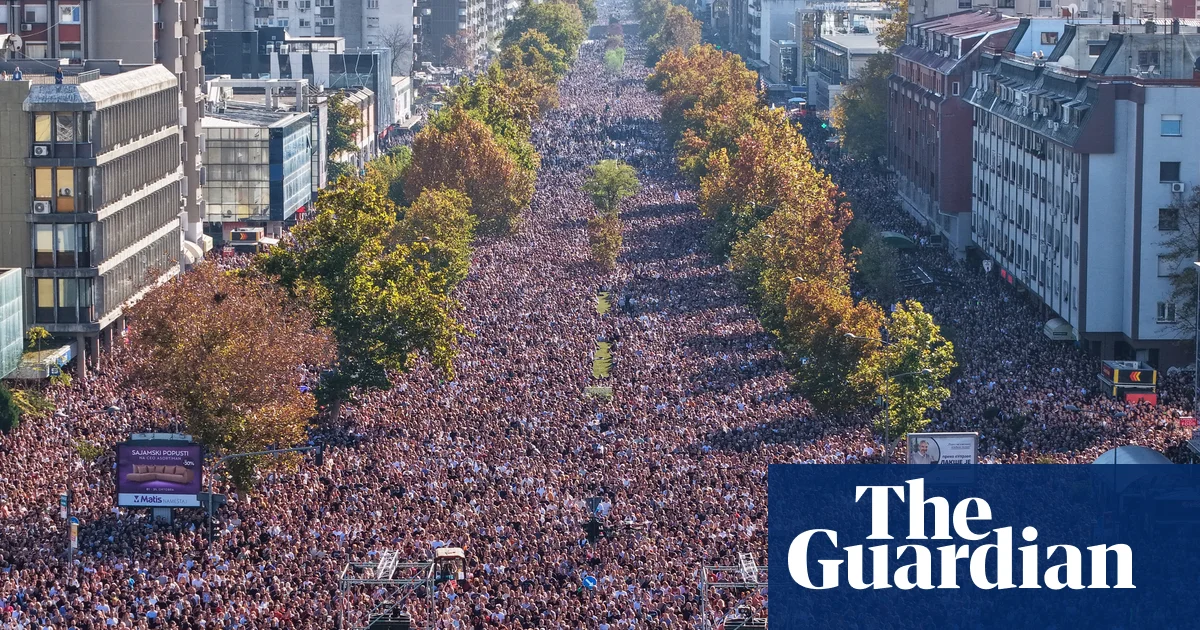
A leaderless student group is challenging power in Serbia. This was reported by Qazaqyia.kz citing The Guardian.
On 1 November 2024, the collapse of a concrete canopy at the railway station in Novi Sad, Serbia's second largest city, killed 16 people. The youngest was a six-year-old girl, Sara Firic, who was sitting on a bench with her grandfather and older sister. The Serbian Times reported they were still holding hands when their bodies were dug out of the rubble.
In the aftermath of the disaster, student-led protests developed organically, with demonstrators blocking a nearby crossroads for the same number of minutes as lives lost. As details emerged of botched refurbishment work carried out in what critics described as a corrupt deal with a Chinese consortium, the anger mounted. Ongoing protests were brutally suppressed and Vučić himself branded demonstrators western-backed "terrorists".
Two years later, that single tragedy has sparked a mass movement for accountability and inclusive democracy to counter the creeping authoritarianism of Vučić's Serbian Progressive party (SNS).
"There was a deep well of public discontent, and the students were inspirational in keeping the protest movement going," says Julian.
Vučić expected the protesters to dissipate – instead, the mounting pressure forced the president to resign and call a snap parliamentary election, as he endeavours to consolidate his 12 years in power in a Putin-inspired switch to become prime minister.
In response, the student movement is fielding a list of 250 candidates of its own, mainly locally respected academics but also actors, musicians and farmers, with each candidate approved by citizens' assembly.
Some polling suggests that Student List is edging ahead; others that the SNS is consolidating support. Julian tells me he left Belgrade with the sense that anything could happen on Sunday.
How did a student network put together an election campaign?
The Serbian student I spoke to is buzzing ahead of Sunday's vote: "We're really excited," he tells me over the phone from the Serbian capital. "We hope we win." He is studying for a masters in dramatic arts at the University of Belgrade, and asks not to be named in accordance with the leader-less structure of his movement.
He talks me through the "big collective effort", including collecting canvas data door to door, and the "A student in every village" programme targeting Vučić's base of rural voters, all coordinated by democratic citizens' assembly. The thinking is that a higher turnout of disaffected voters will favour Student List.
Julian encapsulates the Student List movement as "a bold democratic experiment", and that is how my student describes it: "The essence of our movement is direct democracy. This collective effort is about making people feel part of the decision-making, not just spectators."
When Julian joined Student List volunteers canvassing in the housing estates of Krnjača, a Belgrade suburb, they were met with overwhelmingly positive reactions – "the response was 'bring it on'" – though he caveats that opinion in outlying suburbs varies from those of the urban intelligentsia and others in more rural settings.
"People were saying to the volunte..." the excerpt ends.