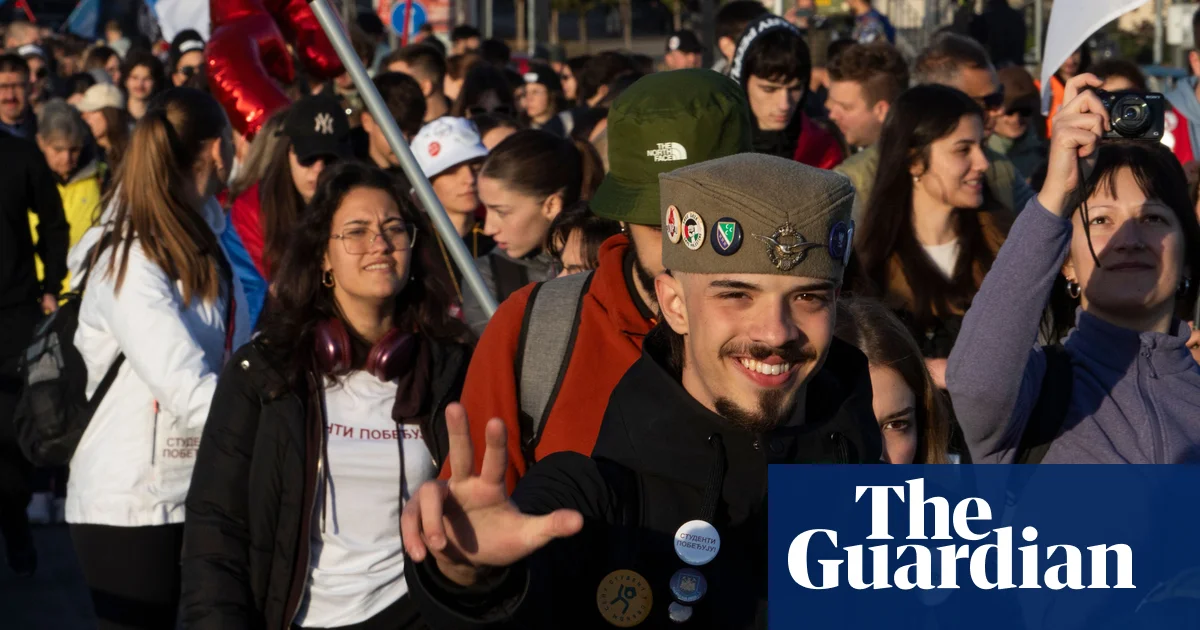
A mass student movement, Student List, that has rocked Serbia with two years of constant protests, will on Sunday represent the most serious challenge Aleksandar Vučić has faced in his 12 increasingly authoritarian years in power, by putting forward their own candidates in parliamentary elections. This was reported by Qazaqyia.kz citing The Guardian.
Campaign trail
On a cool autumn evening, a team of Serbian student volunteers went canvassing in the housing estates of Krnjača, a Belgrade suburb. They were equipped with lanyards emblazoned with the word “victory”, a stock list of questions and a mobile app that mapped visited homes and the level of support in each. Law student Zak Veličković and campaign photographer Danijela Radojković were welcomed with overwhelming support. Most promised their vote and a large minority offered help: some taxi drivers with flats in the low-rise apartment blocks said they would help ferry voters to the polling stations.
“Turnout is the key,” one said, adding: “Orbán fell with 80%” – a reference to the Hungarian elections in April.
Pre-election landscape
Opinion polls have varied wildly, but many expert observers say a close race is quite possible, with neither side prepared to accept a loss as a legitimate result, raising the risk of post-election unrest and clashes. In order to win, the students’ list of 250 candidates would have to break the mould of Serbian politics, along with Vučić’s grip on the country. He stepped down as president last month, five months before the end of his second and last term in office under the constitution, but only with the aim of extending his hold on power as prime minister at the head of his Serbian Progressive party (SNS).
Corruption concerns
Corruption was the most frequent single complaint. On the corruption index run by Transparency International, Serbia ranks far worse than any of its neighbours, as the most corrupt country in Europe bar the dictatorships in Belarus and Russia. There are frequent allegations of links between the SNS and organised crime, and the Student List’s slogan confronts that widespread perception head on, posing the question: “Serbia or Mafia?” The government denies all accusations and officially claims to be tackling organised crime.
The key local issues in Krnjača were the poor repair of the road bridge linking the suburb and central Belgrade, and the sewage system, which repeatedly fails in heavy rain, despite a personal promise by Vučić, who residents said had visited a few years earlier, to fix the problem. The economy has been growing in recent years, but there is a widespread opinion that the fruits are not being fairly distributed. Porsche and Land Rover car showrooms have been established in Krnjača but public spaces look neglected. Some of Belgrade’s trams are more than 50 years old.
Origins of the movement
It was a major infrastructure failure that sparked the student protests – the collapse of a concrete canopy in Novi Sad railway station on 1 November 2024, killing 16 people. Evidence pointed to botched modifications made during refurbishment work, but so far there has been no official finding on the cause, and no official has been held accountable. When Belgrade students blocked a road in a vigil for the victims three weeks after the disaster, they were attacked by a SNS mob and the protest movement went nationwide.
A different kind of politics
The students initially distanced themselves from opposition parties and avoided any kind of hierarchy or conventional leadership structure. That was partly an ideological choice and partly practical. The SNS and state-run media rule in part through smearing opponents and the students’ collective approach offered fewer targets.
Vučić rose to prominence in the 1990s as a radical nationalist, who supported the policies of Serbian expansion and ethnic cleansing led by Slobodan Milošević, who died of a heart attack in detention in The Hague during his trial on charges of genocide and crimes against humanity committed in Croatia, Bosnia and Kosovo. He served as Milošević’s information minister throughout the Kosovo conflict. As president, Vučić has not emulated his predecessor’s militarism, but he has maintained his nationalist playbook in domestic politics, dismissing the opposition as stooges of unspecified foreign powers.
So far those well-worn tactics have