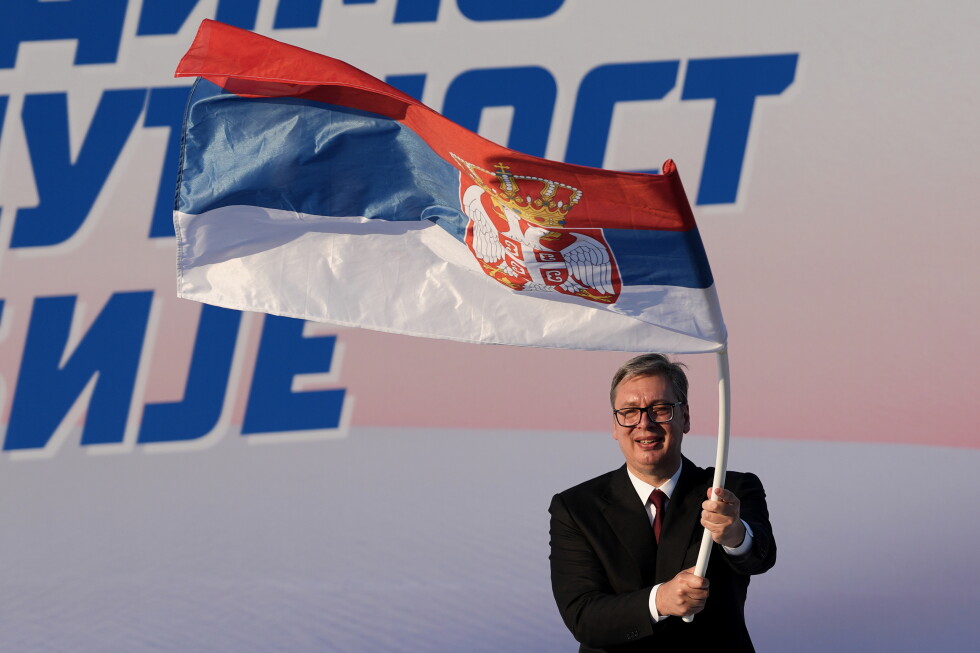
Serbian President Aleksandar Vucic on Wednesday scheduled an early parliamentary election in Serbia for Oct. 25, a test of his hold on power after nearly two years of street protests that have rattled his rule. This was reported by Qazaqyia.kz citing Associated Press.
Vucic, who cannot run for another presidential term, has said he plans to run for prime minister instead. He issued a decree dissolving the 250-member Parliament and paving the way for the vote. He said the elections were necessary because of ongoing tensions and divisions in the Balkan country.
“We have had … huge turbulences,” Vucic said in an address. “We need election results that will clearly show the will of the people and the direction where Serbia is going.”
The ballot will be held in an atmosphere of heightened political tensions as ruling populists seek to hold on to power despite widespread popular discontent.
The protests started after a train station tragedy on Nov. 1, 2024, killed 16 people in northern Serbia. The protesters demanded accountability for the concrete canopy collapse in the city of Novi Sad and an end to the corruption they blame for substandard renovation work.
Almost daily demonstrations, sometimes drawing hundreds of thousands of people, shook Vucic more than at any time since he came to power in 2012.
The president and his right-wing Serbian Progressive Party have been accused of curbing democratic freedoms and of ties to organized crime, which he has denied. Serbia’s bid to join the European Union has stalled under Vucic, who has maintained close ties with both Russia and China.
Vucic has faced additional EU pressure in the past week over the public homage to war criminal Ratko Mladic, the former Bosnian Serb army commander, who was buried as a hero in Serbia on Monday despite his conviction for genocide by a U.N. court.
The student-backed election list for Parliament is expected to include university professors and experts. The movement has gained huge support among the 6.5 million voters in Serbia, many of them disillusioned by mainstream politicians.
Vucic has pushed hard against the protesters, sparking international concern over police violence and arbitrary detentions. He has accused the students and professors behind the protests of an intention to “destroy the state.” Hundreds of people have been detained or lost their jobs for supporting the protests.
Vucic reiterated on Wednesday that “it would be wrong to assume” that political tensions were the result of disagreements in Serbia alone. He said that “we have had unrest and clashes and a divided society with considerable interference of foreign powers.” He did not specify which alleged foreign powers nor offer any evidence for his claims.
Vucic has said he will resign the presidency in the coming weeks so he can join the campaign for the parliamentary vote. He cannot run for president again after serving two almost full terms. An early presidential election will be held separately.
Analysts say the so-called Students’ List presents a serious challenge to the ruling populists. Dejan Pavlovic, from Belgrade’s Faculty of Political Sciences, compared the situation to this year’s election in Hungary that swept from power another authoritarian, Viktor Orban. A scenario might unfold, Pavlovic predicted, “similar to (the) Hungarian one, where the challenger, without the media support, without the resources, still manages to provide (a) very persuasive win.”
The populists have gradually taken over Serbia’s institutions and mainstream media after coming to power in 2012.