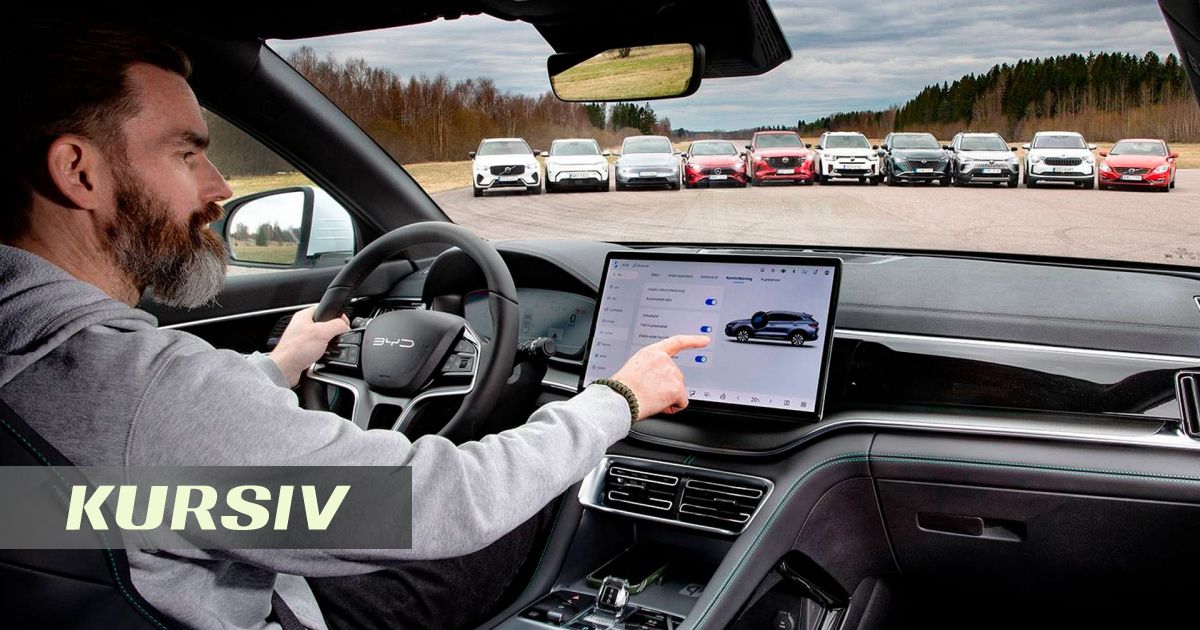
A new study by Swedish magazine Vi Bilägare has found that touchscreens cause drivers to spend more time performing simple tasks, meaning they are distracted from the road for longer. This was reported by Qazaqyia.kz citing Kursiv Media.
Swedish experts repeated a study first conducted in 2022. While driving on a closed airfield at 110 km/h, drivers had to perform several common actions: turn on the radio, adjust the heating, set the navigation, etc. Before the tests, participants were given time to familiarize themselves with each car's interface.
The key metric was the distance the car traveled while the driver completed the tasks. In 2022, this distance was 756 meters; in 2026, it increased to 813 meters. This means modern interfaces cause drivers to be distracted about two seconds longer.
The winner of the test was the Volvo XC60. Despite almost fully digital controls, the driver completed all tasks in just 485 meters. The study authors attribute this to a well-organized interface: main functions are visible, and menus are logically arranged.
Skoda also received good marks for balancing the touchscreen with physical buttons.
One of the main conclusions was that the problem lies not in the displays themselves but in the quality of their implementation. For example, the Tesla Model Y showed significant progress compared to the Model 3 tested four years earlier, reducing the task completion distance by more than 100 meters.
However, the new Mercedes-Benz CLA was one of the underperformers. It took the driver 35 seconds to complete all actions, and after starting the car, the multimedia system began responding to touches only after 19 seconds.
The study also showed that physical keys alone do not guarantee convenience. For instance, the 2016 Volvo V60 with a traditional button panel lagged behind most modern cars due to a cluttered center console and complex control logic.
The authors concluded that manufacturers increasingly prioritize stylish interior design over ease of use. Yet interface ergonomics directly affect the safety of the driver and others.
Earlier, Kia announced it would bring back physical buttons at the request of car enthusiasts. Volkswagen also kept its promise and returned traditional keys in the new Polo.
Additionally, Kursiv Avto reported that all new cars in European Union countries must now be equipped with a driver attention monitoring system.