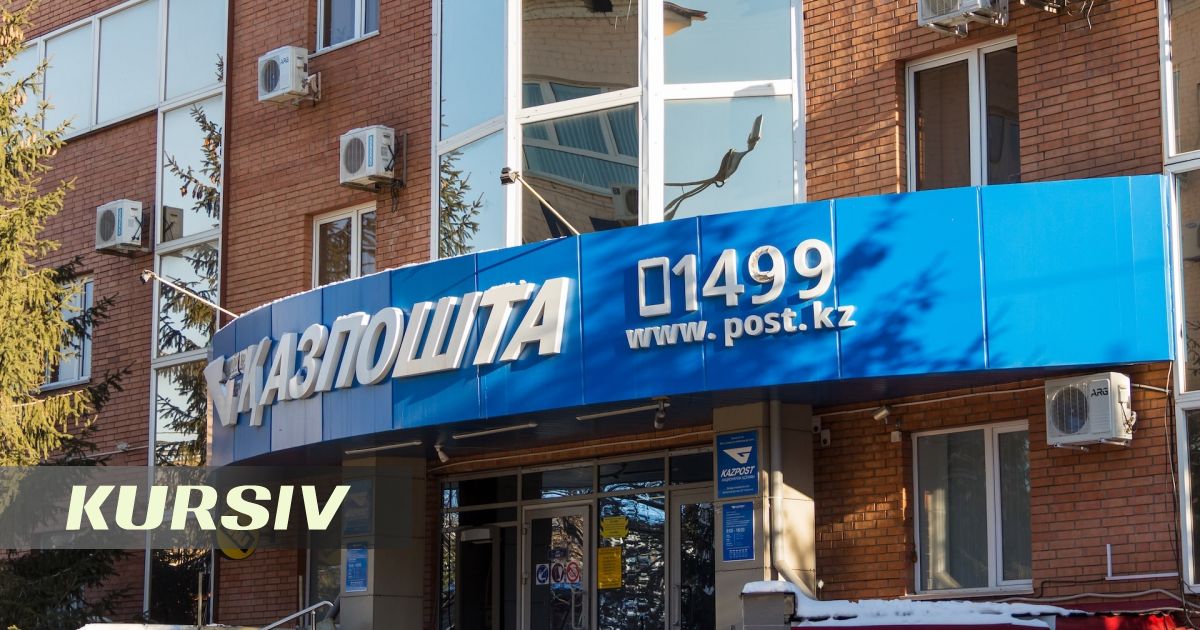
Kursiv Research concludes its series of materials analyzing the 2025 results for the largest national companies of Kazakhstan, based on their audited annual financial statements. The final material in the series covers the results of Kazpost, Samruk-Kazyna Construction, and the fund's new asset PGU Turkestan. This was reported by Qazaqyia.kz citing Kursiv Media.
The national postal operator returned to ninth place in the top 10 largest portfolio companies of Samruk-Kazyna. This happened despite Kazpost's assets shrinking by 10% to 362 billion tenge in 2025.
In recent years, current assets have prevailed over long-term ones in Kazpost's asset structure. The decline in the aggregate indicator is due to a reduction in the short-term portion of assets: as of 2025, the postal operator's current assets fell by 14% to 287 billion tenge, as the amount of cash at the company's disposal decreased by 23% to 207 billion tenge.
The reason for such changes in Kazpost's balance sheet structure is trivial. The national company's postal business is unprofitable: in 2025, the company once again posted a gross loss before interest income of 4 billion tenge (revenue grew by 9% to 68 billion tenge, cost of sales decreased by 1% to 81 billion tenge). This loss was offset by net interest income, which amounted to 9 billion tenge last year.
Kazpost has licenses to conduct certain banking and broker-dealer operations. It has historically attracted depositor funds, but several years ago, national companies began placing funds with Kazpost, and the postal operator redistributed them into financial assets, earning income and covering losses from its core activities.
In recent years, such clients included KazMunayGas (42 billion tenge at end-2025), KTZ (25 billion tenge), Kazakhtelecom (15 billion tenge), Samruk-Kazyna Construction (9 billion tenge), as well as QazaqGaz and Tau-Ken Samruk. Client funds accounted for 77% of total liabilities (323 billion tenge, down 11% year-on-year), totaling 248 billion tenge (down 19% year-on-year). These are mainly deposits with maturities of up to one year.
Therefore, Kazpost selected mostly short-term assets for placement: reverse repo (this item accounts for almost 75% of all cash), as well as investment securities represented by bonds of the Ministry of Finance of Kazakhstan and US Treasuries.
However, taking into account general and administrative expenses and net exchange rate losses, the company still posted an operating loss for the year, while net income was weakly positive due to income tax savings: 246 million tenge, three times less than a year earlier.
Returning to Kazpost's balance sheet: there are several critical indicators. Fixed assets decreased by 20% to 33 billion tenge over the year due to depreciation, reclassification, and impairment of the postal workers' real and movable property. Accounts receivable increased by 63% to 13 billion tenge, both due to expansion of operations and delays in reimbursement of costs for delivering pensions to rural areas.
While the receivables problem is a matter of settlements with the National Bank (which were eventually carried out), the rapid reduction in fixed assets is a serious issue: Kazpost's capital expenditure to revenue ratio was 4% in 2025, half of the previous year and half of the company's average.
This, along with negative cash flow from operations and free cash flow, calls into question Kazpost's long-term business model as a postal operator. State subsidies do not cover the operating loss. The turnover from investment activities, which allows the national company to make ends meet, is insufficient to develop the company as a business with a strong financial core. Kazpost's depositors are its sister companies, and the scheme with their deposits looks more like a rescue operation for the postal operator than business diversification.
Kazpost needs an investor who can organically integrate its postal assets into their business, which should be somehow related to courier delivery across Kazakhstan. Does this investor have to be the state? The current Law "On Postal Service" sets the framework of requirements for the national operator, fixing its obligation to provide universal postal services, but not the form of ownership of the operator. Kazpost has been included in privatization lists several times (including the most recent one approved by government resolution), but divestiture has not yet occurred.
Meanwhile, until a private investor is found, the fund directly helps its postal subsidiary. The company's liabilities include 5-year bonds worth 7 billion tenge purchased by the National Fund. The maturity of this loan, issued in 2019, was approaching its end in 2024, but was extended for another five years at a rate equal to the NBK base rate plus 1%. Last September, the loan's maturity and rate were changed again: Kazpost must repay it in 2033, with a preferential rate of 6%. Moreover, interest payments have been deferred to the end of the loan term.
In October, Samruk-Kazyna allocated 1.3 billion tenge to Kazpost at 0.01% per annum for one year. In December, the fund purchased the postal operator's 3-year yuan-denominated bonds equivalent to 26 billion tenge at a rate of LPR1Y plus 120 bps (4.20% at the time of placement). The company did not pay dividends in 2024.
Another portfolio company that lost a significant portion of its assets in 2025 was Samruk-Kazyna Construction. The assets of the company responsible for implementing construction projects plummeted from 565 billion to 115 billion tenge (down 80% year-on-year).
This reduction in asset size is not related to problems in SKC's operations. The national project "Comfortable School" for 2023–2025 (renamed "Keлешек мектептері" towards the end) came to an end, which had lifted the company to 9th place in the fund's top.
Over three years, SKC, acting as the project directorate (de facto operator), built 208 schools with 217,000 places (according to the company's annual report, as of end-2025, the total number of student places introduced under the project was 203,000).