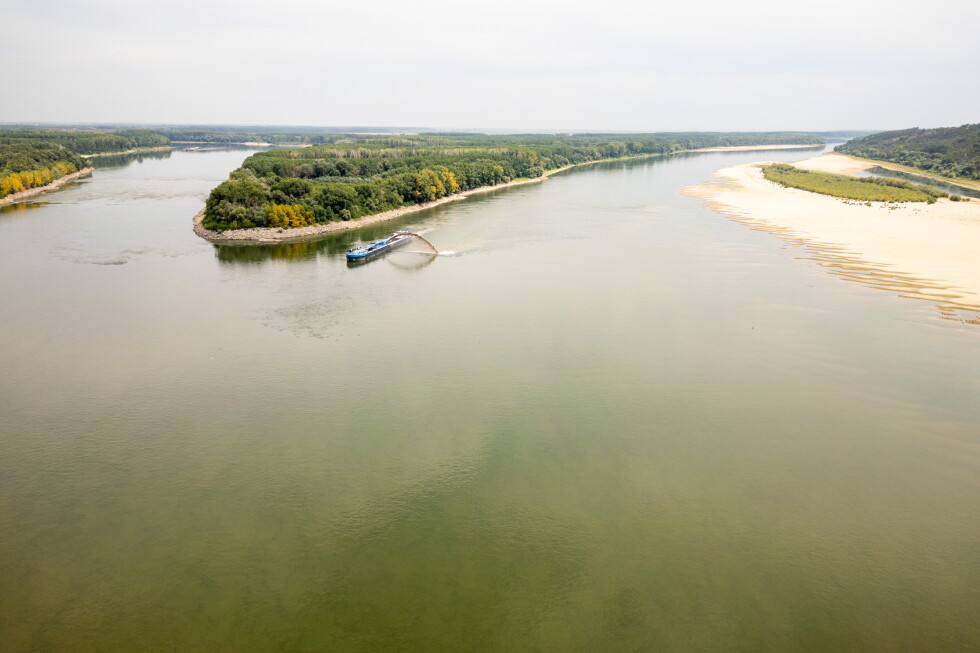
Romania raced on Thursday to sink four barges laden with rock into the Danube River in an attempt to redirect water downstream toward a nuclear power plant, to buy more time before its second reactor is likely forced offline due to record-low water levels. This was reported by Qazaqyia.kz citing Associated Press.
Extreme heatwaves and low rainfall across the region have left the Danube at record lows over the past week, forcing the shutdown of a reactor at Romania's Cernavoda nuclear plant last week. The state-owned nuclear power plant accounts for about 20% of the country's electricity generation when fully operational and uses river water to cool its reactors.
The four barges were loaded with rock that Romania's military blasted from the river this week using explosives near the Danube's Bala Canal. Once submerged, the barges will create an underwater barrier to redirect the water down the river's main channel and toward the Cernavoda plant.
Speaking to local news channel Digi24, the plant's director Romeo Urjan said Thursday the Danube's water level had decreased about two centimeters (0.7 inches) from Wednesday to Thursday and that, without sinking the barges, the plant's second reactor would likely have to be shut down in five to six days.
"If the installed barges do not change the water flow, the reactor will have to be shut down," Urjan said.
The Cernavoda plant uses Canadian CANDU technology and operates heavy-water reactors. The plant's two reactors have a combined capacity of 1,400 megawatts, providing about 20% of the country's electricity.
The Danube is Europe's second-largest river, flowing from Germany to the Black Sea. The river's low level is also affecting navigation in the region, hampering cargo transport between Romania, Bulgaria, Serbia, and Hungary.
Romanian authorities have imposed restrictions on river navigation due to the falling water level. This situation is another example of rivers in Europe shrinking due to climate change.
Forecasts indicate no rain is expected in the region in the coming days, which could lead to a further drop in water levels. The Romanian government is considering additional measures to ensure the plant's operation.
The first reactor at the Cernavoda plant was shut down last week due to the falling water level. To keep the second reactor running, the method of sinking barges is being employed.
This method has been used before, but on such a scale it is being implemented for the first time. Military engineers have developed a special plan for precise placement of the barges.
Romania's Energy Minister Sebastian Burduja emphasized the importance of these measures, noting that keeping the plant operational is crucial for the country's energy security.
The water shortage in the region is also affecting agriculture, with farmers suffering losses. The Romanian government plans to allocate additional funds to help farmers.
The low level of the Danube is also causing environmental problems, with mass fish deaths observed in some parts of the river. Ecologists warn of possible long-term consequences of this situation.
Romanian authorities said they will monitor the situation and take additional measures if necessary. The operation of the Cernavoda plant remains important for the country's energy system.